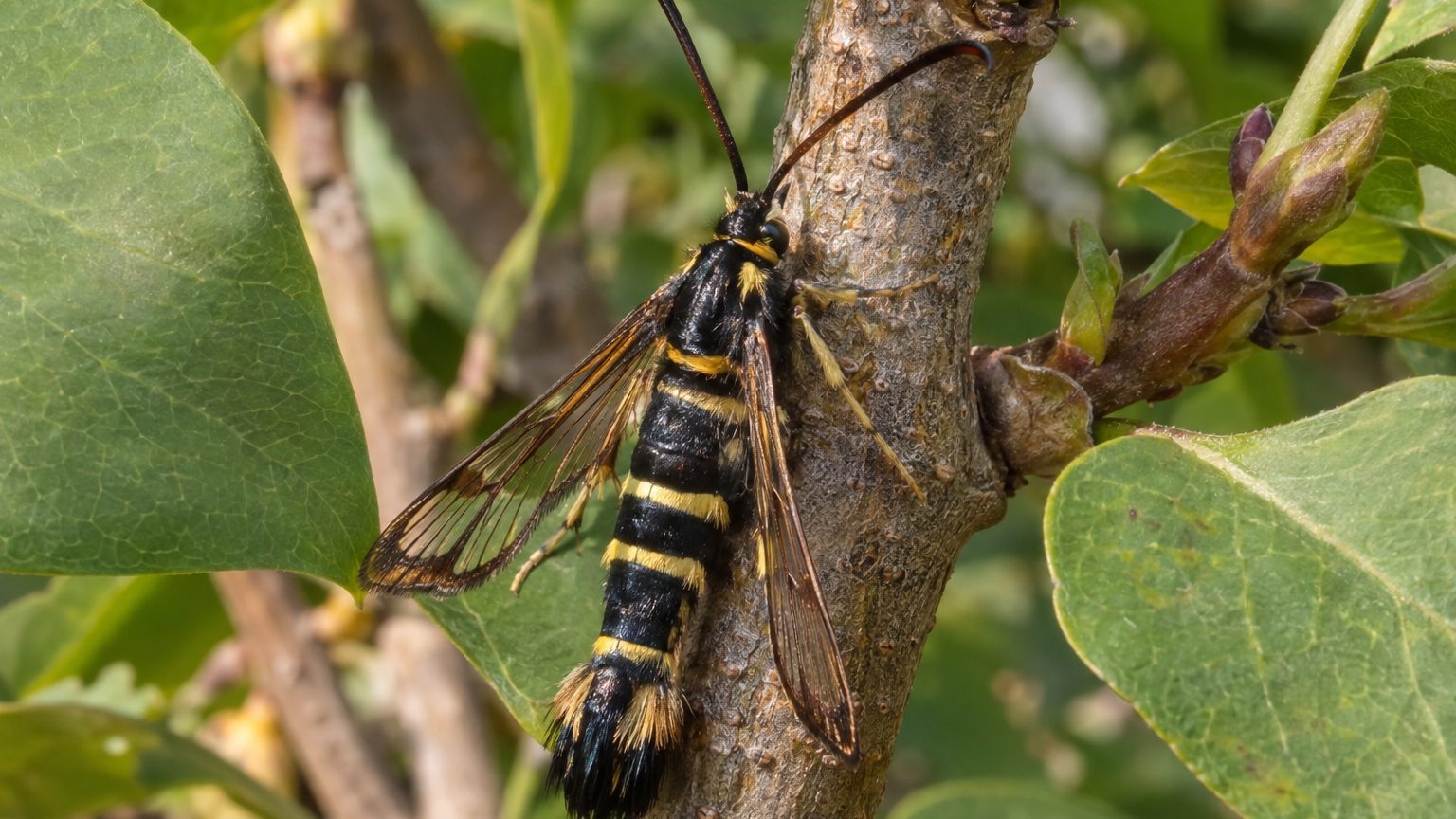
Sawdust-like specks at the foot of a lilac, or a stem that wilts in summer heat while its neighbors stay green, usually mean larvae are feeding inside the wood. That is the work of the lilac borer. Knowing what it looks like, when the moths fly and what you can still do for an infested shrub makes the difference between losing a stem and losing the plant.
Lilac Borer: What You See

The clearest sign is on the bark near the ground, well before the leaves say anything.
- Trunks and large stems show cracked bark and holes, with material like sawdust (frass) pushed out of the tunnels.
- Cut into an infested stem and you find a creamy white caterpillar with a small dark head, and full-grown larvae are 1 inch long.
- Leaves wilt on infested branches in hot weather, and the weakened branches often break off easily.
- Empty pupal skins stay attached to the bark at the emergence holes, which tells you the pest was there even after the moth has flown.
- The adult is a clearwing moth that looks like a wasp, and in Maryland it emerges in mid-May.
On lilac, the damage stays at the base of the plant, so that is where to look first.
From the almanac
Lilacs in your state
The dates on this page depend on where you live. Your state's page carries its frost dates, its USDA zones and the year laid out month by month.
Northeast
Southeast
- Alabama
- Arkansas
- Delaware
- Florida
- Georgia
- Kentucky
- Louisiana
- Maryland
- Mississippi
- North Carolina
- South Carolina
- Tennessee
- Virginia
- West Virginia
Midwest
Southwest
West
Pacific Northwest
Canada
Lilac Borer or Something Else?
A tunnel in the wood does not always mean this pest. Several wood borers leave similar holes, and the larva itself is the most reliable way to tell them apart.
Check the body, not just the damage. The borer is a moth caterpillar, so its legs are reduced to fleshy prolegs that carry rings of tiny hooks at the tips.
| Looks like | How to tell them apart |
|---|---|
| A grub inside a tunnel in the wood, with sawdust at the entrance | Beetle larvae lack prolegs, while the lilac borer larva has prolegs with hook-like crochets in rings, which you can see under a hand lens |
The adult can fool you too, since the moth resembles a wasp. If it is hovering near the base of a stem, look for frass and cracked bark before you assume it is a stinging insect. On ash trees, the emerald ash borer is a separate pest, so the same borer holes there need a closer look at the larva.
What Causes Lilac Borer, and Where It Is Worst
The cause is the female moth laying eggs in cracks, crevices and wounds in the bark, usually low on the trunk or at the base of major branches. The eggs hatch, and the tiny larvae tunnel in and feed under the bark. A shrub with rough bark or fresh injuries gives them more places to start.
In Idaho, larvae spend the summer feeding under the bark and then move toward the heartwood for the winter. In Utah, they keep feeding in the sapwood as summer goes on. There is usually just one generation a year, and the larval stage is the one that does the harm.
The pest is generally distributed throughout the United States and Canada. In Iowa, severe damage is more common on young ash trees than on lilac shrubs. Lilac and privet are hit much less often. Lilac borers can still weaken a shrub, though, because larvae in small stems can girdle and kill them.
How to Treat Lilac Borer
Once larvae are inside the wood, nothing reaches them, so treatment is mostly about removing damaged stems and protecting the rest.
- Inspect the base of every stem for frass and cracked bark, so that you know which stems are infested and which are still clean.
- Cut out stems that wilt in the heat or snap easily, taking them to the base, so that the larvae inside are removed with the wood.
- Thin out older stems with renewal pruning, so that younger and more vigorous ones take their place, and take no more than one third of the branches in a given year.
- Get the cut wood away from the shrub and dispose of it, so that no moths can emerge from the pile next to your lilacs.
- Call your county extension office and ask which preventive treatments are registered in your state and when to apply them, since only preventive treatments exist.
Removing damaged stems takes the larvae inside them away from the shrub. A shrub with frass at the base of nearly every stem needs the extension office’s advice before you cut deeply.
How to Prevent Lilac Borer Coming Back
Prevention follows the moth’s year, from the dormant season to the cleanup after leaf drop.
- Use renewal pruning to remove older stems and allow younger, more vigorous ones to grow.
- Ask your extension office when to time any preventive treatment where you live.
- Keep mowers and string trimmers away from the base of the shrub, because females lay eggs in bark wounds.
- During hot weather, watch for wilting branches, which can reveal tunneling.
- Clear out cut stems and fallen branches from around the shrub.
Mulch kept a little back from the stems also keeps the bark at the base easier to check.
Where This Comes From
These notes draw on university extension publications written for Colorado, Idaho, Iowa, Maryland and Utah. Timing differs from state to state, so check with your own state’s extension service before you plan treatments.
Common Questions
Can a Lilac Survive Lilac Borer?
The outcome depends on how much of the shrub has been damaged. The larvae weaken the plant gradually, and in small stems they can girdle and kill the stem. Renewal pruning removes older stems and allows younger, more vigorous ones to grow.
Will Lilac Borer Spread to Ash or Privet?
It can. Ash, privet and lilac are all hosts. If you have an ash tree nearby, look at the base of its trunk for the same sawdust-like frass.
How Many Generations of Lilac Borer Are There in a Year?
Usually just one. The larval stage is the damaging phase, and there is usually only one generation per year.