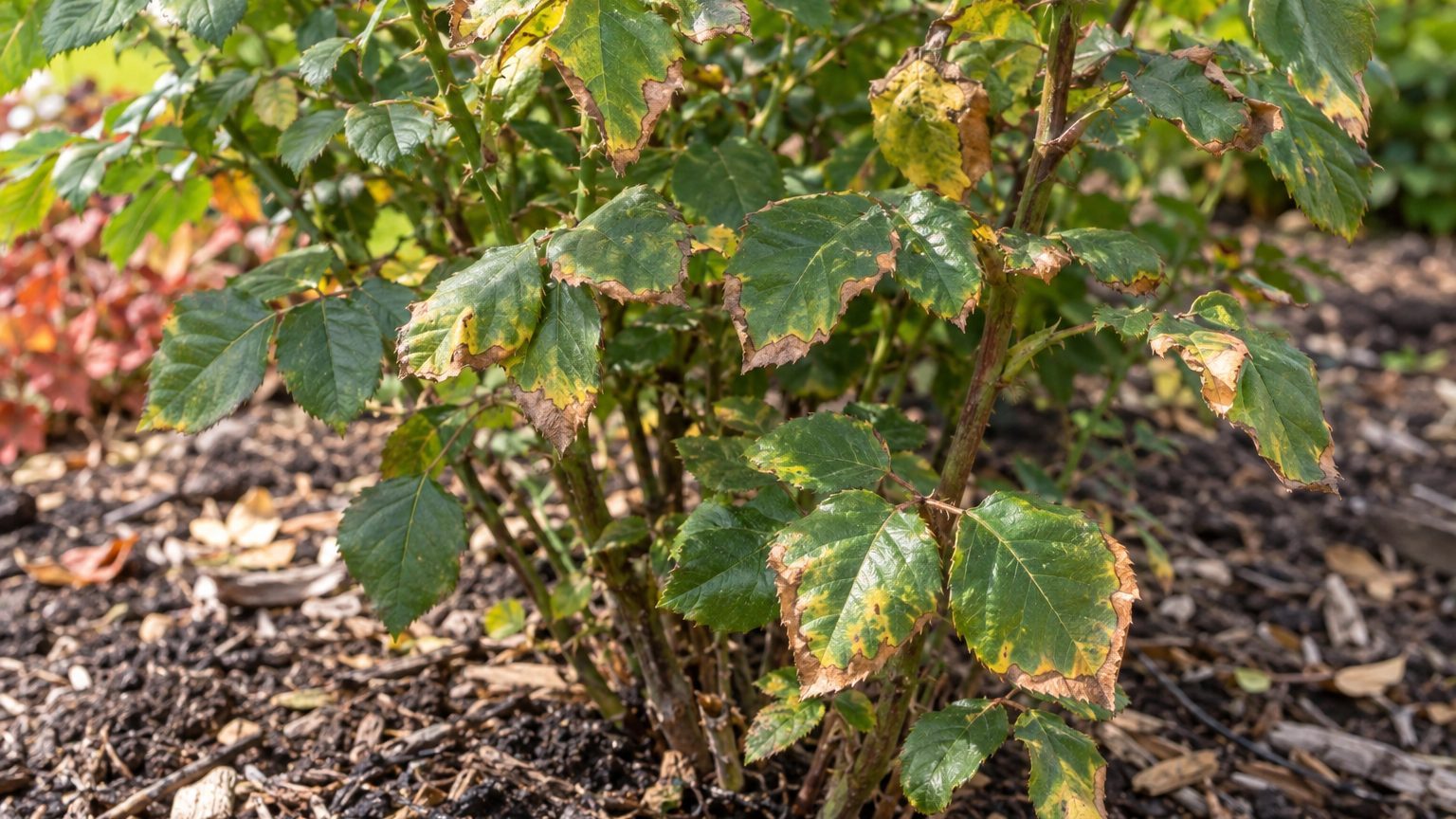
Walk past a rose in summer and the leaf rims may look crisp and tan, as if singed by a match. On roses, brown edges most often trace back to salts that have built up in the soil and moved into the leaf tissue, usually from fertilizer or from watering that never flushes the root zone.
Brown Edges on Rose Leaves: What You See

The clearest sign is a brown, dry rim that runs along the leaf edge.
- The edges of the leaves turn brown and dry, and the browning follows the outline rather than forming spots in the middle.
- Roses growing close to roads or sidewalks tend to show it, as do roses that have been fed heavily.
- Growth is slow and the plant looks stunted compared with a healthy neighbor.
- Dig carefully and the roots may be dead and brown from the tip back.
Spots, blotches and fuzzy margins point to something else, covered next.
From the almanac
Roses in your state
The dates on this page depend on where you live. Your state's page carries its frost dates, its USDA zones and the year laid out month by month.
Northeast
Southeast
- Alabama
- Arkansas
- Delaware
- Florida
- Georgia
- Kentucky
- Louisiana
- Maryland
- Mississippi
- North Carolina
- South Carolina
- Tennessee
- Virginia
- West Virginia
Midwest
Southwest
West
Pacific Northwest
Canada
Brown Edges on Rose Leaves or Something Else?
Several rose problems leave brown on the leaf, but they put it in different places. A browned rim is one pattern, and spots with a distinct outline are another.
Checking the shape of the damage and where it sits on the leaf settles most cases.
| Looks like | How to tell them apart |
|---|---|
| Black spot | Brown to black round spots with feathery edges, often ringed in yellow, and infected leaves often drop even with only a few lesions. |
| Downy mildew | Angular purple, red or brown spots sit between the veins, then leaves yellow and drop, and pale felty patches may show on the undersides. |
| Leaf scorch from soggy roots | Browning appears after poor drainage or too much water, so the soil stays wet and the roots lack oxygen. |
Spots with brown to gray centers that may drop out are reported in Tennessee, and they belong with the spot diseases rather than with salt damage.
What Causes Brown Edges on Rose Leaves, and Where It Is Worst
Salt is the usual culprit. It builds up in the soil and then in the plant tissue, and it comes from too much fertilizer or from watering that is too shallow to push salts down and away from the roots. Deicing salt can do the same job near a driveway or street.
Poor drainage adds another route. When the soil stays soggy, roots lose oxygen and the leaves scorch at the margins, so a wet spot in the bed can produce the same look as a salty one.
Roses beside salted roads or sidewalks, and heavily fertilized roses, commonly show this problem. Check those beds first.
How to Treat Brown Edges on Rose Leaves
Work from the soil up, since the leaves reflect what the roots are living in.
- Look at the site, so that you know whether deicing salt runoff, a heavy feeding or soggy ground is the likely source.
- Stop fertilizing the bush, because more fertilizer adds to the salts already in the soil.
- Water slowly and deeply, so that the salts are leached past the root zone instead of sitting around the roots.
- Improve drainage where water pools, since roots short of oxygen scorch the leaves in the same way.
- Check a few roots, so that you can tell whether they are dead and brown from the tip back or still healthy.
- Leave the browned leaves alone unless they bother you.
If spots rather than clean brown rims are the problem, remove and destroy fallen leaves and water so the foliage stays dry. If a leaf-spot disease is confirmed, a fungicide can protect new foliage.
How to Prevent Brown Edges on Rose Leaves Coming Back
Prevention comes down to how and when you feed and water through the season.
- Read the fertilizer label before feeding and measure carefully, since over-applying is a direct route to salt buildup.
- Water slowly and deeply from time to time so salts move below the root zone.
- Through the growing season, keep sprinklers off the foliage and water at the base, which also protects against the leaf spot diseases.
- Follow the fertilizer label throughout the season and do not over-apply.
- Keep deicing salt from being shoveled or plowed onto the bed.
Roses planted well away from salted pavement start with an advantage.
Where This Comes From
This damage starts when salts build up in the soil and then in plant tissue.
Common Questions
Can You Cut Off Rose Leaves with Brown Edges?
You can, and it tidies the look, but it does not fix the cause. Deal with the soil salts or drainage first, since new leaves will brown the same way if the roots stay stressed.
Does Brown Leaf Edging Mean the Rose Is Dying?
Not by itself. Plants with this problem are often stunted and slow, but the thing to check is the roots. Roots that are dead and brown from the tip back confirm root damage; if the roots are still healthy, focus on reducing salt buildup in the soil.
Can Too Much Water Make Rose Leaf Edges Brown?
Yes. Poor drainage or too much water starves roots of oxygen, and the leaves scorch as a result. Soil that stays soggy points to this cause, while dry, salty soil near pavement points to salt.