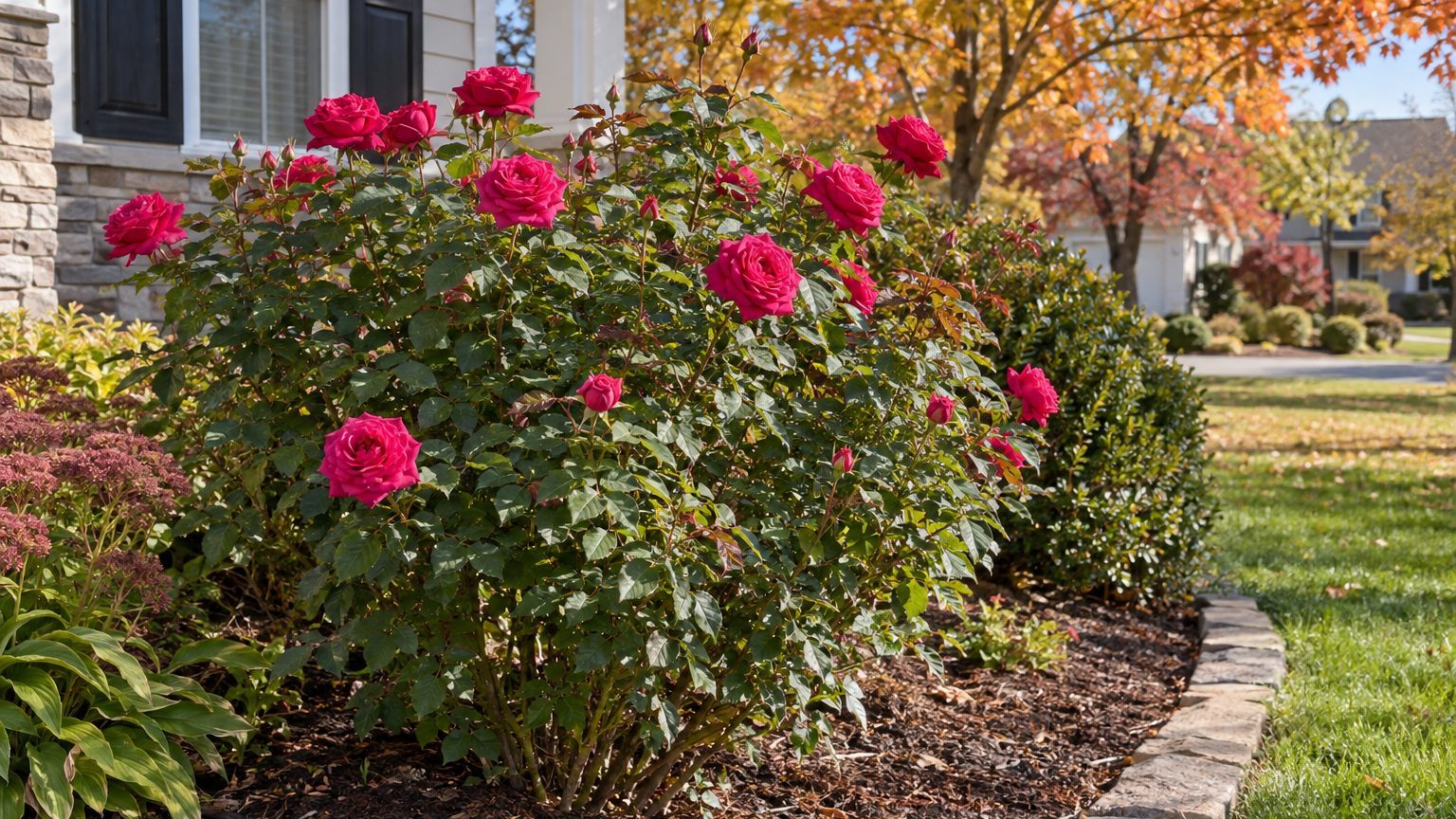
Roses pair well with low, tidy neighbors planted well back from the canes. A rose in bloom with soft foliage at its feet is a classic picture, and it works only when the companions leave the rose its light, its airflow and its roots. Plant choice and spacing both matter.
What Should You Plant Around Roses?
Choose plants that stay low, like full sun and keep their roots out of the rose’s way. Companions should never crowd the canes or shade the leaves, because roses need open air to dry quickly after rain or dew.
Distance matters first. In Alabama, roses should be planted at least 3 feet apart so air and sunlight can reach the foliage and limit the spread of disease. Whatever you plant between and around roses has to fit inside that open space.
The answer shifts with the rose. A compact miniature, a wide shrub rose and a climber on a fence each leave a different amount of room. Bloom habit and climate matter too, since a plant that thrives beside a rose in a mild, humid region may be too thirsty for a dry one.
From the almanac
Roses in your state
The dates on this page depend on where you live. Your state's page carries its frost dates, its USDA zones and the year laid out month by month.
Northeast
Southeast
- Alabama
- Arkansas
- Delaware
- Florida
- Georgia
- Kentucky
- Louisiana
- Maryland
- Mississippi
- North Carolina
- South Carolina
- Tennessee
- Virginia
- West Virginia
Midwest
Southwest
West
Pacific Northwest
Canada
How to Add Companions Around a Rose
Work from the rose outward, and decide how much space the rose needs before you decide what goes beside it.
- Measure the rose’s mature spread, so that the companions you pick are placed around the rose as it will be, not as it looks in the pot.
- Keep a clear ring around the plant. In Texas, leave at least one foot of open space around a fully grown rose so air can move freely through the canes.
- Set neighboring roses well apart. In Vermont, leave about 24 to 36 inches between rose plants so low companions do not touch the canes.
- In South Carolina, keep competing roots out of the rose bed by choosing companions with shallow, modest root systems.
- Place taller companions on the side where their shade will not fall across the rose for much of the day, so that the rose keeps its sun.
- Water and feed the rose according to its needs, and keep competing roots out of its root zone.
Plant companions small and watch how they fill in. A neighbor that looks tidy while young can sprawl as it matures, and it is much easier to move a perennial early than to dig it from around established rose roots.
How Companion Planting Changes by Rose Type
Rose type sets how much room there is to share. Upright hybrid teas leave bare ground at the base, while shrubs and climbers spread wide and leave far less of it.
Bloom habit adds another layer. Companions should leave enough room for you to reach the rose canes without trampling nearby plants.
| What changes | Why it matters |
|---|---|
| Hybrid tea, floribunda and grandiflora: about 3 feet apart in Washington | Companions need to fit in the gaps without touching the canes |
| Shrub and old-fashioned roses: 4 to 6 feet apart in Kentucky | The wider spread leaves more room for plants between them |
| Climbers along a fence: 6 to 10 feet apart in Oklahoma, 8 to 10 feet in Kentucky | Wide gaps between climbers allow underplanting at the base |
| Miniature roses: about 12 inches apart in Florida | Growing neighbors must not shade these small plants |
| Use the mature dimensions on the plant tag | Leave enough room for the mature plant without crowding its neighbors |
For you, this means sizing the bed to the rose first. For old garden roses, rugosas and other types, follow the plant tag and leave generous room. If a rose is a close neighbor of a climber, a little extra spacing helps, since roses touching each other have trouble with airflow.
Companion Planting Mistakes to Avoid
Planting Too Close

Tucking plants tight against the canes looks full at first. Poor airflow keeps leaves wet and helps disease move from plant to plant.
Pull companions back so the rose has open air all around. In Texas, leave one foot of clear space around a mature rose.
Shading the Rose
A tall companion on the sunny side can cut the light the rose needs to bloom. In Florida, miniature roses should not be overshadowed as surrounding plants grow.
Check the bed as the season advances, and move or trim anything that throws shade on the rose.
Planting Under Trees
A bed under a tree seems like an easy spot to fill. In Oklahoma, keep roses out from under tree branches, where they lose light and compete with tree roots.
Roots from any neighbor can do the same harm. Keep greedy plants out of the rose’s root zone and give it a bed of its own.
When Should You Plant Companions Around Roses?
Plant when the soil can be worked and the hard frosts have passed, as the rose comes out of dormancy and its buds begin to swell. Work carefully around dormant or actively growing roses so you do not damage their roots or canes.
- Check when each companion should be planted in your climate before you dig, because its timing may differ from the rose’s.
- Watch the rose’s roots and canes as you work so the new planting does not damage them.
Common Questions
How Much Sun Do Roses Need?
In California, roses do best with 6 hours or more of direct sun. Arizona also sets 6 hours of sunlight a day as the minimum, so choose companions that will not cut into it.
What Soil pH Do Roses Prefer?
In Florida, roses need well-drained soil with a pH between 6.0 and 6.5. Test the bed before adding companions, because their needs may differ from the rose’s.
Is It Better to Plant Many Roses or a Few?
Fewer, well-kept roses give more pleasure. In New Mexico, ten well-chosen varieties produce more blooms and pleasure when carefully maintained than 50 poorly maintained plants.