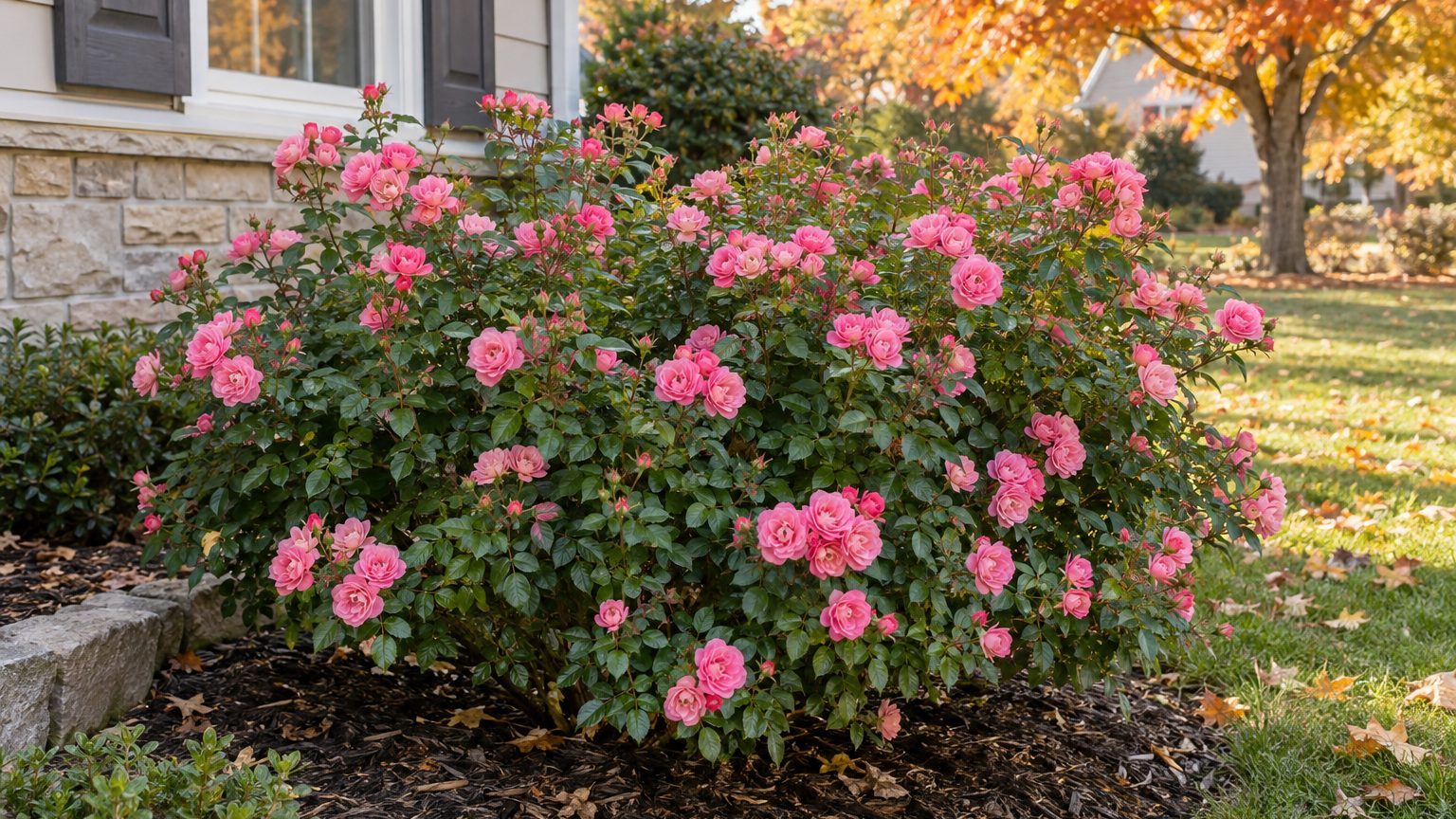
Drift roses are low, spreading shrubs that cover themselves in flowers from spring until frost, usually with no pruning at all. They suit the front edge of a bed, a slope, or a container by the steps.
What Is the Drift Rose?
Drift is a series of landscape roses bred by crossing vigorous, disease-resistant groundcover roses with reblooming miniature roses. The result is a small, mounding shrub with the toughness of the first parent and the steady flowering of the second.
It stays compact at 2-3’ high and 3-5’ wide, so it rarely outgrows its spot. It blooms more or less continuously from spring to frost.
The series is sold under color names such as Coral, Peach, Pink and Red, and the flower form varies from fully double to semi-double depending on the selection.
From the almanac
Roses in your state
The dates on this page depend on where you live. Your state's page carries its frost dates, its USDA zones and the year laid out month by month.
Northeast
Southeast
- Alabama
- Arkansas
- Delaware
- Florida
- Georgia
- Kentucky
- Louisiana
- Maryland
- Mississippi
- North Carolina
- South Carolina
- Tennessee
- Virginia
- West Virginia
Midwest
Southwest
West
Pacific Northwest
Canada
Where Does the Drift Rose Grow Best?
Sun and early watering matter more than the map. A Drift rose does well wherever it gets full sun, and it struggles wherever shade or dry spells hit a young plant. Check the plant tag for the hardiness zone before you buy. These differences between regions are the ones that change how you site it.
- Florida and the Gulf Coast: Give it full sun and water it consistently until it is established. After that, it tolerates drought extremely well.
- Pacific Northwest (Oregon, Washington): Give it the sunniest spot you have. Even partial shade leaves roses sparse and leggy, with poor flowering and less disease resistance.
- Upper Midwest (Minnesota, Wisconsin): Place it in an open bed with no tree cover, and look at the tag for its hardiness zone before planting.
- Southwest and Texas: Full sun is easy to find here, so focus on regular watering through the first season, because a young plant can suffer seriously from drought.
The state selector just below this section takes you to the page for your own state, where the timing is spelled out for where you live.
How to Care for the Drift Rose Through the Year
Spring Wake-Up

New growth starts as the weather warms, and this is the time for the first feeding. Apply a balanced fertilizer, since Drifts appreciate regular fertilizer to support their flower-happy habit. A young plant should be watered consistently until it is established on its own.
Pruning
Drifts usually don’t require pruning. If a cane is dead or damaged, cut it back to healthy wood. Otherwise leave the mounded shape alone, since it forms without shearing.
Bloom Season

Flowers come more or less continuously from spring to frost, so there is no single flush to wait for. Keep the plant in at least 6 hours of sun a day, and more is better. Light is the main thing that decides how heavily it flowers.
Summer
Give a second feeding of balanced fertilizer in mid-summer, from late June to early July. An established plant handles dry weather well, but a plant that is not yet established still needs steady water through the heat.
Autumn
Blooming continues until frost, so there is little to cut back. Stop feeding and let the plant slow down on its own as the days shorten and the weather cools.
Winter
The plant rests through the cold months. Where winters are hard, check the plant tag for its hardiness zone, and look at your state page for local timing before you plant.
Drift Rose Diseases and Weak Points
Drift roses are relatively problem free and tolerate disease very well. That reputation comes from the cross of vigorous, disease resistant groundcover roses with reblooming miniature roses.
The weak points are mostly about placement and the first season, not about the variety itself.
| Threat | How Drift handles it |
|---|---|
| Powdery mildew | Excellent resistance, but it can still get it, and a severe case can cause defoliation and plant death |
| Partial shade | Plants get sparse and leggy, flower poorly, and are less disease resistant |
| Drought | Extremely tolerant once established, but a young plant can suffer seriously |
Moving a shaded plant into full sun is the most direct fix for weak growth, and steady watering carries a new plant until it is established.
Is the Drift Rose Right for Your Yard?
Drift suits a sunny bed, a slope, or a pot where you want color without much upkeep. It does not suit a shaded corner, because roses grown in even partial shade decline.
- Plant it along a walk or at the front of a border, where the low mound will not block taller plants.
- Skip sites that receive less than 6 hours of sun a day.
- Use the state selector under the where-to-grow section to open your state page before you plant, and follow the timing given there.
Common Questions
How Many Drift Rose Varieties Are There?
The series has grown to 12 selections. Coral, Peach, Pink and Red were the original four, and later additions include Apricot, Popcorn and Sweet.
Do Drift Roses Have a Scent?
Some do. Apricot Drift is softly scented, and Sweet Drift has nicely scented double pink blooms.
When Did Drift Roses Come Out?
They first appeared in 2007 with four cultivars. That makes them a compact landscape rose that blooms more or less continuously from spring to frost.