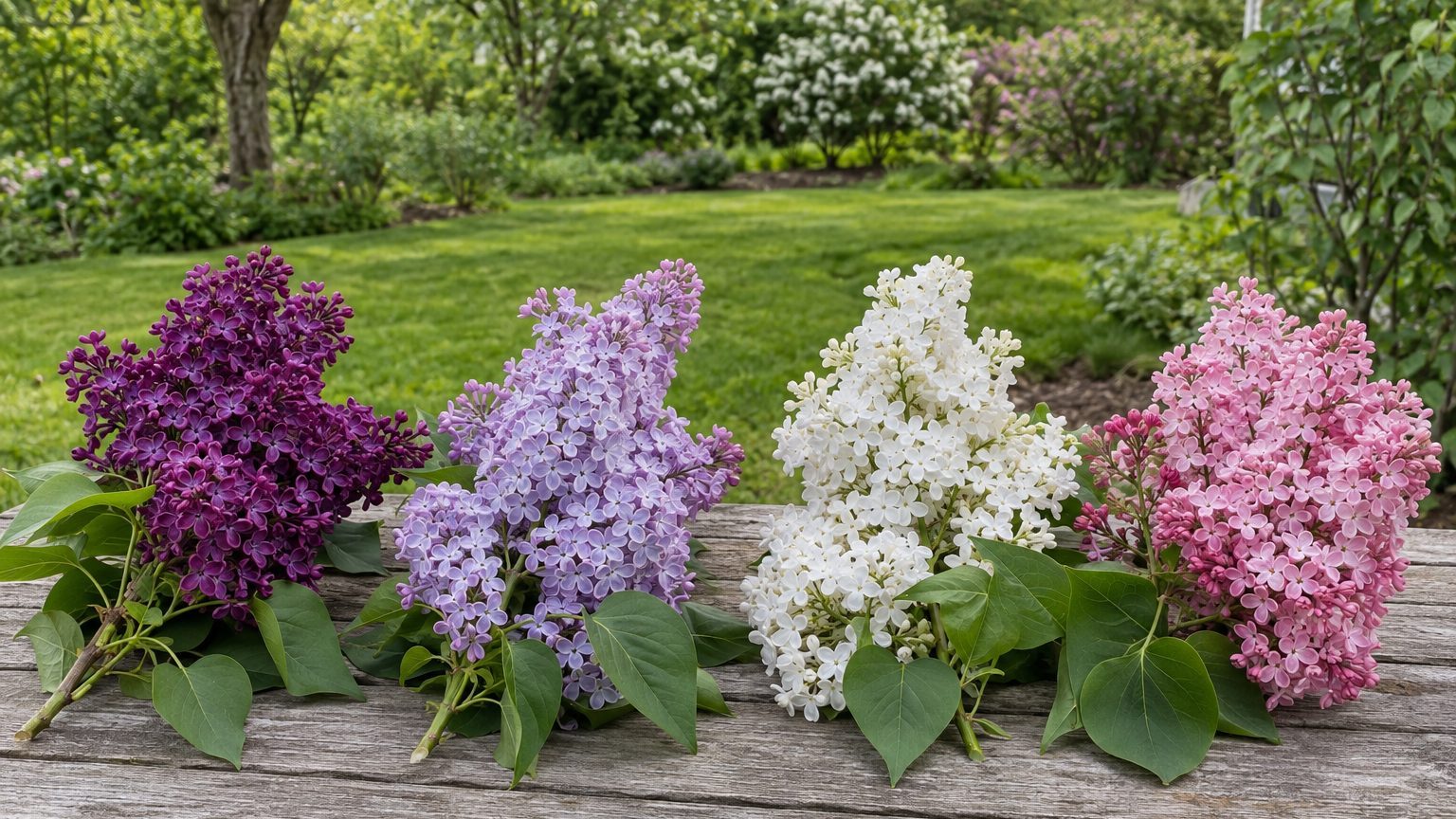
Every spring, one neighbor’s lilac towers over the fence and scents the whole street, while another, a few doors down, stays low and tidy. The difference is usually the type, not the care. Common, hybrid, dwarf and tree lilacs differ in mature size, spread, bloom timing and cold tolerance, and those differences decide which one belongs in your yard.
What Are the Main Types of Lilacs?
For home yards, lilacs are often discussed as common, hybrid, dwarf and tree forms. The general rule is that the type sets mature size, spread and bloom timing, while your climate decides which type will settle in.
- Common lilac: the classic large shrub, with a few dwarf forms available.
- Hybrid lilac: crosses such as Chinese lilac, often wider and more arching.
- Dwarf lilac: a label that can describe slow-growing shrubs such as Miss Kim, whose mature size still needs checking.
- Tree lilac: a lilac with a tree-like form rather than the habit of a large shrub.
Cold tolerance is where climate enters. Use the hardiness rating on the plant tag to check whether a lilac suits your winters. The state selector just under this section leads to the page for your state.
From the almanac
Lilacs in your state
The dates on this page depend on where you live. Your state's page carries its frost dates, its USDA zones and the year laid out month by month.
Northeast
Southeast
- Alabama
- Arkansas
- Delaware
- Florida
- Georgia
- Kentucky
- Louisiana
- Maryland
- Mississippi
- North Carolina
- South Carolina
- Tennessee
- Virginia
- West Virginia
Midwest
Southwest
West
Pacific Northwest
Canada
How to Tell Lilac Types Apart

A few checks, made in this order at the nursery or in a catalog, sort one lilac from another before you spend anything.
- Compare mature height with the spot you have, because in Montana many lilacs grow 10 to 12 feet tall, and only some dwarfs stay well below that.
- Look at how the shrub spreads, since Chinese lilac is non-suckering while Persian and early lilac send up suckers in Wisconsin, and suckers decide how much space and edging work the bed will need.
- Read the mature height of anything labeled dwarf, because Miss Kim earns that label for its slow growth even though it can reach 8 or 9 feet tall in Alaska.
- Match the hardiness zone to your winters, so that a shrub rated only for milder sites is not left to the cold, and note that in Alaska a common lilac such as Sensation is considered hardy to Zone 3 yet is still a poor fit for the colder parts of Fairbanks and North Pole.
- Choose types that flower at different times, since a mix gives lilacs in bloom for over 6 weeks every spring instead of one short burst.
Local numbers can differ for the same shrub. At an arboretum near Chaska, Minnesota, most lilacs bloom between May 15 and June 15; in Maryland, Miss Kim is described as blooming slightly later than common lilac.
Lilac Types Compared by Lilac Type
Size, spread habit and cold rating are the traits that change most from one type to the next. Each one affects where the shrub fits and how much work it asks for once it is established.
Sizes and zones below come from the places that published them, so treat them as a guide and confirm locally.
| Lilac Type | What changes | Why it matters |
|---|---|---|
| Common lilac | Grows 10 to 12 feet tall in Montana, with some dwarfs available | Needs a full-size spot, so plan for the grown shrub, not the pot |
| Early lilac (Syringa oblata) | Upright, compact and suckering, 8–12 feet tall in Wisconsin | Rated Zone 3b in Wisconsin, so compare that rating with your local winter conditions; suckers also need watching |
| Chinese lilac | Wide, arching and non-suckering, spreading 8–12 feet in Wisconsin | Its non-suckering habit limits root shoots, and it is rated Zone 4a in Wisconsin |
| Persian lilac | Arching and suckering, 4–8 feet tall in Wisconsin | A smaller shrub for mid-size beds, rated Zone 3b there |
| Manchurian lilac | Dense foliage, 5 to 8 feet high in Nebraska | Fits smaller yards, and Miss Kim, a Manchurian type, is listed as powdery mildew resistant in Maryland |
| Late lilac | Reaches up to 12 feet tall and wide in Montana | Grows best on loams, silt loams and silty clay loams in the 14–30 inch precipitation zone |
For you, this means matching the shrub to the space first and the color second. Tree lilacs have a tree-like form, so read the tag for mature height before planting near wires or eaves.
Lilac Selection Mistakes to Avoid
Mixing Up California Lilac
California lilac, or Ceanothus, is a different plant from true lilac (Syringa). In Oregon, one form is a large rounded evergreen shrub that can easily reach 10 feet tall and wide. Another grows up to 2 feet tall and can spread to 6 feet or more as a groundcover.
Look for Syringa on the tag before you pay.
Ignoring Mature Size
A small pot hides a shrub that, in Nebraska, can grow 10 to 12 feet tall as early lilac. Planted tight against a window or walkway, it needs constant cutting back and loses its natural shape.
For a tight spot, compare the mature size of locally available Persian and Manchurian lilacs, or give a larger lilac open ground.
Trusting the Dwarf Label
For Miss Kim, the dwarf label refers to its slow growth rather than a very small mature size. Miss Kim is grouped with the dwarfs for its slow growth, yet it reaches 8 or 9 feet tall in Alaska.
Read the mature height listed for your own state before planting under a low window, and ask the nursery how the shrub has done in local yards.
Best Lilac Types for Your State
The type that suits you is the one rated for your winters and sized for your space. When lilacs open in your neighborhood, note which ones look healthy, since that is the moment to start choosing. The months for each state are on that state’s page.
- Your state’s page may list local bloom and planting months, so check it before you shop.
- Take the mature height and zone from the tag to the nursery, and compare them with your space.
Common Questions
What Causes White Powder on Lilac Leaves?
Powdery mildew is the usual cause when a gray-white film coats the leaves and the shrub is crowded or shaded with poor airflow. Space plants so air moves through them, and favor types listed as mildew resistant.
Do Lilacs Need Full Sun?
Yes. Full sun supports flowering, while heavy shade can reduce flower-bud production. Choose an open spot away from tall trees and walls.
Are Lilacs Fussy About Soil?
Lilacs need soil that drains freely. Heavy clay that stays soggy after rain stresses the roots, so choose a better-drained site or plant slightly high.