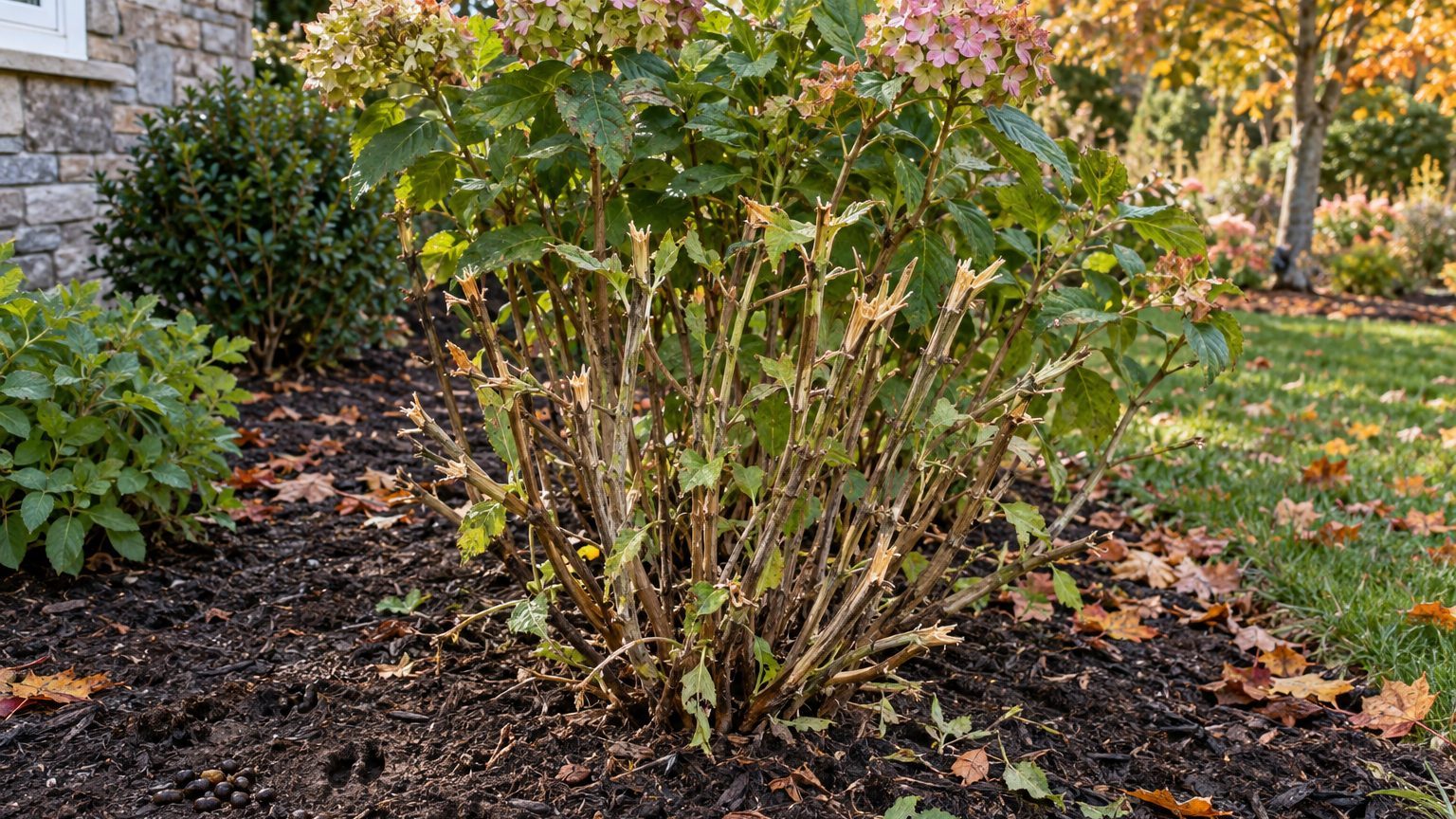
Yes, deer eat hydrangeas, and no type earns a pass. Ragged stem tips, missing buds and stripped lower leaves point to them, though frost and leaf disease can mimic the loss. The fix starts with a physical barrier around the plant, gentler pruning of the damage, and a call to your state extension about what is registered locally. Timing depends on your zone and type.
Deer: What You See

The NC State Extension Gardener Plant Toolbox lists deer among the animals that damage hydrangeas, and a bigleaf at 3 to 6 feet tall and wide keeps most of its growth within easy reach. Look for these signs:
- Stem tips torn off, with ragged, frayed ends rather than a clean snip.
- Flower buds and blooms gone from the reachable side of the shrub, often overnight.
- Leaves stripped from the lower part of the plant while the top stays green.
- Tender shoots nibbled in spring, blooms in summer, bare twigs in winter.
- Hoof prints or droppings in the mulch or soft soil nearby.
Missing buds on a bigleaf hurt twice, because it flowers on last year’s wood and the lost buds were next season’s blooms.
From the almanac
Hydrangeas in your state
The dates on this page depend on where you live. Your state's page carries its frost dates, its USDA zones and the year laid out month by month.
Northeast
Southeast
- Alabama
- Arkansas
- Delaware
- Florida
- Georgia
- Kentucky
- Louisiana
- Maryland
- Mississippi
- North Carolina
- South Carolina
- Tennessee
- Virginia
- West Virginia
Midwest
Southwest
West
Pacific Northwest
Canada
Deer or Something Else?
Not every missing bloom is a deer. The NC State Extension Gardener Plant Toolbox says bigleaf forms its buds the previous summer, so a late frost or a spring prune can remove the flowers with no animal involved.
Two checks settle it fast. Walk all the way around the plant, because deer damage stops where a mouth can reach, while frost hits the whole shrub.
| Looks like | The sign that tells them apart |
|---|---|
| Bare bigleaf after a late frost or a spring prune | Stems are whole or cleanly cut, and the loss runs from top to bottom instead of stopping at a browsing line. |
| Leaf spot or powdery mildew | The leaves are still on the plant, spotted or coated in white. Deer take the leaf itself. |
Aphids and mites are on the source’s list too, but it calls them rarely a problem. If you find insects or fine webbing instead of torn stems, read Aphids on Hydrangeas and Spider Mites on Hydrangeas. The rest are covered under Hydrangea Pests.
What Causes Deer, and Where It Is Worst
Deer browse hydrangeas wherever the two meet, and the NC State Extension Gardener Plant Toolbox lists deer as a damage agent across a genus that spans USDA zones 3a through 9b. That entry also files deer under resistance, so I go by what is observed: hydrangeas get browsed.
The source maps no deer pressure, so the regions below sort by what is planted and what a browse costs.
- Great Lakes and the North (Michigan, Minnesota, Wisconsin): panicle and smooth dominate, both flower on new wood, so a winter browse costs fewer blooms.
- The Mid-Atlantic and Ohio Valley (Pennsylvania, Virginia, Ohio): bigleaf in the colder pockets can lose old-wood buds to frost and deer in the same winter.
- The South (Georgia, Texas, the Carolinas): bigleaf and oakleaf carry buds on old wood through winter, so every browsed stem is a lost bloom.
Your state’s page in this series gives the zone, type and timing that apply where you live.
How to Treat Deer
Start with the plant in front of you, then work outward, all in the same week.
- Confirm the browse: torn stem ends and an uneven line of damage separate deer from frost, and the table above covers the other look-alikes.
- Wrap or cage the plant: size the barrier to the shrub, since the NC State Extension Gardener Plant Toolbox puts bigleaf at 3 to 6 feet tall and wide.
- Hold the pruners on old-wood types: bigleaf, oakleaf, mountain and climbing hydrangeas carry buds on old wood, so trim only torn stubs and wait to see what leafs out.
- Mulch the roots: bigleaf and panicle are both shallow-rooted and benefit from mulch, which helps a stripped plant rebuild.
- Ask your extension office about repellents: only your state’s service knows which ones are registered where you live, so ask before buying anything.
Growth is medium for the genus and rapid for bigleaf and panicle, and upkeep is low. A browsed shrub has the pace to refill, if the barrier stops the second visit.
How to Prevent Deer Coming Back
Prevention follows the calendar, and the exact windows depend on your zone and type, so check your state page for them.
- Late winter: repair the fence or cage before new shoots show, and cut panicle hard now, since it flowers on the current season’s growth.
- Spring growth: refresh the mulch around bigleaf and panicle, and check the barrier after any storm.
- Summer bloom: walk the bed each week for torn tips, and fix any gap the same day.
- Fall cleanup: the NC State Extension Gardener Plant Toolbox says to cut dead hollow stems to 12 to 24 inches and leave them standing until they disintegrate, which shelters native bees.
- Winter: keep barriers up, because old-wood types carry next season’s buds through the cold months.
- Planting time: choose the type that suits your zone and set it inside the protected area from day one.
A panicle at 8 to 25 feet will outgrow a cage, so fencing the whole bed beats wrapping single plants.
Where this comes from
The plant types, hardiness and pest list here come from the NC State Extension Gardener Plant Toolbox entry for Hydrangea, which gives the genus USDA zones 3a through 9b. It names deer as a damage agent and stresses that the answer depends entirely on the type.
Its two deer entries disagree, so I report what is observed rather than claim resistance. Before you spend money, check with your state’s cooperative extension service, which knows what is registered and what works in your county.
Common questions
Are hydrangeas deer resistant?
Not reliably. The source lists deer as a damage agent and also under resistance, and two entries that disagree cannot be trusted as a promise. Hydrangeas are browsed, so protect them with a barrier instead of counting on the plant.
Will deer browsing ruin next year’s flowers?
It depends on the type. Bigleaf, oakleaf, mountain and climbing hydrangeas flower on old wood, so lost buds mean lost blooms. Panicle and smooth flower on new wood, so regrowth can still set flowers.
Are hydrangeas poisonous to pets or to deer?
Only bigleaf is documented toxic, and only when large quantities are eaten, with nausea, stomach pain, vomiting and sweating. Cats, dogs and horses are affected too. The source does not say this keeps deer away, so do not rely on it.