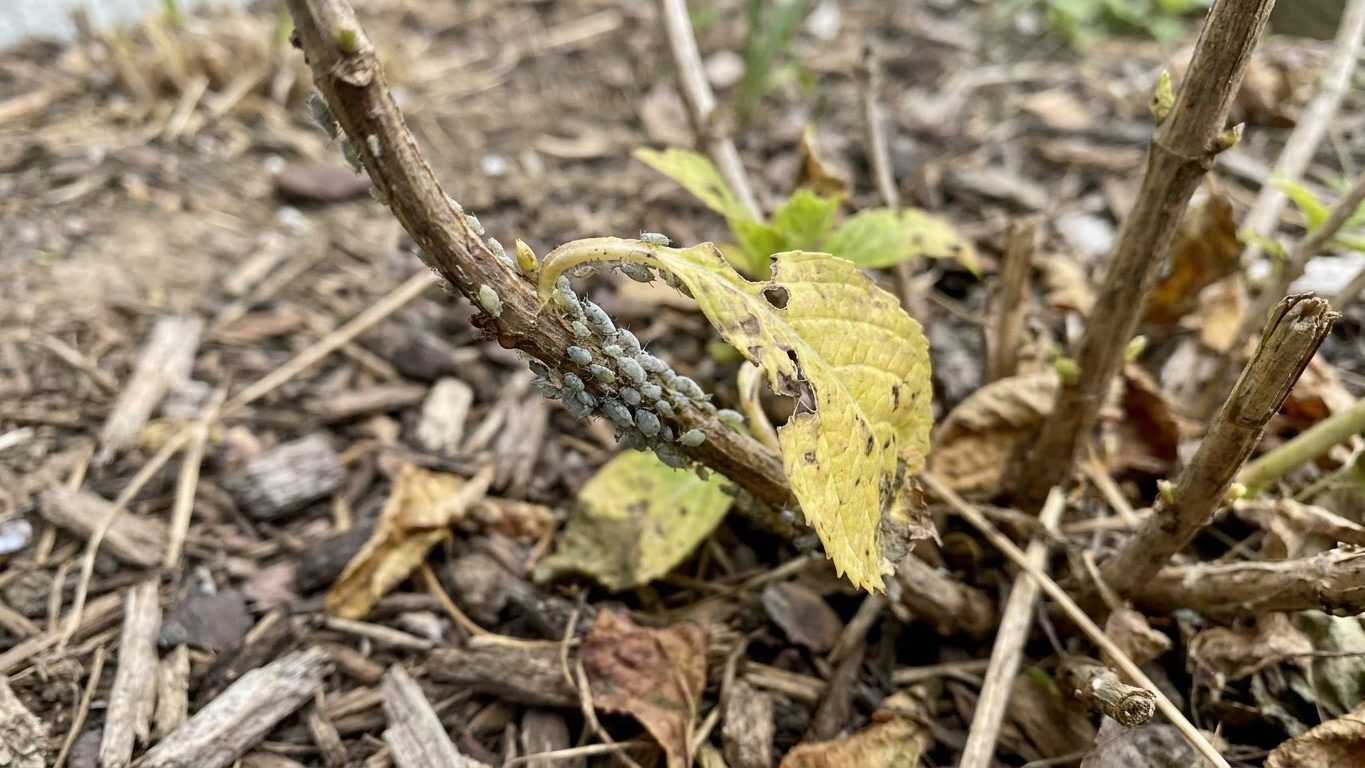
Aphids on hydrangea show up as tiny, soft-bodied insects, green, black, or pink, clustered on new stems, leaf undersides, and unopened buds, mostly in spring and early summer. NC State Extension Gardener Plant Toolbox lists them among the pests that turn up on this genus and calls the group rarely a problem. Sticky honeydew and curling leaves are usually the first clue.
Aphids: What You See

Aphids arrive as a cluster, not a lone bug, and they settle first on the softest growth a hydrangea has to offer.
- Color runs from pale green to black, sometimes pink, depending on the colony.
- Shape is small, pear-bodied, and soft, with no hard shell.
- Location is the tip of new stems, the underside of young leaves, and unopened flower buds.
- Timing runs from spring into early summer, when growth is soft and fast.
- Sticky residue on leaves below the colony is honeydew, and it often draws ants.
- Leaves near a heavy colony curl or pucker instead of lying flat.
NC State Extension Gardener Plant Toolbox lists aphids among the pests that occasionally turn up on hydrangea, alongside scales, nematodes, and mites, and calls the whole group rarely a problem. The tissue they favor is always the newest and softest growth on the plant, and that detail is what separates them from most look-alikes.
From the almanac
Hydrangeas in your state
The dates on this page depend on where you live. Your state's page carries its frost dates, its USDA zones and the year laid out month by month.
Northeast
Southeast
- Alabama
- Arkansas
- Delaware
- Florida
- Georgia
- Kentucky
- Louisiana
- Maryland
- Mississippi
- North Carolina
- South Carolina
- Tennessee
- Virginia
- West Virginia
Midwest
Southwest
West
Pacific Northwest
Canada
Aphids or Something Else?
Two or three other problems leave a similar mess on hydrangea leaves and stems, and it pays to check the sign that actually decides which one you’ve got before you treat anything.
The source’s own pest and disease list for hydrangea names scale, mites, and powdery mildew alongside aphids, and each one leaves its own kind of clue behind on the leaf.
| Kind | Looks like | The sign that tells them apart |
|---|---|---|
| Scale | Small waxy bumps clustered on stems | Scale stays fixed in place, aphids crawl and cluster on soft new growth |
| Powdery mildew | A pale, dusty coating on leaf surfaces | Mildew is dry and powdery, aphid damage leaves a sticky honeydew film instead |
| Mites | Leaves that look dusty or bronzed | Mites are nearly invisible without a hand lens, aphids are visible as a cluster |
Nematodes and bacterial wilt are also on the source’s list, but their signs are underground or systemic rather than something you can spot on a leaf, so the other kinds are on their own pages.
What Causes Aphids, and Where It Is Worst
Aphids find hydrangea through soft new growth, and colonies build fastest in the weeks right after a spring flush, especially on a plant pushed hard with quick-release nitrogen.
- The South and Gulf Coast (Georgia, Texas, the Carolinas): warm springs bring an earlier flush on bigleaf hydrangea, which NC State Extension Gardener Plant Toolbox lists as hardy through USDA zone 11b, giving aphids a longer window before summer heat slows new growth.
- The Upper Midwest and Northeast (Michigan, Minnesota, New York): panicle hydrangea, hardy to zone 3a, leafs out later, so the aphid window lines up with a single, shorter spring flush.
- The Pacific Northwest (Washington, Oregon): mild, humid springs keep new growth soft for weeks at a stretch, which is exactly the tissue aphids prefer.
Your own zone and hydrangea type decide how long that window stays open, so check your state page before you plan a treatment.
How to Treat Aphids
Most colonies on hydrangea need nothing more than a few minutes of attention this week, taken in order.
The order that works
- Check the undersides of leaves and buds first: aphids cluster low and out of sight, especially in the top few inches of new growth.
- Knock them off with a strong jet of water: this alone clears most light colonies without harming the plant, since NC State Extension Gardener Plant Toolbox calls aphids rarely a problem on hydrangea overall.
- Look for ants and honeydew before deciding to treat: heavy ant traffic on a stem is a reliable sign the colony is worth a second look.
- Leave nearby plantings alone for a week: ladybugs and lacewings often clear a light colony on their own once they find it.
- Call your state extension office for a labeled product: only your state’s service knows what’s approved for hydrangea where you live.
- Recheck weekly through the spring flush: new growth keeps arriving, so a colony can rebuild fast if the plant keeps pushing soft tissue.
When a spray is actually needed
A normal year rarely calls for one, since the source treats aphids as a minor pest on this genus. The exception is a young plant with only a handful of stems, where even a light colony can slow its first season of growth.
How to Prevent Aphids Coming Back
Prevention on hydrangea has less to do with the aphids themselves and more to do with the growth they’re chasing.
- Mulch in spring: a steady layer keeps roots cool and moist, since both bigleaf and panicle hydrangea are shallow-rooted and benefit from it.
- Skip high-nitrogen fertilizer: quick-release nitrogen pushes exactly the soft new growth aphids prefer, so a slow-release feed or none at all keeps growth steadier.
- Water at the soil line: keeping foliage drier makes it a little less inviting to sap-feeding pests looking for a place to settle.
- Prune only at the right time for your type: the correct timing depends on whether your hydrangea flowers on old wood or new growth, so check your type’s page before you cut.
- Leave some stems standing through winter: NC State Extension Gardener Plant Toolbox notes that native bees nest in the dead hollow stems, cut to 12 to 24 inches and left until they break down, and those same beneficial insects help keep pest colonies in check.
- Walk the bed weekly once new growth starts: catching a small colony early, before it reaches the buds, keeps a hose rinse enough to handle it.
None of this guarantees a season without aphids, but together it keeps a colony rare and easy to manage when one does show up.
Where this comes from
The identification details, zone ranges, and pest list here come from NC State Extension Gardener Plant Toolbox’s hydrangea profile, a standard reference for home gardeners across hardiness zones.
Aphid pressure, timing, and treatment options shift by state and by hydrangea type, so check with your own state’s extension service before you spray anything.
Common questions
Do aphids kill hydrangea?
Rarely. NC State Extension Gardener Plant Toolbox calls aphids a minor pest on this genus, and a healthy plant usually outgrows a light colony on its own within a couple of weeks.
Are aphids the reason my hydrangea leaves are curling?
They can be, but check the underside of the leaf first. Curling from a colony comes with honeydew and often ants, while curling without either points toward a disease instead.
Do ants on my hydrangea mean I have aphids?
Usually, yes. Ants feed on the honeydew aphids leave behind, and a line of them climbing a stem is often the first sign of a colony before you spot the insects themselves.