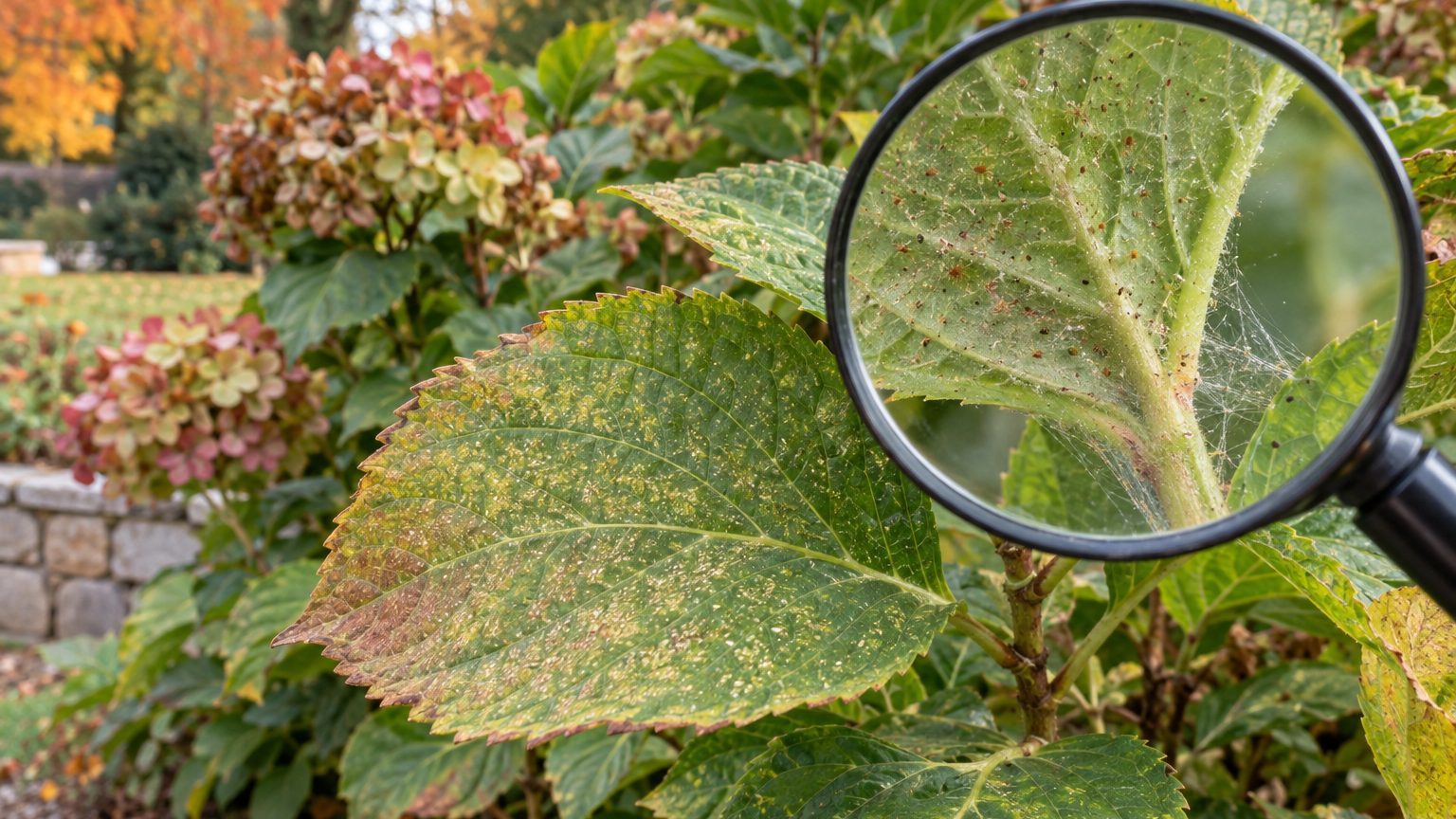
Spider mites on hydrangeas show up as fine pale stippling on the leaves, a dull bronze cast, and silk on the underside, most often in hot, dry weather. The animals are smaller than a poppy seed, so you see the damage first. A firm jet of water, repeated, deals with most cases before anything stronger is needed.
Spider Mites: What You See

NC State Extension Gardener Plant Toolbox names mites among hydrangea pests, and the spider kind announces itself on the leaf long before you spot the animal.
- Tiny pale specks scattered across the leaf surface, as if pricked with a fine pin.
- Leaves that turn dull, bronze or gray-yellow instead of glossy green.
- Fine silk webbing on the underside of leaves and where the leaf meets the stem.
- Moving specks, red, tan or green, on the underside, smaller than a poppy seed.
- Damage that builds in hot, dry summer weather, then leaves curling and dropping late in the season.
Tap a branch over a sheet of white paper. Specks that crawl are your answer.
From the almanac
Hydrangeas in your state
The dates on this page depend on where you live. Your state's page carries its frost dates, its USDA zones and the year laid out month by month.
Northeast
Southeast
- Alabama
- Arkansas
- Delaware
- Florida
- Georgia
- Kentucky
- Louisiana
- Maryland
- Mississippi
- North Carolina
- South Carolina
- Tennessee
- Virginia
- West Virginia
Midwest
Southwest
West
Pacific Northwest
Canada
Spider Mites or Something Else?
NC State Extension Gardener Plant Toolbox lists powdery mildew and leaf spot among hydrangea diseases, and aphids among the pests. Each can leave a leaf looking tired, so a quick test saves you from treating the wrong problem.
Mites do not chew. Torn, ragged shoots and missing tips point to browsing, which is covered on Deer on Hydrangeas.
| Kind | Looks like | The sign that tells them apart |
|---|---|---|
| Powdery mildew | Grayish-white, dusty leaves | A white film that wipes off under your thumb, with no silk underneath |
| Leaf spot | Speckled, blotchy leaves | Spots with a defined edge, and nothing moves when you tap a branch over white paper |
| Aphids | Distorted, sticky new growth | Clusters of soft insects on shoot tips, with sticky residue on the leaves below |
Other sap-feeders have their own pages, including Whiteflies on Hydrangeas. If nothing on the table fits and the paper test shows moving specks, you have mites.
What Causes Spider Mites, and Where It Is Worst
NC State Extension Gardener Plant Toolbox lists mites as “rarely a problem”, so the cause is usually the season and not the plant: hot, dry, dusty stretches and roots short of water let a small population explode.
- Great Lakes and the North (Michigan, Minnesota, Wisconsin): panicle, listed at 3a to 8b, and smooth carry the region, and trouble comes in a dry midsummer spell, not a cool wet year.
- The South (Georgia, Texas, the Carolinas): long hot summers stress bigleaf most, especially in the afternoon sun it is meant to be protected from.
- Dry West and Plains (Colorado, Kansas, Nevada): low humidity and blowing dust favor mites, and shallow-rooted bigleaf and panicle dry out fast.
- Pacific Northwest (Oregon, Washington): cool and damp most of the year, so problems wait for a late-summer dry spell.
Your state’s page carries the local timing, and Hydrangea Pests sets mites beside the other pests on the list.
How to Treat Spider Mites
Start with the cheapest tools and work up, and do it this week while the population is still small.
- Confirm with white paper: tap a branch over it and look for specks that crawl, since dust and mildew do not move.
- Rinse the undersides hard: NC State Extension Gardener Plant Toolbox puts bigleaf at 3 to 6 feet tall and wide, so a hose reaches most of the leaf undersides in the morning.
- Bag the worst leaves: pick off the heaviest webbing and put it in the trash, not the compost pile.
- Water deeply and mulch: bigleaf and panicle are shallow-rooted and both benefit from mulch, which keeps the soil evenly moist.
- Rinse again every few days: mites rebuild fast in heat, so recheck the undersides each time.
- Call your extension office before buying a spray: only your state’s extension service knows what is registered where you garden.
Do not prune to chase mites. Bigleaf flowers on last year’s wood, so a spring cut removes the flowers, while panicle flowers on the current season’s growth and tolerates a hard cut in late winter.
How to Prevent Spider Mites Coming Back
Prevention follows the calendar, and most of it is water and housekeeping.
- Late winter: cut panicle back hard, since it flowers on new growth, and leave bigleaf alone.
- Spring: lay mulch over the shallow roots so the soil holds moisture through summer.
- Early summer: start flipping leaves every week or so, before the heat arrives.
- Dry, hot spells: water deeply at the base and shade bigleaf from afternoon sun.
- Midsummer: wash dust off the foliage with the hose, because dusty leaves suit mites.
- Autumn: NC State Extension Gardener Plant Toolbox says to cut hollow stems back to 12 to 24 inches and leave them standing for native bees, which nest in them.
- After leaf drop: rake up leaves from a plant that had mites and bag them.
The exact dates depend on your zone and hydrangea type, so check your state’s page for the local window.
Where this comes from
NC State Extension Gardener Plant Toolbox names mites among hydrangea pests and calls them rarely a problem. Zone and type change the timing of every task above.
Your state’s extension service has the final word on what is registered and when to act locally. A quick call or a look at their site is worth it before you buy any treatment.
Common questions
Do spider mites kill hydrangeas?
Rarely. The extension entry lists mites as rarely a problem, and a healthy, well-watered plant usually recovers. A heavy, long-running infestation can strip leaves and weaken a stressed plant.
Is a dry, dusty hydrangea more likely to get mites?
Yes. Hot, dry, dusty conditions favor them, and a plant short of water is the easy target. Deep watering, mulch and a rinse of the leaves take away most of that advantage.
Does the same treatment work for every type?
The rinse, the watering and the cleanup are the same across types. Pruning is not: bigleaf flowers on last year’s wood and panicle on the current season’s growth, so cut the two on different schedules.