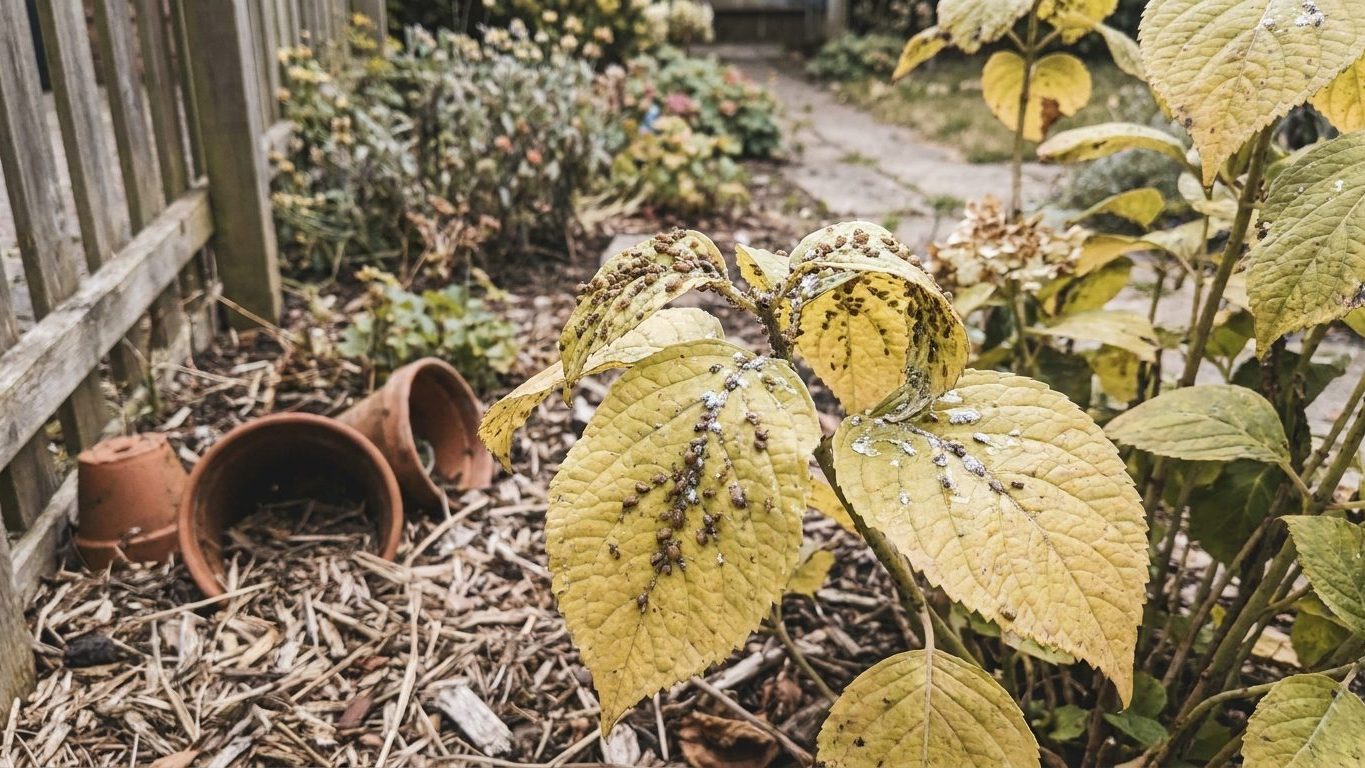
Most hydrangeas fend off pests on their own. NC State Extension Gardener Plant Toolbox names only aphids, scales, nematodes, and mites for the whole genus, and calls all four rare. Deer are the real threat, browsing buds through fall and winter no matter the zone. What decides the outcome is which hydrangea you grow, since old-wood types lose a season to missing buds while new-wood types simply regrow.
Hydrangea Pests: The Short Answer
Hydrangea pest pressure stays low across the genus. NC State Extension Gardener Plant Toolbox names aphids, scales, nematodes, and mites as the pests to know, and calls all four rarely a problem in a genus that spans USDA zones 3a through 9b.
Deer are the one exception, browsing stems and dormant buds no matter the zone or the type. A single pass through a bigleaf hydrangea can strip the buds that would have opened as flowers.
What changes the real risk is which hydrangea you grow, since bigleaf and mountain types flower on last year’s wood while panicle types flower on new growth. Losing buds costs a bigleaf its whole season, but a panicle simply regrows and blooms regardless.
The state selector below this section opens the page built for your zip code. It carries local pest notes and the pruning calendar that apply where you live.
From the almanac
Hydrangeas in your state
The dates on this page depend on where you live. Your state's page carries its frost dates, its USDA zones and the year laid out month by month.
Northeast
Southeast
- Alabama
- Arkansas
- Delaware
- Florida
- Georgia
- Kentucky
- Louisiana
- Maryland
- Mississippi
- North Carolina
- South Carolina
- Tennessee
- Virginia
- West Virginia
Midwest
Southwest
West
Pacific Northwest
Canada
Hydrangea Pests, Step by Step

Pest and disease pressure moves through a hydrangea in a fairly fixed order across the growing year, from soft new leaves in spring to dormant wood in winter.
- Check new growth for aphids first: NC State Extension Gardener Plant Toolbox lists aphids among the four pests it names for the genus, and they cluster on the soft tips as new leaves unfold.
- Look under leaves for mites and scales next: both tend to show up once the canopy fills in, and the source calls both rarely a problem, so a light hand is enough.
- Watch for leaf spot and powdery mildew through humid stretches: both diseases appear on the source’s list for the genus and spread fastest when foliage stays wet overnight.
- Add rust and bud blight to the watch list on panicle types: the source names both as extra risks specific to H. paniculata, usually showing up later in the season as buds form.
- Check for nematodes if a plant wilts despite regular water: nematodes work in the soil and root zone, and the source lists them as rarely a problem but worth ruling out first.
- Fence or spray for deer once wood goes dormant: deer browse stems and buds through fall and winter, and a bigleaf or mountain hydrangea loses next year’s flowers when the buds it already set get eaten.
None of these six pests usually becomes a real infestation, and the source’s own summary calls maintenance for the genus low. The one step that changes a season’s outcome is the last one, since old-wood types cannot simply regrow what deer take over winter.
Hydrangea Pests by Hydrangea Type
Pest and disease exposure tracks the wood a hydrangea blooms on. Old-wood types carry their whole season’s flowers through winter as exposed buds, which is exactly what deer target.
New-wood types like panicle regrow after damage, but they pick up their own disease risks that old-wood types don’t share.
| Kind | Flowers on | USDA zones | Pest or disease note |
|---|---|---|---|
| Bigleaf / mop-head / lacecap | Last year’s wood | 6a-11b | Only type documented toxic to pets in quantity |
| Panicle / peegee | Current season’s growth | 3a-8b | Only type also listed with rust and bud blight |
| Smooth (Annabelle-type) | New wood | — | Hardiest of the genus |
| Mountain | Old wood | — | Buds tolerate late frost better than bigleaf |
| Climbing | Old wood | — | Slow to start flowering, clings by aerial rootlets |
Oakleaf hydrangea also flowers on old wood, but the source gives it no separate pest or disease note, so it stays on its own page rather than in this table.
Hydrangea Pests: Mistakes That Cost a Season
Pruning at the wrong time

Bigleaf, mountain, oakleaf, and climbing hydrangeas set their buds the previous summer, so a late prune removes flowers before they open. Prune those types right after bloom, and save hard cuts for panicle and smooth types instead. The exact window belongs on the state page.
Trusting deer resistance

The source lists deer both as a damage agent and under resistance to challenges for the genus, which is a contradiction worth noting rather than trusting. Where deer actually browse, they eat hydrangea stems and buds regardless of that label, so fencing or repellent beats faith in the plant list.
Chasing blue with coffee grounds

Coffee grounds shift soil pH by a very small amount, which is why kitchen remedies disappoint. Flower color on bigleaf and mountain hydrangeas moves with available aluminum, and high-phosphorus fertilizer locks that aluminum up, pushing blue toward pink even when the acidity looks right.
Hydrangea Pests in Your State
The national list holds everywhere: aphids, scales, mites, nematodes, and deer. Timing and pressure both shift by zone and by which type is planted.
- Your state page: the frost dates and the pruning window for the hydrangea type you grow.
- Which type holds up here: your hardiness zone matched against bigleaf, panicle, smooth, oakleaf, mountain, or climbing needs.
- Local extension office: the closest source for an outbreak that doesn’t show up on a national list.
Common Questions
Do hydrangeas attract pests that spread to other plants nearby?
The source lists only aphids, scales, nematodes, and mites for the genus, and calls all four rarely a problem, with no note of spreading to neighboring plants.
Are hydrangeas deer resistant?
The source itself is split, listing deer both as a resistance factor and as a damage agent. What’s actually observed is browsing, so plant as if deer will visit if they’re active locally.
Which hydrangea is toxic if a pet chews on it?
Only bigleaf hydrangea is documented toxic, and only in large quantities, through cyanogenic glycosides in the bark, flowers, leaves, and stems. It affects cats, dogs, and horses as well as people.