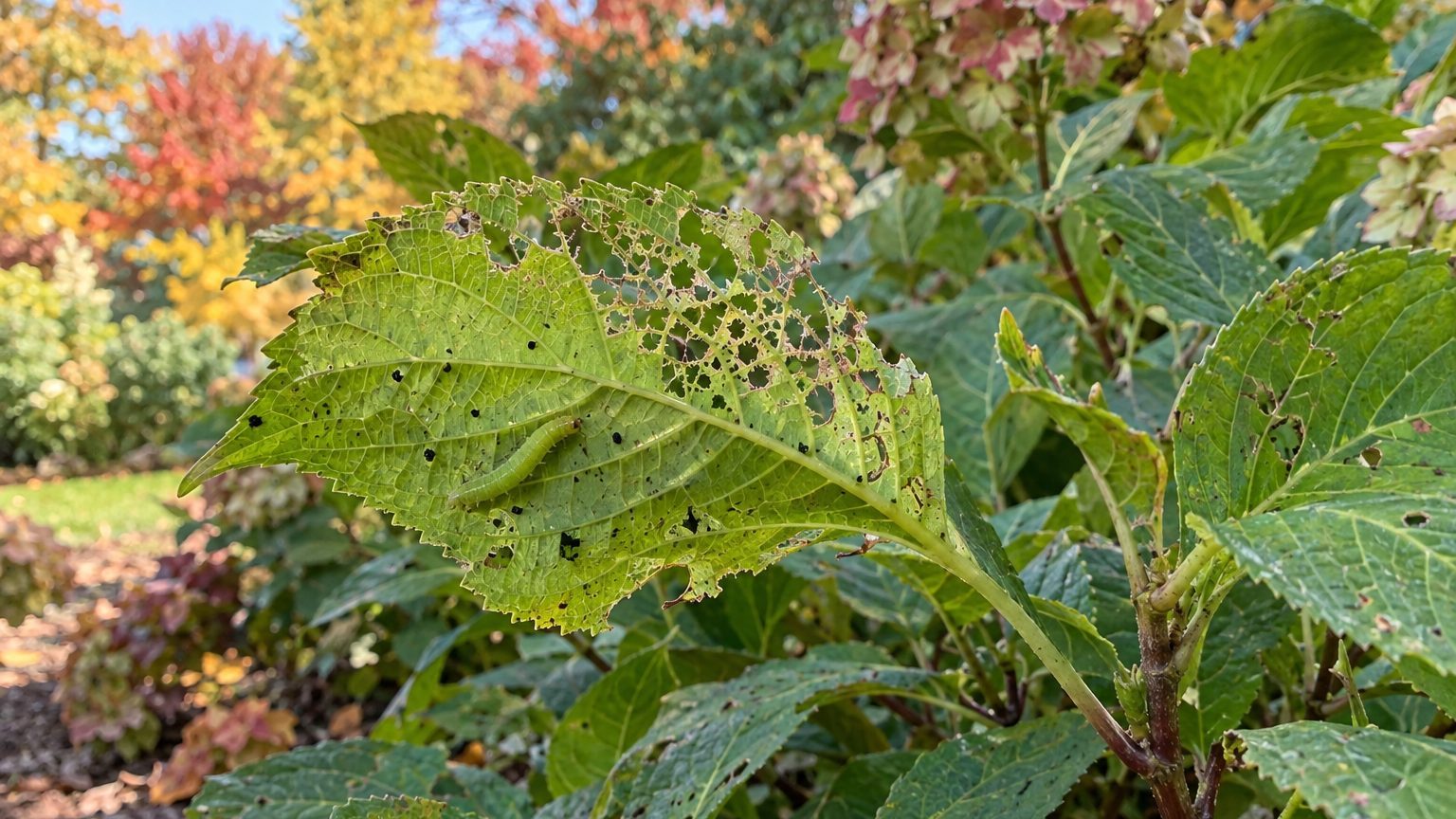
Ragged, chewed hydrangea leaves make many gardeners suspect caterpillars first. The extension source behind this silo does not list them, though. It names aphids, scales, nematodes and mites as rarely a problem, and deer as the animal that damages the plant. So the first job is confirming what is actually eating the foliage.
Foliage-Feeding Caterpillars: What You See

The NC State Extension Gardener Plant Toolbox names four insect and nematode pests for hydrangeas, all rarely a problem, and caterpillars are not among them, so I go by the damage and by what I find on the leaf.
- Holes with chewed edges in the leaf blade, often on softer new growth.
- Leaves eaten down to the veins, leaving a lacy skeleton.
- Small dark droppings on the leaves and on the ground under the shrub.
- A soft, worm-shaped larva sitting on a leaf underside or along a stem.
None of these signs proves anything alone. A larva caught on the leaf is the sign that decides, so look before you treat.
From the almanac
Hydrangeas in your state
The dates on this page depend on where you live. Your state's page carries its frost dates, its USDA zones and the year laid out month by month.
Northeast
Southeast
- Alabama
- Arkansas
- Delaware
- Florida
- Georgia
- Kentucky
- Louisiana
- Maryland
- Mississippi
- North Carolina
- South Carolina
- Tennessee
- Virginia
- West Virginia
Midwest
Southwest
West
Pacific Northwest
Canada
Foliage-Feeding Caterpillars or Something Else?
The NC State Extension Gardener Plant Toolbox lists deer as an animal that damages hydrangeas, and it also names scales, aphids, mites and nematodes. Several of these leave a shrub looking chewed or worn.
Each has one feature that separates it from a caterpillar. Check that feature before you spend money on anything.
| Looks like | The sign that tells them apart |
|---|---|
| Deer on Hydrangeas: leaves and shoot tips missing, stems shortened | Stems are torn or snapped, the damage sits on the tallest growth, and no insect or dropping turns up. |
| Scale Insects on Hydrangeas: bumps on stems and veins, sticky leaves | The bumps stay put and scrape off with a fingernail, and the leaf blade is not chewed. |
| Aphids: curled, sticky new growth | Clusters of tiny insects on the tips, with leaf tissue distorted rather than eaten through. |
Mites and nematodes are covered on the Hydrangea Pests page, since neither leaves a chewed hole.
What Causes Foliage-Feeding Caterpillars, and Where It Is Worst
A caterpillar is the larval stage of a moth or butterfly, so the cause is an adult that laid eggs on or near the shrub. The source draws no map of caterpillar pressure, so here is which hydrangeas grow where.
- Great Lakes and the North (Michigan, Minnesota, Wisconsin): panicle is rated USDA 3a to 8b, and smooth is the hardiest of the genus, so these two carry the region.
- The middle band (Ohio, Virginia, Kentucky): bigleaf starts at 6a here, so it shares beds with panicle and oakleaf.
- The South (Georgia, Texas, the Carolinas): bigleaf runs from 6a to 11b, the widest range of any type, so mop-heads are the shrub most likely to be chewed.
The NC State Extension Gardener Plant Toolbox puts the whole genus at 3a through 9b, so the answer depends on your zone and type. Your state’s page on this site gives the details for your city.
How to Treat Foliage-Feeding Caterpillars
Work through these in order this week, and stop at the first step that solves it.
- Find the feeder: check leaf undersides and stems, ideally in the evening, and look for a larva before you assume anything.
- Rule out deer and scale: torn stem tips or scrape-off bumps send you to a different fix than a chewed leaf does.
- Hand-pick what you find: drop larvae into a bucket of soapy water, and check again over the next few days.
- Tolerate light damage: the NC State Extension Gardener Plant Toolbox rates maintenance as low and growth as rapid for bigleaf and panicle, so a few chewed leaves are rarely worth an intervention.
- Ask your state extension before spraying: only your state’s extension service knows what is registered where you live, so read the label and get their advice first.
I name no product on purpose. What is legal and sensible in Ohio can differ from Georgia, and the local extension office answers that for free.
How to Prevent Foliage-Feeding Caterpillars Coming Back
Prevention is a calendar of small habits, and it depends on type: the NC State Extension Gardener Plant Toolbox says panicle flowers on the current season’s growth, while bigleaf sets buds the previous summer.
- Late winter: cut panicle back hard and clear fallen leaves from beds, but leave bigleaf uncut so its flower buds survive.
- Early spring: lay mulch over the shallow roots of bigleaf and panicle to keep the shrub steady.
- As leaves open: walk the shrub weekly and turn leaves over, because small larvae are easiest to remove early.
- Summer: water during dry spells so the shrub can replace any leaves that get chewed.
- Late summer: go easy on the shears, since bigleaf forms next year’s buds now.
- Winter: cut hollow stems to 12 to 24 inches and leave them standing for native bees.
A shrub in the right zone, with the right pruning, is the best defense you have.
Where this comes from
Every plant fact here comes from the NC State Extension Gardener Plant Toolbox, which lists the pests and diseases of hydrangeas. Caterpillars are not on its list, so the identification steps rest on ordinary garden practice.
Extension advice is local by nature. Confirm your zone, your hydrangea type and any treatment with your own state’s extension service before you act.
Common questions
Will caterpillars kill my hydrangea?
The source lists no caterpillar damage and calls the pests it names rarely a problem. A shrub with some chewed leaves is a cosmetic issue in most cases. Look for other causes if whole stems are failing.
Are hydrangeas deer resistant?
No. The source lists deer as an animal that damages the plant, and hydrangeas are browsed. Treat torn stem tips as a deer problem, not an insect problem.
Who tells me what to spray?
Your state’s extension service. Registered products differ by state, so ask them what is approved for hydrangeas where you live, and follow the label.