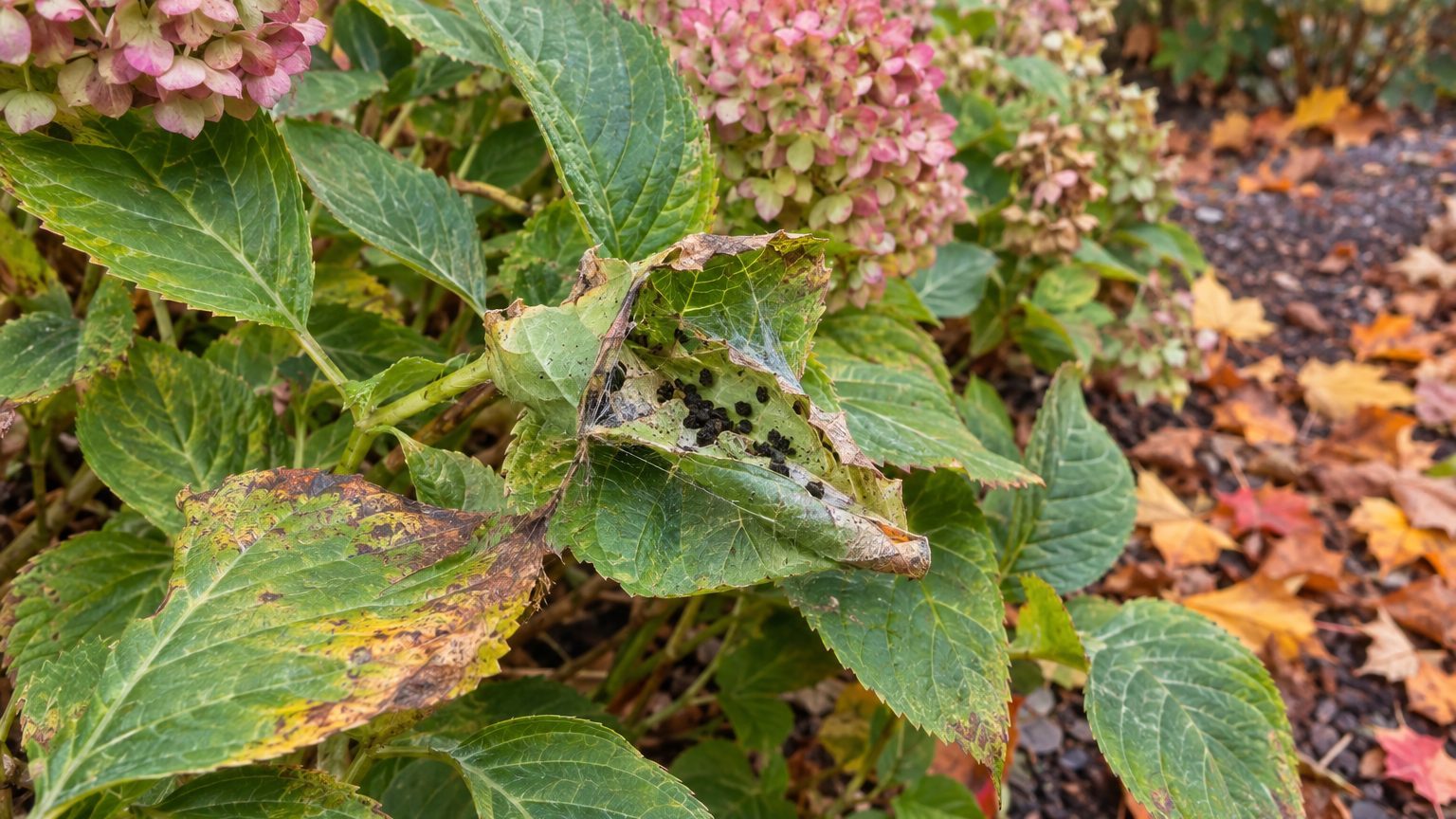
A hydrangea leaftier shows up as leaves pulled together with silk and folded into a small shelter, with something feeding inside. Open one and you have your answer. Treatment is mostly by hand, and it starts with knowing which hydrangea type you grow. One caution up front: the extension source behind this series does not list a leaftier, so I stick to what you can see and check.
Hydrangea Leaftier: What You See

The NC State Extension Gardener Plant Toolbox lists aphids, scales, nematodes and mites for hydrangea, calls them rarely a problem, and names no leaftier, so identification rests on signs you can check on the leaf itself.
- Two or more leaves drawn together and held shut with fine silk threads.
- A single leaf folded over on itself, its edges stuck down like a pocket.
- Ragged chewing inside the folded shelter rather than along the outer leaf edge.
- Small dark specks of droppings tucked into the fold.
- A caterpillar that wriggles when you pry the leaves apart.
- Browning, curled foliage on the outside of a tied cluster as the season goes on.
All of this appears while the plant is in leaf, so a walk around the shrub in late September still turns it up. Open one tied cluster gently before you decide anything.
From the almanac
Hydrangeas in your state
The dates on this page depend on where you live. Your state's page carries its frost dates, its USDA zones and the year laid out month by month.
Northeast
Southeast
- Alabama
- Arkansas
- Delaware
- Florida
- Georgia
- Kentucky
- Louisiana
- Maryland
- Mississippi
- North Carolina
- South Carolina
- Tennessee
- Virginia
- West Virginia
Midwest
Southwest
West
Pacific Northwest
Canada
Hydrangea Leaftier or Something Else?
Ragged leaves on a hydrangea do not always mean a caterpillar. The NC State Extension Gardener Plant Toolbox lists deer as a damage agent, along with leaf spot and mites, and each of those can pass for leaftier damage from ten feet away.
The tell is always the same: silk that holds leaves together. If nothing is stuck, folded or webbed shut, you are probably looking at one of these three.
| Looks like | The sign that tells them apart |
|---|---|
| Deer browsing: torn, uneven leaves and stems | Torn edges, no silk anywhere, and leaves that stay flat instead of folding shut. |
| Leaf spot: brown patches on the foliage | The spots sit on a flat leaf surface, and no leaves are stuck together. |
| Mites: dull, speckled foliage | Fine stippling across the leaf with no folded shelter to open. |
Other insects that chew hydrangeas have their own pages, starting from Hydrangea Pests, including Rose Chafer on Hydrangeas and Giant Whitefly on Hydrangeas.
What Causes Hydrangea Leaftier, and Where It Is Worst
The cause is a small moth caterpillar that ties leaves with silk so it can feed out of sight. No source I trust maps where it is worst, so I sort by what does change with your region: the hydrangea types you can grow.
- Great Lakes and the North (Michigan, Minnesota, Wisconsin): panicle and smooth types carry the load here, and the NC State Extension Gardener Plant Toolbox rates panicle at USDA 3a to 8b.
- The South (Georgia, Texas, the Carolinas): bigleaf is rated 6a to 11b, and it needs protection from afternoon sun.
- Northeast and Mid-Atlantic (New York, Pennsylvania, Virginia): bigleaf buds form on last year’s wood, so a clean-up of tied leaves must not turn into a stem prune.
- Mountain West (Colorado, Utah, Montana): panicle is the only hydrangea that takes full sun well, and the source calls it a good substitute for mop-head where that species is not winter hardy.
Your state’s page in this series gives the pruning window and zone verdict for your reference city, so read it before you cut anything.
How to Treat Hydrangea Leaftier
Work in this order this week, and stop short of anything that needs a product label.
- Confirm your type: the NC State Extension Gardener Plant Toolbox says bigleaf flowers on last year’s wood and panicle on the current season’s growth, so what you cut matters.
- Open one tied cluster: look for the caterpillar, and rule out deer, leaf spot and mites first.
- Remove tied leaves by hand: take the leaf, not the stem, so next year’s buds on old wood stay put.
- Bag what you remove: seal it for the trash rather than the compost pile.
- Recheck in a week: fresh silk on new leaves means a caterpillar is still feeding.
- Call your state extension office: only it knows which products are registered in your state for your hydrangea type.
Skip any spray until that call is made. Hand removal costs nothing, and the source rates hydrangea maintenance as low, so a light touch fits the plant.
How to Prevent Hydrangea Leaftier Coming Back
Prevention follows the calendar, and the NC State Extension Gardener Plant Toolbox supplies the timing hooks for each type.
- Late September: rake up fallen leaves under the shrub and bag them.
- After leaf drop: pick off any dead leaves still tied to the stems and bin them.
- Late winter: cut panicle back hard, since it flowers on the current season’s growth.
- Old-wood types: hold off cutting bigleaf, oakleaf, mountain and climbing until your state page gives the window.
- Spring: refresh mulch around bigleaf and panicle, both shallow-rooted.
- Early growing season: walk the shrub weekly and open any leaves that look stuck together.
- Hollow stems: cut them back to 12 to 24 inches and leave them standing for native bees.
That last step matters more than it looks, because those same stems shelter bees that nest in them until they disintegrate.
Where this comes from
Plant types, hardiness ranges and flowering habits all come from the NC State Extension Gardener Plant Toolbox entry for Hydrangea. It does not name a leaftier, so the signs described here are what you can check on the leaf.
Before you buy or spray anything, take a folded leaf or a photo to your state’s cooperative extension office. They know what is registered where you live, and they can match advice to your zone and hydrangea type.
Common questions
Will a leaftier kill my hydrangea?
Nothing in the extension source says so, and it calls hydrangea pests rarely a problem. A few tied leaves are mostly cosmetic. Keep watching the shrub and act if fresh silk keeps appearing.
Should I prune the damaged stems?
Take the leaf, not the stem. Bigleaf forms buds the previous summer, so a spring prune removes the flowers. Panicle is the exception, since it flowers on current-season growth and can be cut back hard in late winter.
Are the removed leaves safe to handle?
Only bigleaf is documented as toxic, and only if large quantities are eaten. Cats, dogs and horses are affected too. Handling is fine, but bag the clippings and keep them away from pets.