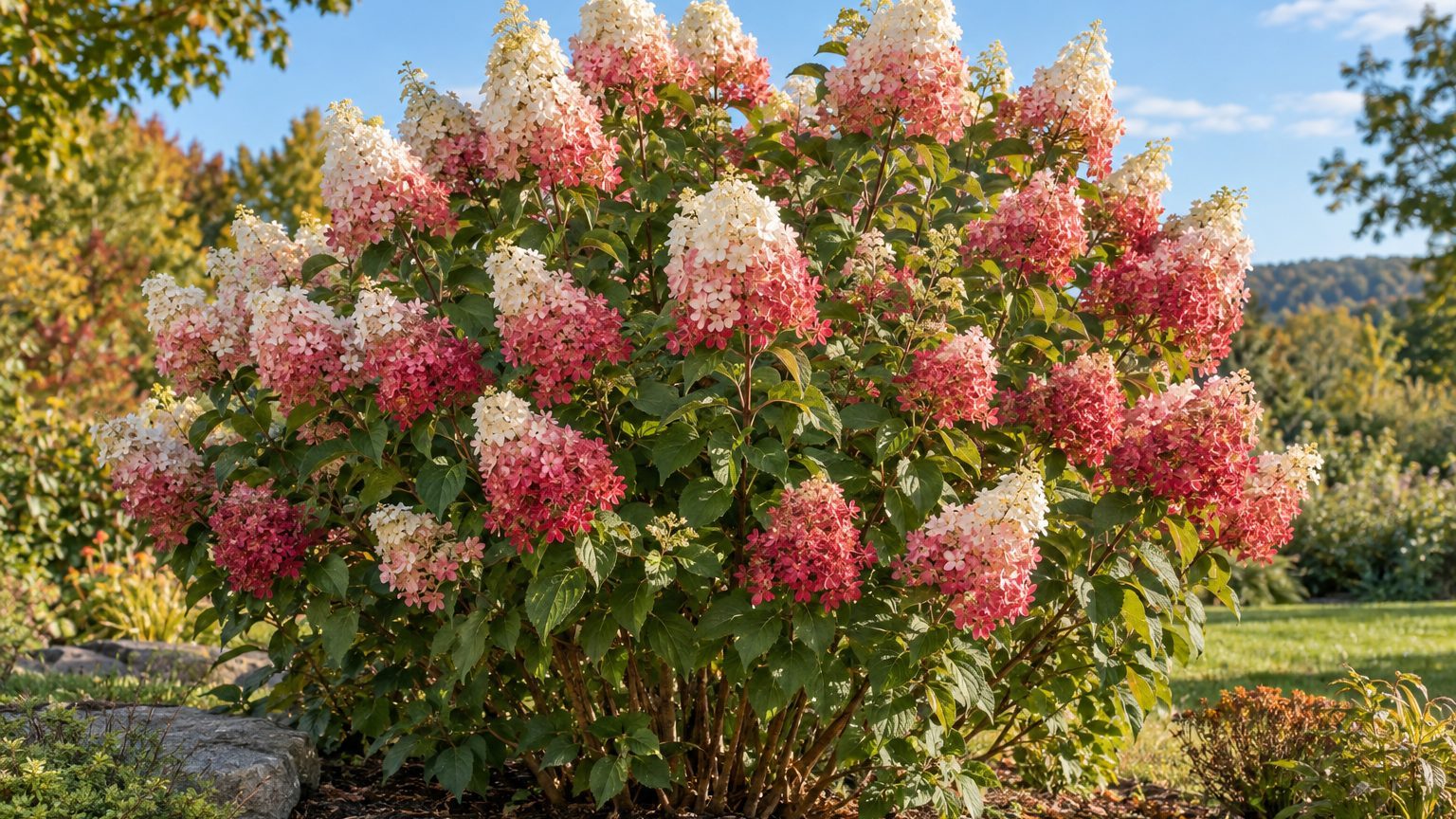
Quick Fire is a panicle hydrangea that opens white in early summer, then blushes pink and deepens toward red as the season runs on. It takes more sun than a bigleaf and blooms on new wood, so a hard winter rarely costs you flowers. What follows tracks the calendar, from planting to the first freeze.
What This Variety Is
Quick Fire is a panicle hydrangea, Hydrangea paniculata, grown as an upright woody shrub with cone-shaped flower clusters. It is sold mainly for one trait: it opens its blooms earlier than most other panicles.
The flowers start white, shift to pink, and finish in a rosy red as nights cool. Because they form on the current year’s growth, pruning timing is forgiving compared with a bigleaf.
Sun is the other difference from a mophead. Panicles like this one want open light, and they take more heat and cold than the bigleaf types sold in spring garden centers.
The plant tag and your state page carry the numbers that matter for your yard.
From the almanac
Hydrangeas in your state
The dates on this page depend on where you live. Your state's page carries its frost dates, its USDA zones and the year laid out month by month.
Northeast
Southeast
- Alabama
- Arkansas
- Delaware
- Florida
- Georgia
- Kentucky
- Louisiana
- Maryland
- Mississippi
- North Carolina
- South Carolina
- Tennessee
- Virginia
- West Virginia
Midwest
Southwest
West
Pacific Northwest
Canada
Where It Grows: Zones and Regions
Panicle hydrangeas are the tough branch of the family, and Quick Fire follows suit. Region by region, the difference is mostly how much heat and how much cold you have to plan around.
- Great Lakes and the North (Michigan, Minnesota, Wisconsin): panicles are the hydrangeas that keep blooming after a brutal winter, since flower buds form on new wood.
- The Northeast (New York, Pennsylvania, Massachusetts): a dependable choice in full sun, with the earliest color of the panicles.
- The South (Georgia, Texas, the Carolinas): summer heat is the test, so give it afternoon shade and steady water.
- The West (Washington, Oregon, Colorado): coastal gardens suit it, while dry inland yards need irrigation to keep the flowers from browning.
The state selector just below this section leads to the page for your state, with local frost dates and the pruning window.
The Year With It, Season by Season
Spring
Quick Fire leafs out later than many shrubs, so a bare-looking plant in April is not dead. Scratch a twig to check for green. Plant into loose soil in full sun, water deeply, and wait for real growth before you judge it.
Early summer
This is the payoff, because it flowers ahead of most other panicles. Blooms open white and start to blush within weeks. Water at the base during dry spells, and compare it with later bloomers in Hydrangea Varieties Compared before adding more shrubs.
Midsummer
Heat pushes the color toward pink and can stress the leaves. Wilting at midday is normal, wilting at dawn is not. Soak the root zone deeply once or twice a week rather than sprinkling daily, and mulch to hold moisture.
Fall
Cooler nights deepen the pink into red, and the dried heads hold their shape. Stop fertilizing so new growth can harden off. Leave the flower clusters on the plant, since they add fall interest and cost you nothing.
Winter
Once the shrub is dormant, pruning is safe because blooms form on the new season’s growth. Cut back in late winter, before buds swell, and shape rather than shear. Your state page gives the window for your area.
Diseases and Pests It Resists
Any claim that it shrugs off mildew, leaf spot, or insects would need a named source, and none is attached here.
The sensible approach is to treat it as a normal landscape shrub. Give it good air movement, water at the soil line rather than over the leaves, and check the foliage every couple of weeks in humid summers.
A comparison table would be empty, so I left it out. Your county extension office can tell you which problems show up on panicle hydrangeas near you, and the other hydrangea kinds are on their own pages.
Where to Plant It in a Yard
Use Quick Fire where it gets open sun and room to fill out, such as a front-yard foundation corner, a property line, or a mixed border. It also works as a low hedge when planted in a row.
- Hydrangea Varieties Compared: side-by-side notes to help you choose between panicles, bigleafs, and the rest.
- Vanilla Strawberry Hydrangea: Size, Zones, Pruning and Care: another panicle with a white-to-pink color change, for a later show.
- Pink Elf Hydrangea: Size, Zones, Pruning and Care: a compact option when the spot is smaller.
Before you dig, open your state page and note the frost dates and pruning window for your area.
Common questions
When does Quick Fire bloom?
It blooms earlier than most panicle hydrangeas, starting in early summer. Exact timing shifts with your climate, so your state page is the better guide for local dates.
When should I prune it?
Prune while the shrub is dormant, in late winter before buds swell. It flowers on new wood, so this cut will not remove the coming season’s blooms.
Why are the flowers turning pink?
That is the variety’s normal color change. Blooms open white, blush pink, and deepen toward red as the season cools. It is not a disease or a nutrient problem.
Sources : gardenia.net