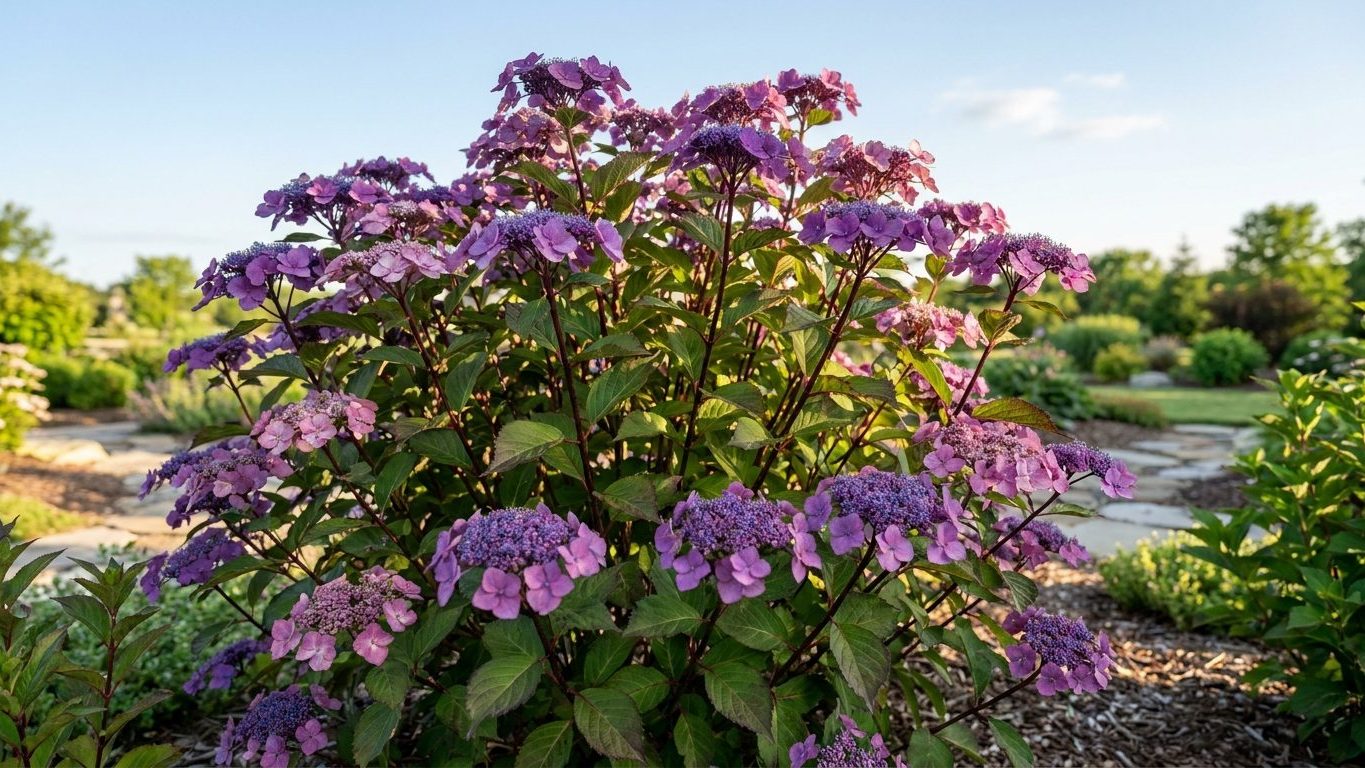
Bloomstruck is a reblooming bigleaf hydrangea that tops out around 3 to 4 feet tall and wide, hardy in USDA zones 4 through 9. It flowers on both old and new wood, so a late frost that nips last year’s buds still leaves a summer show. It takes more sun than most bigleaf types and holds its mophead-lacecap blooms through heat that wilts other hydrangeas.
What This Variety Is
Bloomstruck is a bigleaf hydrangea, Hydrangea macrophylla, bred into the Endless Summer collection for a rounded, mounding habit. It reaches 3 to 4 feet tall and spreads about the same width, smaller than older mophead varieties that can sprawl past 6 feet.
What sets it apart is that it sets flower buds on last season’s stems and on new growth the same year. That double bloom path is why gardeners in colder zones still see color after a hard winter kills the old wood back.
Its flower heads mix mophead and lacecap shapes on the same shrub. Color runs from pink through purple to a deeper red-purple as the soil pH turns more acidic.
The stems run a dark burgundy-red and the leaves pick up a similar wine tone before they drop in fall. That two-tone look, dark stem against green leaf, is one of the easiest ways to spot this cultivar in a nursery row.
From the almanac
Hydrangeas in your state
The dates on this page depend on where you live. Your state's page carries its frost dates, its USDA zones and the year laid out month by month.
Northeast
Southeast
- Alabama
- Arkansas
- Delaware
- Florida
- Georgia
- Kentucky
- Louisiana
- Maryland
- Mississippi
- North Carolina
- South Carolina
- Tennessee
- Virginia
- West Virginia
Midwest
Southwest
West
Pacific Northwest
Canada
Where It Grows: Zones and Regions
NC State Extension Gardener Plant Toolbox lists Bloomstruck hardy from zone 4 through zone 9, a wider spread than the straight bigleaf species usually manages on its own.
- Upper Midwest and Northeast (Minnesota, Wisconsin, Vermont): zone 4 winters kill the old wood most years, so the shrub leans on its new-wood rebloom to flower at all.
- Mid-Atlantic and Ohio Valley (Virginia, Ohio, Kentucky): both wood types usually make it through winter here, which gives two separate waves of bloom in one season.
- Deep South (Georgia, Alabama, Louisiana): zone 8 and 9 heat pushes bloom color toward a deeper purple and shortens the spring flush before summer heat stalls new buds.
- Pacific Northwest (Oregon, Washington): mild, wet winters keep old wood intact most years, so bloom timing tends to run earlier than in colder zones.
The state selector below this section opens straight to the zone map and frost dates for wherever you garden.
The Year With It, Season by Season
Spring
Buds swell on old wood first, and pruning now means cutting live flower buds off the shrub. The safe move is to wait until leaves fully open, then remove only stems that stayed bare and gray.
Early Summer
The old-wood flush opens first, mophead and lacecap heads together, while new stems keep stretching toward the second wave. Deadheading spent blooms back to the first healthy leaf pair pushes the plant toward that second flush.
Midsummer Heat
New-wood buds open through the hottest stretch, and afternoon sun on dry soil scorches leaf edges fast. A 2 to 3 inch mulch ring and deep watering twice a week keep blooms from wilting by midday.
Fall
Bloom slows as stems set next year’s old-wood buds, so this is the wrong season for a hard cutback. Leaves shift toward burgundy before dropping, a color change that signals the shrub is closing out growth for the year.
Winter
Old wood above ground rides out zone 6 through 9 winters intact most years, but zone 4 and 5 cold routinely kills stems back to the base. A 3 to 4 inch mulch layer over the root zone protects the crown so new-wood rebloom still shows up on schedule.
Diseases and Pests It Resists
Bigleaf hydrangeas as a group draw aphids, spider mites, and Japanese beetles, and Bloomstruck is not immune to any of them. NC State Extension Gardener Plant Toolbox notes the species is also prone to leaf spot fungus and powdery mildew in humid, still air.
Deer browse the leaves and flower buds readily, especially on young plants, and the shrub carries no documented resistance to deer pressure. Root rot shows up fast in soil that stays wet, since bigleaf hydrangea roots need drainage more than most shrubs on this list.
| Threat | This one | Source |
|---|---|---|
| Powdery mildew | Susceptible in humid, still air | NC State Extension |
| Leaf spot | Susceptible, worse with overhead watering | NC State Extension |
| Deer browsing | No resistance documented | NC State Extension |
| Aphids and spider mites | Common on new growth | NC State Extension |
Bloomstruck carries no bred-in resistance beyond what the species already has, so the same air circulation and drip irrigation habits that protect any bigleaf hydrangea apply here too.
Where to Plant It in a Yard
Bloomstruck fits a foundation bed, a mixed border, or a spot along a shaded patio where its 3 to 4 foot spread won’t crowd a walkway. Part sun to part shade suits it best, with some cover from hot afternoon sun in zone 8 and 9 gardens.
- Your state page: the frost dates and pruning window that decide when old wood on Bloomstruck is safe to cut.
- Hydrangea pruning guide: the cuts that protect both bloom flushes on rebloomers like this one.
- Which hydrangeas hold up here: a side-by-side of bigleaf, panicle, and smooth types for the same yard.
Common questions
Does Bloomstruck bloom on old or new wood?
Both. It sets buds on stems that survived winter and on new growth the same season, which is why it still flowers after a hard freeze damages the old wood.
How tall does Bloomstruck hydrangea get?
Most plants settle in at 3 to 4 feet tall and about the same width, smaller than older bigleaf mopheads that can reach 6 feet or more.
What zone is best for Bloomstruck hydrangea?
NC State Extension Gardener Plant Toolbox lists it hardy from zone 4 through zone 9, though old wood survives more reliably from zone 6 up.
Sources : pepiniere.ca