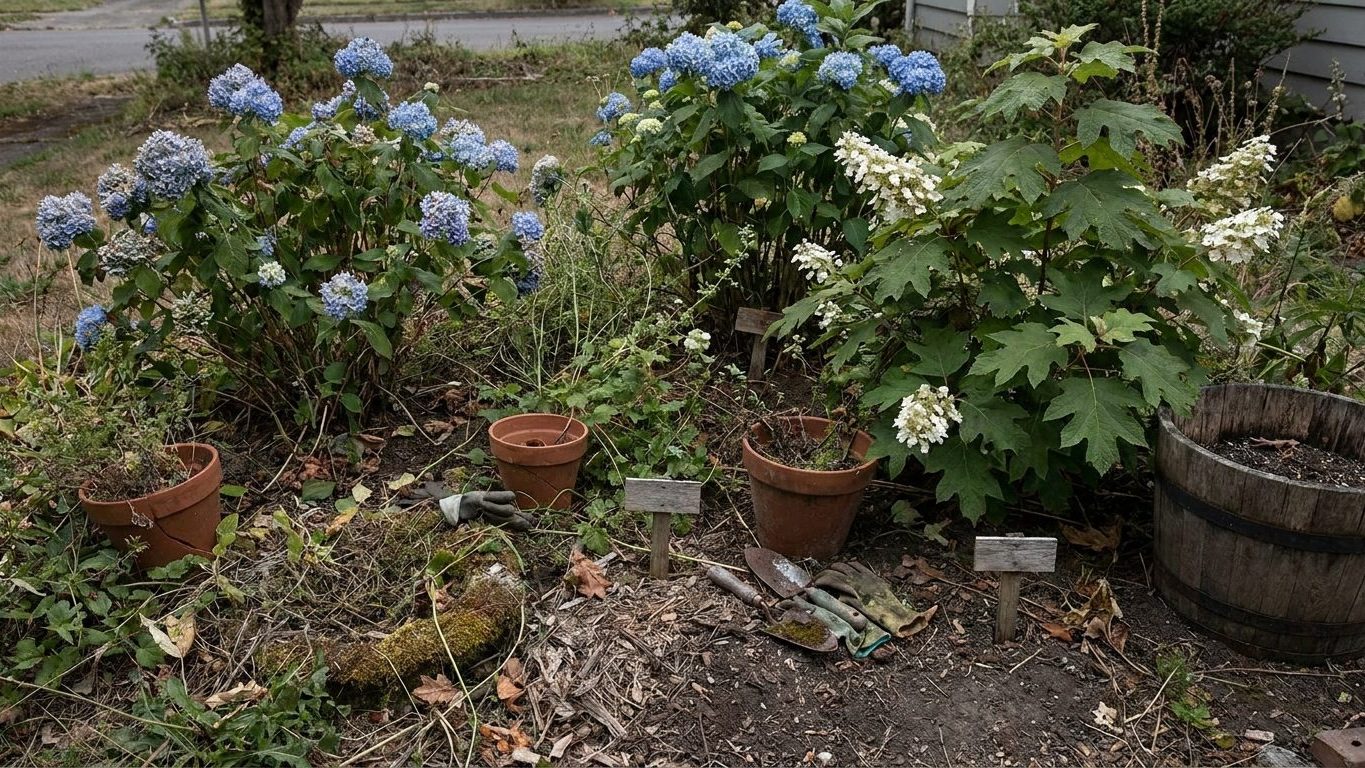
The hydrangea that fits a yard depends less on flower shape and more on two facts: which zone the yard sits in, and whether that shrub blooms on last year’s wood or this year’s growth. Bigleaf wants shade and protects last year’s buds. Panicle takes full sun and forgives a hard cut. The right pick follows those two answers first.
Hydrangeas Varieties: The Short Answer
The right hydrangea for a yard depends on the shrub’s hardiness zone and which wood it flowers on, not on the genus name alone. NC State Extension Gardener Plant Toolbox puts the whole genus at USDA zones 3a through 9b, but that spread hides real differences by type.
Panicle hydrangeas tolerate zone 3a and take full sun. Bigleaf hydrangeas need zone 6a or warmer and want shade from afternoon sun.
Only bigleaf and mountain hydrangeas shift color with soil pH. The other types stay white, cream, pink or green no matter what the soil measures.
The state selector below this section opens the page tuned to a reader’s own zone, frost dates and pruning window. That page turns this national range into one answer for one yard.
From the almanac
Hydrangeas in your state
The dates on this page depend on where you live. Your state's page carries its frost dates, its USDA zones and the year laid out month by month.
Northeast
Southeast
- Alabama
- Arkansas
- Delaware
- Florida
- Georgia
- Kentucky
- Louisiana
- Maryland
- Mississippi
- North Carolina
- South Carolina
- Tennessee
- Virginia
- West Virginia
Midwest
Southwest
West
Pacific Northwest
Canada
Hydrangeas Varieties, Step by Step

Matching a hydrangea to a yard follows a short sequence, done in order.
- Check the zone first: NC State Extension Gardener Plant Toolbox lists panicle hardy from zone 3a and bigleaf only from zone 6a, so a cold yard rules out bigleaf right away.
- Read the light next: panicle is the only type here that takes full sun well, while bigleaf, oakleaf, mountain and climbing hydrangeas want dappled or partial shade.
- Decide on bloom wood: bigleaf, oakleaf, mountain and climbing hydrangeas set buds on last year’s wood, so a hard prune or a late frost erases that year’s flowers.
- Match size to the space: panicle can reach 25 feet, oakleaf tops out near 5 feet, and climbing hydrangea needs a wall or trellis since it clings by aerial rootlets.
- Test the soil before a bigleaf goes in: a pH below 5.5 pushes blooms toward blue and above 6.5 toward pink, a step that does nothing for panicle, smooth, oakleaf or climbing types.
- Plan the mulch ring: bigleaf and panicle are both shallow-rooted, so a mulch layer protects roots through summer heat and winter swings.
None of these steps sets a pruning date for a specific state. Those windows shift by zone and appear on the reader’s own state page, further along this cocoon.
Hydrangeas Varieties by Hydrangea Type
Five kinds show up most often in home yards, and each one answers to a different clock.
NC State Extension Gardener Plant Toolbox puts bigleaf at 6a to 11b on old wood, while panicle runs 3a to 8b on new wood, close to opposite ends of the genus.
| Kind | Flowers on | USDA zones | Sun |
|---|---|---|---|
| Bigleaf | Last year’s wood | 6a–11b | Dappled or partial shade |
| Panicle | Current season’s growth | 3a–8b | Full sun |
Smooth, oakleaf, mountain and climbing hydrangeas are on their own pages, since the source doesn’t give a zone range or a sun requirement for them here.
Hydrangeas Varieties: Mistakes That Cost a Season
No flowers on a healthy shrub

Bigleaf, oakleaf, mountain and climbing hydrangeas set buds on last year’s wood, so a late prune removes next year’s flowers before they open. NC State Extension Gardener Plant Toolbox recommends pruning bigleaf before August 1, and the same old-wood rule applies to the other three.
Blue flowers fading to pink

High-phosphorus fertilizer locks aluminum in the soil, and that shift pushes blue bigleaf blooms toward pink even when the pH reads acid. Switching to a low-phosphorus feed, and checking pH on its own, keeps the color decision with the soil instead of the feeding schedule.
Coffee grounds instead of soil test

Coffee grounds and citrus peel are widely believed to turn blooms blue, but the pH shift they cause is small, and the flower actually needs available aluminum, not just acidity. A soil test, followed by aluminum sulfate on bigleaf or mountain types only, moves color reliably where the kitchen remedy falls short.
Hydrangeas Varieties in Your State
Zone, frost date and pruning window all vary by state, so the genus-level range here can’t set a mounding depth or a calendar date for one particular yard.
- Your state page: the frost dates and the pruning window where you live.
- Which types hold up here: a shortlist matched to your zone, drawn from the ranges above.
- Local extension office: a soil test and a second opinion on pH and aluminum before changing bloom color.
Common Questions
Which hydrangea variety is hardiest?
Smooth hydrangea, the type that includes Annabelle, is the hardiest of the genus and flowers on new growth, so a late frost doesn’t erase the season’s blooms.
Can any hydrangea turn blue with soil treatment?
No. Only bigleaf and mountain hydrangeas shift color with pH, moving toward blue below about pH 5.5 and toward pink above about pH 6.5. Panicle, smooth, oakleaf and climbing hydrangeas stay white, cream, pink or green regardless of soil.
Are hydrangeas toxic to pets?
Only bigleaf hydrangea is documented toxic, and only if large quantities are eaten, causing nausea, stomach pain, vomiting and sweating in cats, dogs and horses, according to NC State Extension Gardener Plant Toolbox.