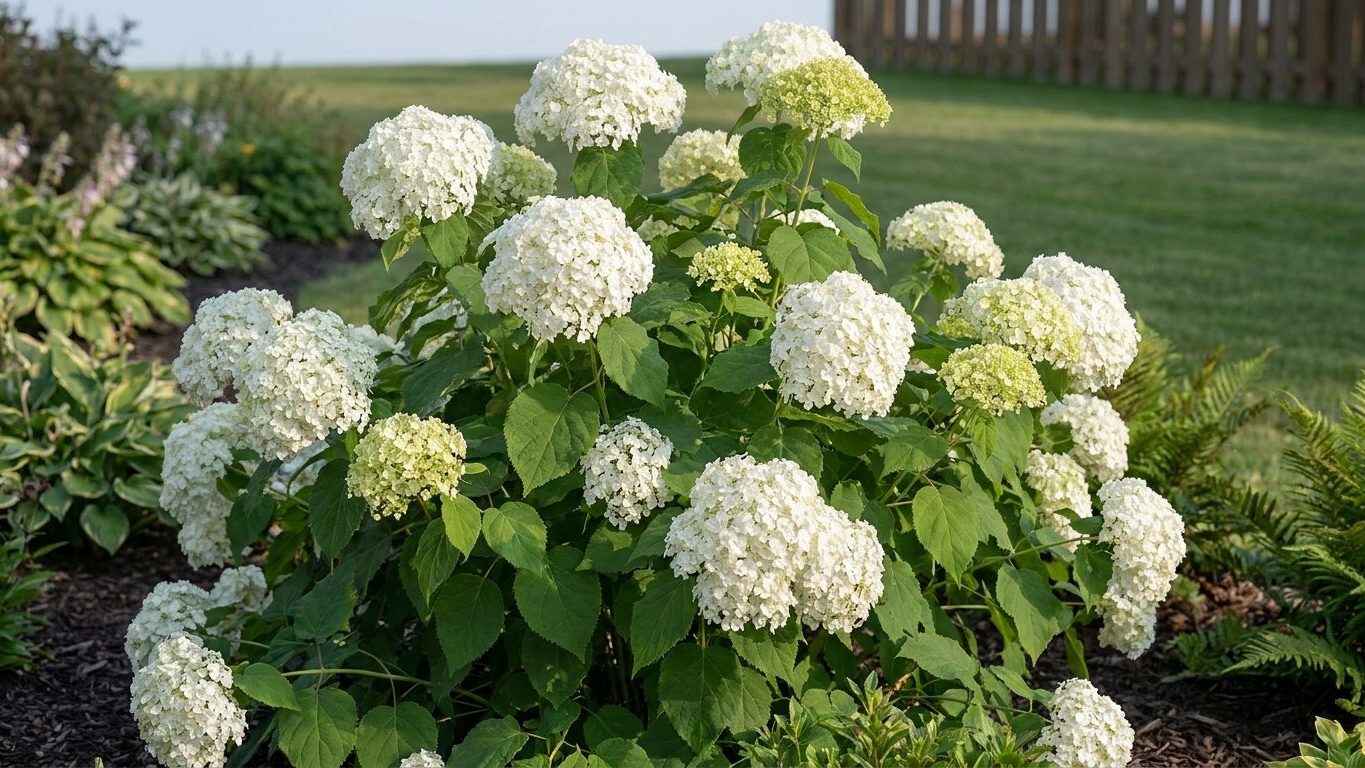
Annabelle hydrangea is a smooth hydrangea (Hydrangea arborescens) that grows 3 to 5 feet tall, holds up through USDA zones 3 to 9, and flowers on new wood, which means the hard prune happens in late winter rather than being skipped to protect old stems. Its white, mophead blooms open in early summer and keep their shape into fall.
What This Variety Is
Hydrangea arborescens ‘Annabelle’ is a smooth hydrangea native to eastern woodlands, not a bigleaf or panicle type. Missouri Botanical Garden Plant Finder puts it at USDA zones 3 to 9, a wider range than most mophead hydrangeas sold at garden centers.
It grows 3 to 5 feet tall and spreads about the same, forming a rounded mound rather than a tall hedge. Its white flower heads can reach up to 12 inches across, among the largest blooms in the genus.
The trait that sets it apart: it flowers on new wood, the growth it puts out each spring. That single fact decides how and when I cut it back, and it is the opposite of what bigleaf owners are told to do.
Left alone for a few seasons, the stems thin out and the heavy flower heads flop over after rain. That habit is common enough to the cultivar that many growers pick a stiffer-stemmed selection instead.
From the almanac
Hydrangeas in your state
The dates on this page depend on where you live. Your state's page carries its frost dates, its USDA zones and the year laid out month by month.
Northeast
Southeast
- Alabama
- Arkansas
- Delaware
- Florida
- Georgia
- Kentucky
- Louisiana
- Maryland
- Mississippi
- North Carolina
- South Carolina
- Tennessee
- Virginia
- West Virginia
Midwest
Southwest
West
Pacific Northwest
Canada
Where It Grows: Zones and Regions
USDA zone 3 covers cold like International Falls, Minnesota, and Annabelle takes that cold without the dieback that flattens many other hydrangeas. Missouri Botanical Garden Plant Finder lists its hardy range up through zone 9, which reaches Gulf Coast heat near Baton Rouge, Louisiana.
- Great Lakes and the North (Michigan, Minnesota, Wisconsin): winters this cold kill the top growth of many hydrangea types, but since Annabelle blooms on new wood, it flowers again from the base every year without fail.
- Mid-Atlantic and Northeast (Pennsylvania, Virginia, New York): humid summers push bacterial leaf spot and mildew, so morning sun with afternoon shade keeps the foliage drier through the growing season here.
- The South (Georgia, Louisiana, the Carolinas): zone 9 heat near the coast calls for **part shade** and steady moisture, or the blooms fade fast and the leaf edges scorch by midsummer.
- Midwest and Plains (Iowa, Kansas, Nebraska): swings between hard winters and dry summer wind ask for a spot out of prevailing gusts, since the stems and the heavy flower heads bend easily.
- Pacific Northwest (Oregon, Washington): mild, wet summers suit the plant well, and the bigger challenge there tends to be deer pressure rather than heat or drought.
Your state page, reached through the selector below, sets the frost dates and the exact pruning window for where you garden, since a March freeze in Minnesota falls weeks apart from one in Georgia.
The Year With It, Season by Season
Planting
Set new plants out in spring or fall once the soil is workable, spacing them 3 to 5 feet apart to match their mature spread. Water deeply through the first growing season while the roots establish, since a young Annabelle stresses fast in dry soil.
Spring Growth

This is the pruning window: cut stems back to 12 to 18 inches, or all the way to the ground, before new growth hardens off. Because flowers form on this new wood, a late prune still leaves enough of the season for buds to develop.
Bloom
Flower heads open in early summer and can reach the full 12 inches the cultivar is known for, holding white through the first weeks. Heavy rain bends the stems under that weight, so a ring support set early in the season keeps the mound upright.
Summer Heat
In zone 7 and warmer, afternoon sun can scorch leaf edges and shorten how long each flower head holds its color. Consistent moisture through July and August matters more here than fertilizer, since drought stress shows up in the blooms within days.
Fall
Flower heads age from white to a papery tan and hold their shape well into the season rather than dropping. I leave mine standing instead of cutting for a vase, since the seed heads add structure and feed birds once other perennials fade.
Winter
Because it blooms on new wood, dieback on the top growth over winter does not cost next year’s flowers the way it would on a bigleaf hydrangea. The plant rests below ground and pushes fresh stems again once soil temperatures climb in spring.
Diseases and Pests It Resists
Annabelle carries the same general toughness the species is known for, and disease is rarely the reason a healthy plant declines. Missouri Botanical Garden Plant Finder lists no serious insect or disease problems for this cultivar, a rare note in the hydrangea group.
The exceptions show up in wet, humid summers: bacterial leaf spot and powdery mildew can mark the foliage, though they rarely kill an established shrub. Deer tend to leave it alone more than they leave bigleaf types, which helps in yards edged by woods.
| Threat | This one | Source |
|---|---|---|
| Bacterial leaf spot | Occasional in humid summers | Missouri Botanical Garden Plant Finder |
| Powdery mildew | Occasional, rarely fatal | Missouri Botanical Garden Plant Finder |
| Deer browsing | Generally resistant | Missouri Botanical Garden Plant Finder |
| Serious insect pests | None documented | Missouri Botanical Garden Plant Finder |
Threats common to bigleaf and oakleaf hydrangeas, like aphids or Japanese beetle damage, are not called out for this smooth hydrangea specifically. The other kinds are on their own pages.
Where to Plant It in a Yard
Give it part shade in hot climates and morning sun further north, in soil that holds moisture but drains. It works as a low hedge, a foundation planting, or a mass near a patio where the white blooms show up at dusk.
- Your state page: the frost dates and the exact pruning window where you live.
- Which hydrangeas hold up here: a comparison of smooth, bigleaf, panicle, and oakleaf types by zone.
- Pruning by type: the old-wood versus new-wood rule explained for each hydrangea in the collection.
Check the state selector below before the first hard prune of the season, since that single date shifts by weeks between the Gulf Coast and the northern Plains.
Common questions
Does Annabelle hydrangea need full sun?
It tolerates more sun than bigleaf types but still does best with some afternoon shade in zone 7 and warmer, where full sun can scorch the leaf edges by midsummer.
Why did my Annabelle hydrangea not bloom?
Since it flowers on new wood, a poor bloom season usually traces back to a late hard freeze after pruning, deep shade, or a prune so hard it left no time to build flower buds before summer.
Can I cut Annabelle hydrangea to the ground?
Yes, cutting it back to 12 to 18 inches, or to the ground, in late winter is standard for this cultivar and will not cost you flowers the way it would on a bigleaf hydrangea.
Sources : plantfinder.mobot.org | mckaynursery.com | gardenia.net