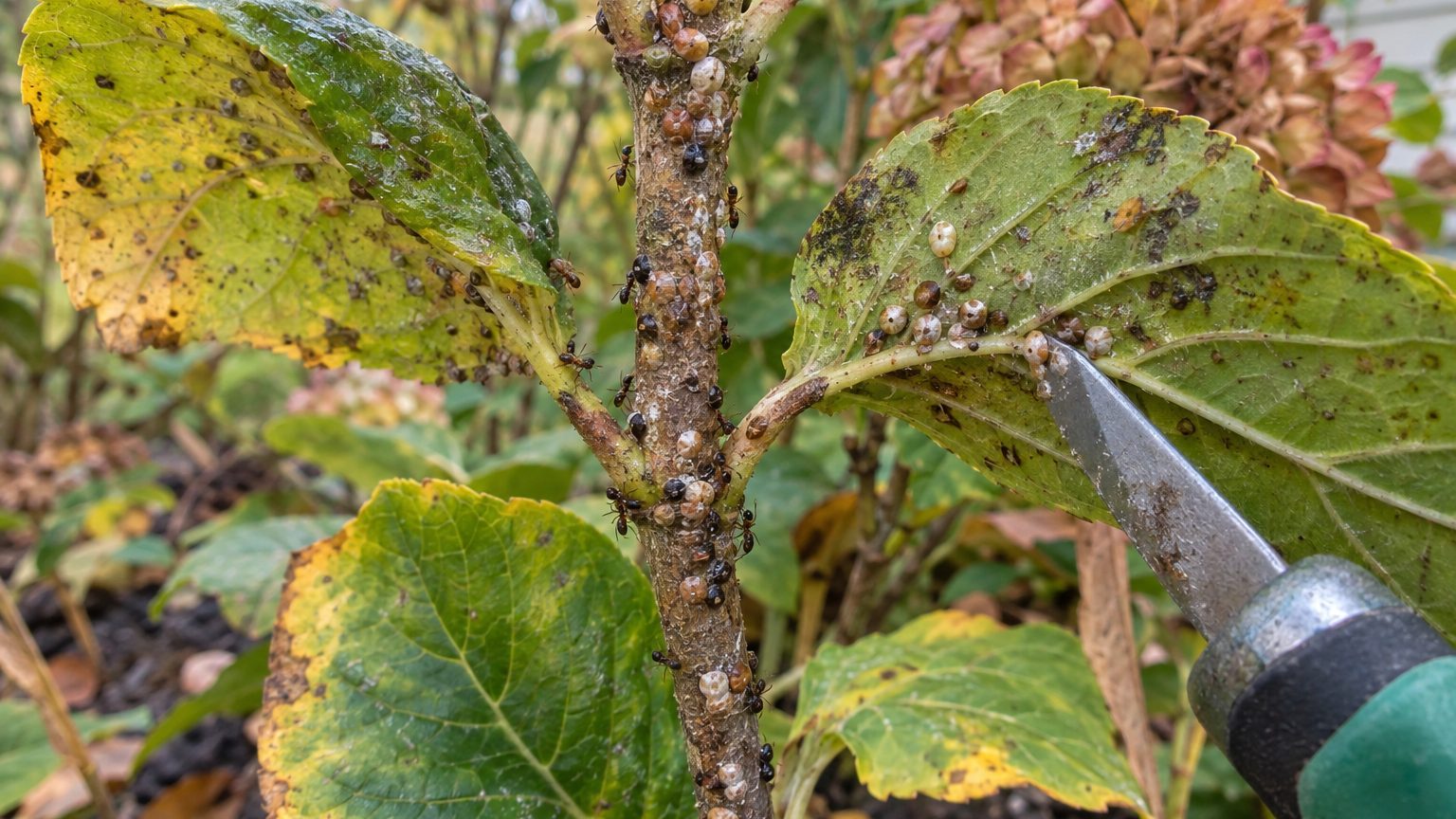
Scale insects on hydrangeas look like small, hard bumps stuck to stems and leaf undersides, and they never move. Scrape one with a fingernail to confirm. A few can be rubbed off or pruned out this week. A heavy infestation calls for a spray your state extension service says is registered locally.
Scale Insects: What You See

The NC State Extension Gardener Plant Toolbox lists scales among hydrangea pests and calls them rarely a problem, so I check for these signs before blaming them:
- Small bumps on stems, flat or domed, tan, brown or whitish, fixed in place like a scab.
- More bumps along the veins on the underside of leaves.
- Sticky, shiny leaves, sometimes with a dark film on top.
- Ants climbing the stems, drawn by the sticky residue.
- Weak growth, yellowing leaves or one stem that dies back.
The sticky leaves show in the growing season, while bare winter stems make the bumps easiest to see. Scrape one bump with a fingernail: if it lifts off as a tiny shell, it is scale.
From the almanac
Hydrangeas in your state
The dates on this page depend on where you live. Your state's page carries its frost dates, its USDA zones and the year laid out month by month.
Northeast
Southeast
- Alabama
- Arkansas
- Delaware
- Florida
- Georgia
- Kentucky
- Louisiana
- Maryland
- Mississippi
- North Carolina
- South Carolina
- Tennessee
- Virginia
- West Virginia
Midwest
Southwest
West
Pacific Northwest
Canada
Scale Insects or Something Else?
Several hydrangea troubles get mistaken for scale. The NC State Extension Gardener Plant Toolbox names aphids and mites among the pests and powdery mildew among the diseases, and each gives itself away differently.
Scale sits still and stays attached. Anything that crawls when brushed, spins fine web or rubs away as powder belongs in the table below.
| Looks like | The sign that tells them apart |
|---|---|
| Aphids: soft bugs clustered on new growth | They are soft-bodied and move when brushed, leaving pale cast skins instead of hard, fixed shells. |
| Mites: dusty, stippled, faded leaves | Fine webbing on leaf undersides, and specks that walk when you tap a leaf over white paper. |
| Powdery mildew: white patches on leaves | The coating wipes off as powder, and nothing hard sits underneath. |
The other kinds are on their own pages. Ragged, chewed edges point to Foliage-Feeding Caterpillars on Hydrangeas, mites have Spider Mites on Hydrangeas, and the full list sits at Hydrangea Pests.
What Causes Scale Insects, and Where It Is Worst
Scale insects are sap feeders, and the NC State Extension Gardener Plant Toolbox lists them among hydrangea pests that are rarely a problem in a genus spanning USDA zones 3a through 9b. It publishes no map of hot spots, so I read the type and the stress.
- Great Lakes and the North (Michigan, Minnesota, Wisconsin): panicle, rated 3a to 8b, and smooth types carry the cold, and winter injury is the strain I would rule out first.
- The South (Georgia, Texas, the Carolinas): bigleaf is rated 6a to 11b and needs protection from afternoon sun, so a mop-head baking against a hot wall is the plant I would inspect.
- Mid-Atlantic and Northeast (New York, Pennsylvania, Virginia): oakleaf and mountain types join the mix, both flowering on old wood, and the source ties no scale problem to any of them.
- The dry interior and West (Colorado, Utah, California): the source accepts soil pH from below 6.0 to above 8.0, so alkaline ground is not the worry, but dry stress on shallow-rooted bigleaf or panicle is.
The page for your state turns these ranges into a verdict for your zone and type.
How to Treat Scale Insects
Start this week with the gentlest step and move up only if the bumps keep coming back.
- Confirm with a scrape: a bump that lifts off as a separate shell is scale, while powder or webbing means something else.
- Rub off small colonies: a soft brush or a rag clears scattered bumps from a stem without harming the bark.
- Cut out crusted stems: prune back to clean wood and bag the cuttings, but on bigleaf, mop-head and lacecap remove only what is heavily coated, because buds formed last summer ride on old wood.
- Cut a panicle back hard: it flowers on the current season’s growth, so a late-winter cut removes the infested stems and costs no bloom.
- Ask your state extension service: it alone knows which sprays are registered where you live, so follow the label and skip anything it does not list.
- Check the same stems again: run a fingernail over them after treatment, since survivors stay put and are easy to find.
I name no product on purpose. Registration varies from state to state, and a spray that is legal in one may not be in the next.
How to Prevent Scale Insects Coming Back
The NC State Extension Gardener Plant Toolbox rates hydrangea maintenance as low, and a few dated habits keep it that way:
- Winter: go over the bare stems for bumps, when nothing hides them.
- Late winter: cut panicle back hard, but leave bigleaf alone, since its buds sit on last year’s wood.
- Spring: lay mulch, because bigleaf and panicle are both shallow-rooted and benefit from it.
- Summer: shield bigleaf from afternoon sun, since a scorched plant is a stressed one.
- Growing season: flip a few leaves each time you water and look along the veins.
- Fall: rake up fallen leaves, then cut dead hollow stems to 12 to 24 inches and leave them standing.
Those standing stems are where native bees nest, so the last step feeds the yard as well.
Where this comes from
The plant descriptions, hardiness ranges and pest list here come from the NC State Extension Gardener Plant Toolbox entry for Hydrangea. That source names scales, aphids, nematodes and mites, and calls them rarely a problem.
How scale looks and behaves is general field knowledge, not a figure from that entry. Before you spray anything, check with your state’s cooperative extension service, which knows what is registered and which types suit your zone.
Common questions
Are scale insects a serious problem for hydrangeas?
Rarely. A handful of bumps is a scrape-and-prune job. A shrub coated from base to tip deserves a call to your county extension office.
Will pruning get rid of scale on my hydrangea?
It removes the stems the insects live on, but timing depends on type. A panicle tolerates a hard late-winter cut, while bigleaf carries next year’s buds on old wood, so cut only what is coated.
Which spray should I use?
I cannot name one, because registration differs by state. Your state cooperative extension service lists what is allowed on ornamentals where you live, and the product label has the final word.