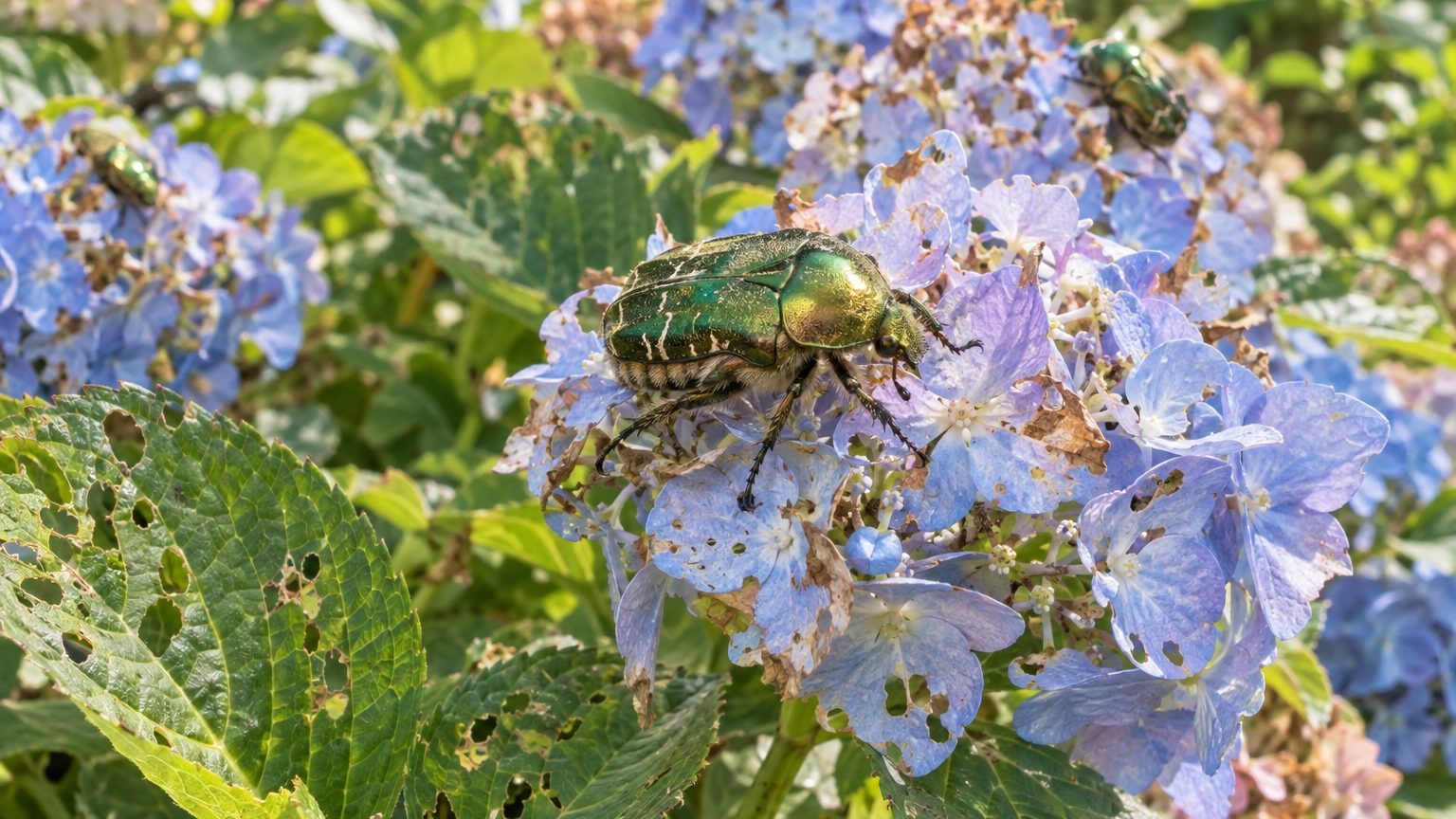
Chewed blooms and ragged leaves on a hydrangea in early summer, with slender tan beetles crowding the flowers, point to rose chafer. Hand-picking in the morning and covering the blooms will get you through a season, and your state extension service can say what is registered locally. For the wider picture, see Hydrangea Pests.
Rose Chafer: What You See

The NC State Extension Gardener Plant Toolbox lists aphids, scales, nematodes and mites for hydrangea and calls them rarely a problem, so rose chafer is something you confirm by eye. Here is what to look for:
- A slender, pale tan beetle with long, spindly legs, sitting on the flowers.
- Petals and sepals full of ragged holes, blooms browning before they should.
- Leaves chewed into lace, with the veins left standing.
- Several beetles on one flower head, dropping or flying off when you jostle the shrub.
- Damage that shows up when the blooms open, not before.
Exact timing shifts from state to state, so watch your own shrub rather than a calendar page.
From the almanac
Hydrangeas in your state
The dates on this page depend on where you live. Your state's page carries its frost dates, its USDA zones and the year laid out month by month.
Northeast
Southeast
- Alabama
- Arkansas
- Delaware
- Florida
- Georgia
- Kentucky
- Louisiana
- Maryland
- Mississippi
- North Carolina
- South Carolina
- Tennessee
- Virginia
- West Virginia
Midwest
Southwest
West
Pacific Northwest
Canada
Rose Chafer or Something Else?
Chewed hydrangeas rarely come with a name tag. Several other visitors leave holes, sticky leaves or ragged stems, and the fix differs for each. The NC State Extension Gardener Plant Toolbox names deer among the things that damage hydrangeas, and browsing is what I check for first.
A single sign usually settles it. Look at the insect itself, then at the pattern of the damage.
| Looks like | The sign that tells them apart |
|---|---|
| Deer browsing | Torn, jagged ends on whole shoots, with no beetles anywhere on the plant. |
| Scale insects | Small bumps stuck to the stems that do not move when you brush them. |
| Aphids | Tiny soft insects packed in clusters on new growth, with sticky leaves below. |
Mites and nematodes are also on the source’s list, though neither leaves beetle-style holes. Details are on the pages for Scale Insects on Hydrangeas and Root-Knot Nematodes on Hydrangeas.
What Causes Rose Chafer, and Where It Is Worst
The beetles that chew your blooms grew up underground as grubs, so they tend to come from nearby lawn or loose, sandy beds. The NC State Extension Gardener Plant Toolbox puts panicle hydrangea at USDA 3a to 8b and bigleaf at 6a to 11b, and it does not map this beetle.
- Great Lakes and the North (Michigan, Minnesota, Wisconsin): panicle and smooth hydrangeas carry the load here, and sandy lawn soil is worth checking first.
- The Mid-Atlantic and Ohio Valley (Pennsylvania, New Jersey, Ohio): bigleaf and panicle both fit, so mixed plantings can have two blooming windows for beetles to find.
- The South (Georgia, Texas, the Carolinas): bigleaf, oakleaf and panicle are all grown, and the source accepts clay, loam or sand, so soil type will not protect you.
How heavy the beetle pressure runs in your county is a question for the page for your state and your extension office.
How to Treat Rose Chafer
Start this week with steps that cost nothing and harm nothing else in the bed. Keep in mind which hydrangea type you grow, because that decides how you handle damaged flowers later.
- Confirm the beetle: check the shrub at dawn and match what you find against the table above before doing anything else.
- Hand-pick into soapy water: go out in the cool morning when they are slow, and repeat daily while they keep arriving.
- Cover the flower heads: fine netting or floating row cover over the blooms keeps beetles off, and you can lift it for a look each morning.
- Leave the pruning alone: a bigleaf forms its buds the previous summer, so cutting hard now removes next year’s flowers, while a panicle can wait for late winter.
- Ask your extension office: only your state service knows which products are registered where you live, and what rate and timing they allow.
I skip product names on purpose. Labels and legal uses vary by state, and a wrong pick can hurt the bees that visit hydrangea blooms.
How to Prevent Rose Chafer Coming Back
Prevention follows the year. A few dated habits leave the beetles less to work with and make the next season easier to read.
- Late winter: on panicle hydrangeas, cut back hard before growth starts, since they flower on the current season’s growth and recover fast.
- Early spring: refresh mulch, because bigleaf and panicle are both shallow-rooted and benefit from it.
- Before bloom: set up netting and start morning checks so you catch the first beetles rather than the fiftieth.
- After bloom: clip off the chewed flower heads on types that bloom on new wood, and leave old-wood types to their own schedule.
- Autumn: leave hollow stems standing at 12 to 24 inches, since the NC State Extension Gardener Plant Toolbox notes native bees nest in them until they break down.
None of this removes grubs from a neighbor’s lawn, but it keeps your own shrubs from becoming the easiest meal on the block.
Where this comes from
The beetle notes are field guidance and should be checked.
Before you buy anything or change a routine, confirm with your state’s cooperative extension service. They know your local beetle timing and what is legal to use.
Common questions
Will rose chafer kill my hydrangea?
The damage I see described is mostly to flowers and foliage, not the whole plant. Even so, a heavily chewed shrub is a good reason to start morning checks and netting right away.
Are the beetles or my hydrangea dangerous to pets?
Only bigleaf hydrangea is documented as toxic, and only when large quantities are eaten. Dogs, cats and horses can be affected, with nausea, vomiting and sweating. Keep soapy pick-up jars out of reach too.
Should I cut off chewed flowers right now?
It depends on the type. Bigleaf sets buds on last year’s wood, so a heavy cut takes next year’s blooms. Panicle and smooth flower on new wood and tolerate more, but check your state page for timing.