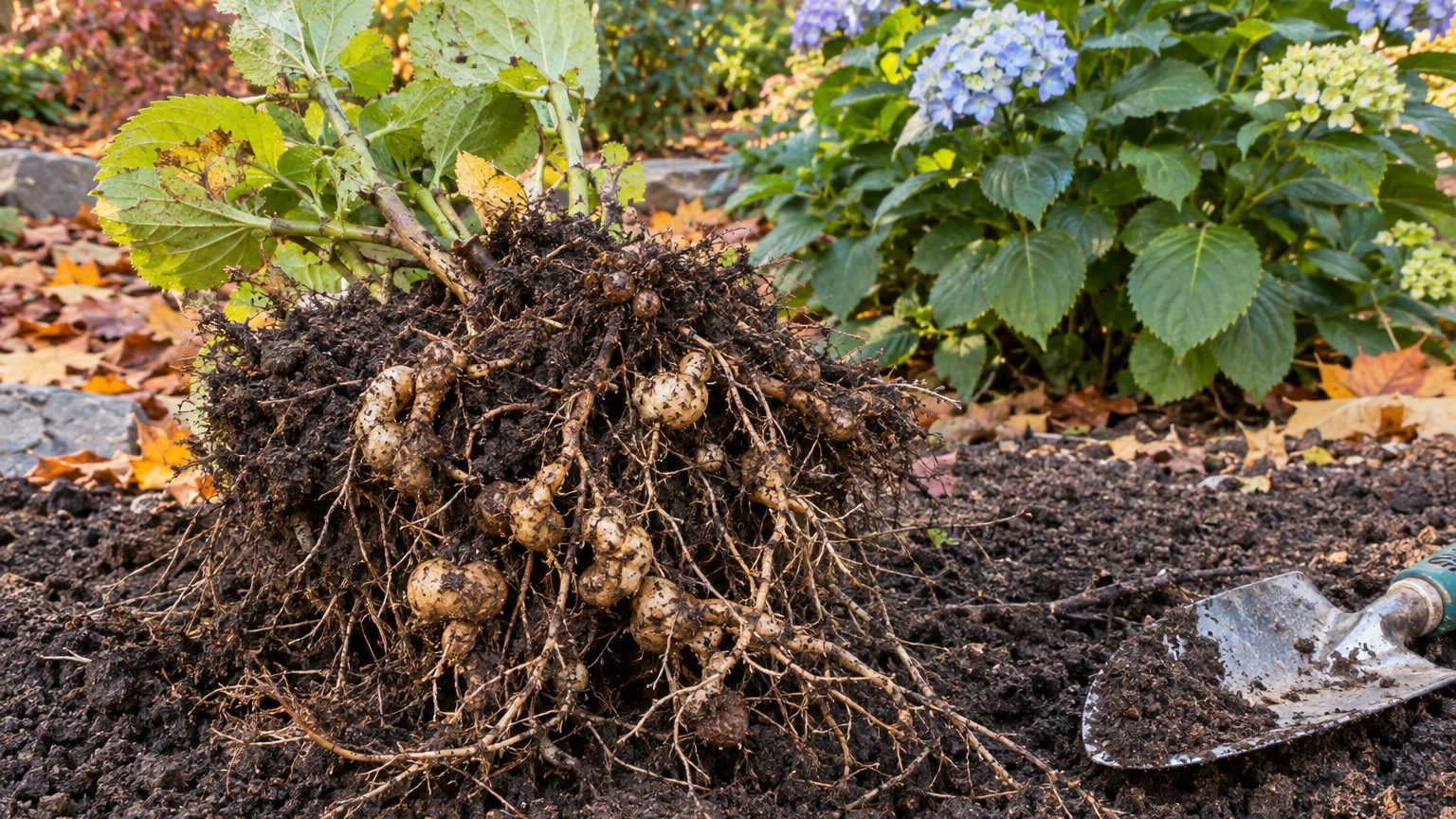
Root-knot nematodes are microscopic worms that live in soil and feed on roots. On a hydrangea they leave one signature you can check with a trowel: knotted swellings along the fine roots. They are among the less common hydrangea troubles, so confirm before you spend money. Dig one plant and look, because the leaves alone can mislead you.
Root-Knot Nematodes: What You See

The worms feed inside the root and choke off water and nutrients, so the signs above ground read as thirst. NC State Extension Gardener Plant Toolbox lists nematodes among hydrangea pests and calls them rarely a problem, so slow, careful looking beats alarm.
- Knots on the roots: firm, rounded swellings along the fine roots that stay fixed when you rub them.
- Pale, yellowing leaves that never quite green up, even after feeding.
- Stunted growth, with fewer and smaller shoots than a healthy plant of the same type nearby.
- Leaves that droop in afternoon heat while the soil below is still moist.
- A patchy pattern, with one corner of the bed declining and the rest holding steady.
- Symptoms that sharpen in the warm months, when the plant asks the most of its roots.
No single sign proves anything. Knots plus a patchy decline make a strong case for sending a sample to your state lab.
From the almanac
Hydrangeas in your state
The dates on this page depend on where you live. Your state's page carries its frost dates, its USDA zones and the year laid out month by month.
Northeast
Southeast
- Alabama
- Arkansas
- Delaware
- Florida
- Georgia
- Kentucky
- Louisiana
- Maryland
- Mississippi
- North Carolina
- South Carolina
- Tennessee
- Virginia
- West Virginia
Midwest
Southwest
West
Pacific Northwest
Canada
Root-Knot Nematodes or Something Else?
Yellow leaves and wilting have a dozen causes, and most of them have nothing to do with worms. NC State Extension Gardener Plant Toolbox names bacterial wilt and leaf spot among hydrangea diseases, and it says bigleaf should be protected from afternoon sun.
So the leaves are a poor witness. The roots decide, and one quick dig sorts out most of the confusion.
| Looks like | The sign that tells them apart |
|---|---|
| Bacterial wilt | The roots are free of knots. Look for wilting that spreads through the plant instead of staying in one patch of the bed. |
| Leaf spot | Spots mark the leaf blades themselves, and the roots come up clean and pale when you dig. |
| Afternoon sun stress on bigleaf | Leaves recover by evening or after shade is added, and the roots show no swellings. |
Chewing damage is another story, and it has its own pages: Foliage-Feeding Caterpillars on Hydrangeas and Rose Chafer on Hydrangeas. Nematodes never chew a leaf.
What Causes Root-Knot Nematodes, and Where It Is Worst
The cause is a soil-dwelling roundworm that enters young roots and triggers the swellings. NC State Extension Gardener Plant Toolbox rates panicle at USDA 3a to 8b and bigleaf at 6a to 11b, and it lists nematodes as rarely a problem without drawing any map.
- Great Lakes and the North (Michigan, Minnesota, Wisconsin): panicle and smooth are the usual choices, and sandy patches in a bed deserve a root check first.
- The South (Georgia, Texas, the Carolinas): bigleaf and oakleaf grow here, and warm soil is where these worms are generally most active.
- Mid-Atlantic and Midwest (Virginia, Ohio, Pennsylvania): types overlap, so a root check matters more than a regional guess.
Your zone and hydrangea type set the rest of the answer, and your state page carries them. The Hydrangea Pests page sets nematodes beside the other pests the source names.
How to Treat Root-Knot Nematodes
NC State Extension Gardener Plant Toolbox puts hydrangea maintenance at low, and the response here should stay just as measured: confirm first, then act.
- Dig one plant, not the bed: lift a small shovel of soil near the edge of the root zone and rinse a few fine roots.
- Send a sample to your state lab: your county extension office can tell you how to bag it and where it goes.
- Water evenly at the base: the source accepts occasional wet soil but wants good drainage, so avoid both soaking and drought.
- Remove plants past saving: bag the roots and the soil around them, and keep them out of the compost pile.
- Ask about registered products: only your state extension service knows what is approved where you live.
- Hold off on replanting: leave that hole alone until extension tells you what to do next.
Skip the garden-center shelf for now. Registered products differ from state to state, and a wrong guess costs a season.
How to Prevent Root-Knot Nematodes Coming Back
NC State Extension Gardener Plant Toolbox notes that bigleaf and panicle are both shallow-rooted and benefit from mulch, which shapes most of the prevention below.
- Dormancy: inspect the roots of anything you lift or divide, since this is the one calm window to see them.
- Planting: slide the plant out of its pot and check the fine roots for knots before it goes in the ground.
- Spring: lay mulch over the shallow root zone to hold moisture steady as growth starts.
- Summer: water at the base, and give bigleaf shade from the afternoon sun.
- Propagation: take stem cuttings or layers only from plants with healthy roots.
- Fall: clean your tools and clear debris after working around a suspect plant.
None of it takes much time, and every step also helps against the diseases the source names.
Where this comes from
NC State Extension Gardener Plant Toolbox names nematodes among hydrangea pests and calls them rarely a problem.
Confirm any diagnosis and any treatment with your state’s extension service before you act. It alone knows what is registered where you garden.
Common questions
Are root-knot nematodes common on hydrangeas?
The source lists nematodes among hydrangea pests but calls them rarely a problem. Check the roots before you blame them.
Does a wilting hydrangea mean nematodes?
Not by itself. Afternoon sun on bigleaf and bacterial wilt both cause wilting. Knots on the fine roots are the sign that separates nematodes from the rest.
Does my hydrangea type change the answer?
The root check is the same for every type. Hardiness, pruning and flowering differ a lot by type, so read your state page for your zone.