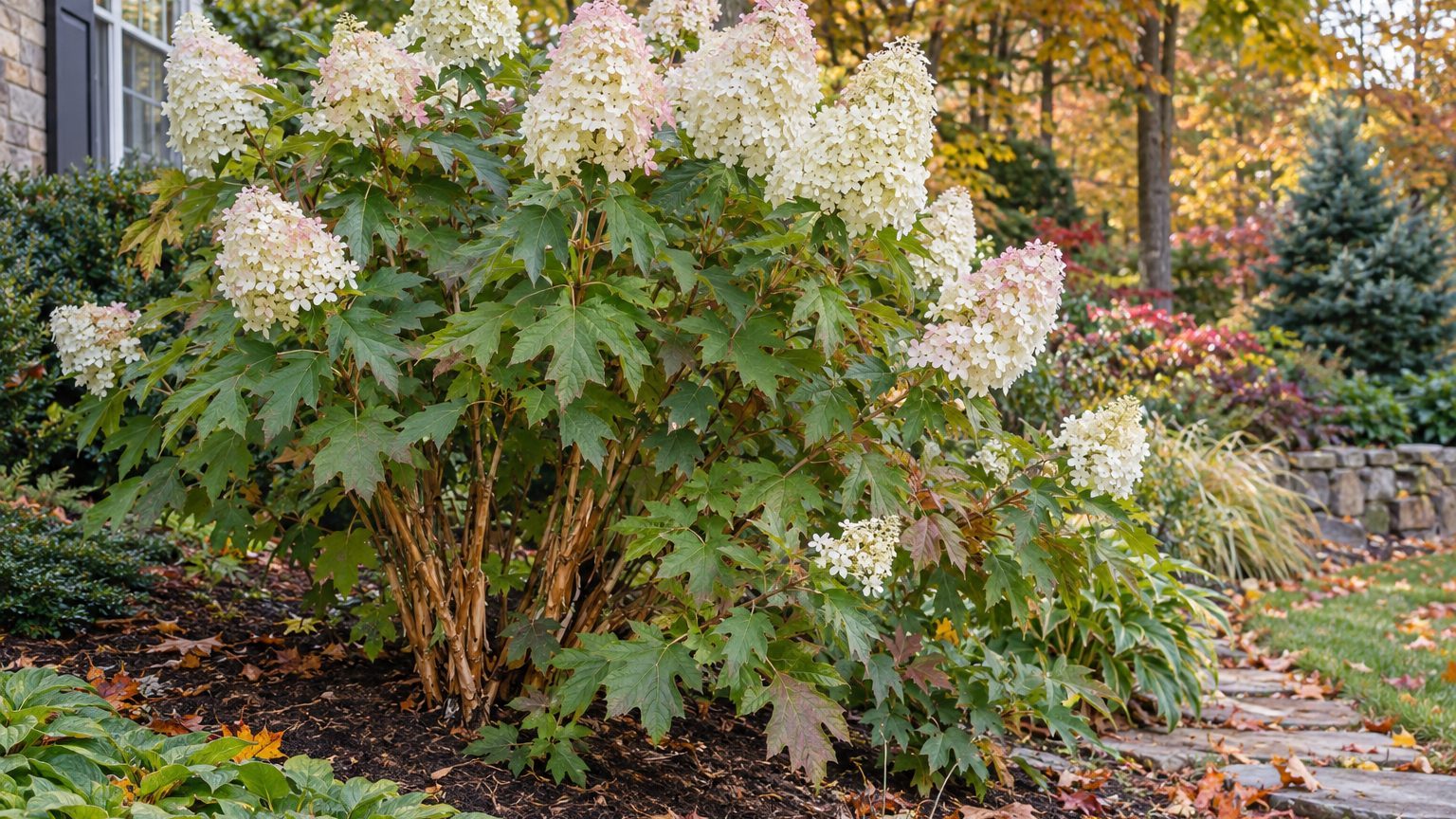
Snow Queen hydrangea is an oakleaf hydrangea, a deciduous shrub with lobed leaves and upright white flower clusters. It blooms on old wood, so a badly timed trim is the usual reason for a flowerless summer. Part shade and well-drained soil suit it best. What follows runs in the order of the year, from planting to winter.
What This Variety Is
Snow Queen is a named cultivar of Hydrangea quercifolia, the oakleaf hydrangea native to the Southeast. It grows as a mounded, multi-stemmed deciduous shrub, not a vine and not a tree.
What sets it apart from a bigleaf is the leaf and the bloom. The foliage is deeply lobed like an oak’s, and the flowers open as upright white cones that slowly fade toward pink.
Two more traits matter in a yard: peeling bark that shows once the leaves drop, and burgundy fall color. The shrub earns its space in every season, not only in summer.
Mophead and panicle hydrangeas follow different pruning rules. Snow Queen follows its own, tied to the old wood that carries its flower buds.
From the almanac
Hydrangeas in your state
The dates on this page depend on where you live. Your state's page carries its frost dates, its USDA zones and the year laid out month by month.
Northeast
Southeast
- Alabama
- Arkansas
- Delaware
- Florida
- Georgia
- Kentucky
- Louisiana
- Maryland
- Mississippi
- North Carolina
- South Carolina
- Tennessee
- Virginia
- West Virginia
Midwest
Southwest
West
Pacific Northwest
Canada
Where It Grows: Zones and Regions
Oakleaf types come from the Southeast, and that shapes where Snow Queen is easy and where it takes some work.
- The South and Southeast (Georgia, Alabama, the Carolinas): home ground, best with morning sun and afternoon relief from the heat.
- Mid-Atlantic and Midwest (Pennsylvania, Ohio, Illinois): usually dependable, though a hard cold snap can damage flower buds on exposed stems.
- Great Lakes and the far North (Michigan, Minnesota, Wisconsin): borderline, so choose a sheltered spot or lean toward a panicle type instead.
- Texas and the dry Southwest (East Texas, Arizona, Nevada): it wants steady moisture, so East Texas can work while desert gardens struggle.
- The Pacific Coast (Oregon, Washington, northern California): mild winters and cool summers generally suit it.
The state selector just below this section leads to the page for your state, with the hardiness range and dates for where you live.
The Year With It, Season by Season
Planting
Roots settle best in cool, moist soil, so plant in fall or early spring rather than midsummer. Set the crown level with the ground, pick a spot with morning sun, and mulch the root zone. Your state page gives the planting window for where you live.
Spring
Flower buds overwinter on last year’s stems, so cutting early removes the summer show. Wait for leaves to open, then scratch the bark: green underneath means the stem is alive. Feed lightly and check your state page for the last-frost date.
Summer
White cones open early in the season and slowly turn pink. Prune right after the flowers fade, and only to shape or to remove spent stems, since next year’s buds follow. Water deeply in dry spells, because afternoon wilting means the roots want more.
Fall
Leaves turn burgundy and bronze as nights cool, and that color is the reward for leaving the shrub alone. Skip fall pruning, which strips buds. Rake leaves off the crown, but keep a layer of mulch over the roots.
Winter
Bare stems show the peeling bark, which is half the reason to grow it. In colder states, mulch the base and hold off on pruning so buds survive. Trim freeze-damaged stems after leaf-out, and check your state page for frost dates.
Diseases and Pests It Resists
I won’t claim it shrugs off any single disease or pest.
What holds for any hydrangea is practical: morning sun, good airflow, and watering at the base keep leaves drier. Treat spotting as a cue to check drainage and spacing before reaching for a spray.
The other hydrangea kinds are on their own pages, including Glowing Embers Hydrangea: Size, Zones, Pruning and Care.
Where to Plant It in a Yard
Plant it at the back of a shade border or along a foundation that gets morning sun, where the lobed leaves and winter bark can be seen. Give it room to mound and keep the root zone uncrowded.
- Hydrangea Varieties Compared: mophead, panicle and oakleaf types set side by side, useful before you buy.
- Cityline Paris Hydrangea: Size, Zones, Pruning and Care: another hydrangea profile to weigh against this one for the same bed.
- Your state page: the frost dates and the pruning window where you live. Open it from the state selector and write the dates on your calendar.
Common questions
When should I prune Snow Queen hydrangea?
Right after the flowers fade in summer, and lightly. Buds for next year form soon afterward on the new growth, so pruning in fall, winter or early spring removes flowers.
Does Snow Queen hydrangea need shade?
Morning sun with afternoon shade is the safest setup, especially in the South. Farther north it tolerates more sun, provided the soil stays evenly moist.
Why is my Snow Queen not blooming?
The common causes are a late trim that removed the buds, a hard freeze that damaged them, or too much shade. Look at when you last pruned first, since that is the most frequent culprit.
Sources : springmeadownursery.com | rhs.org.uk | plumlinenursery.com