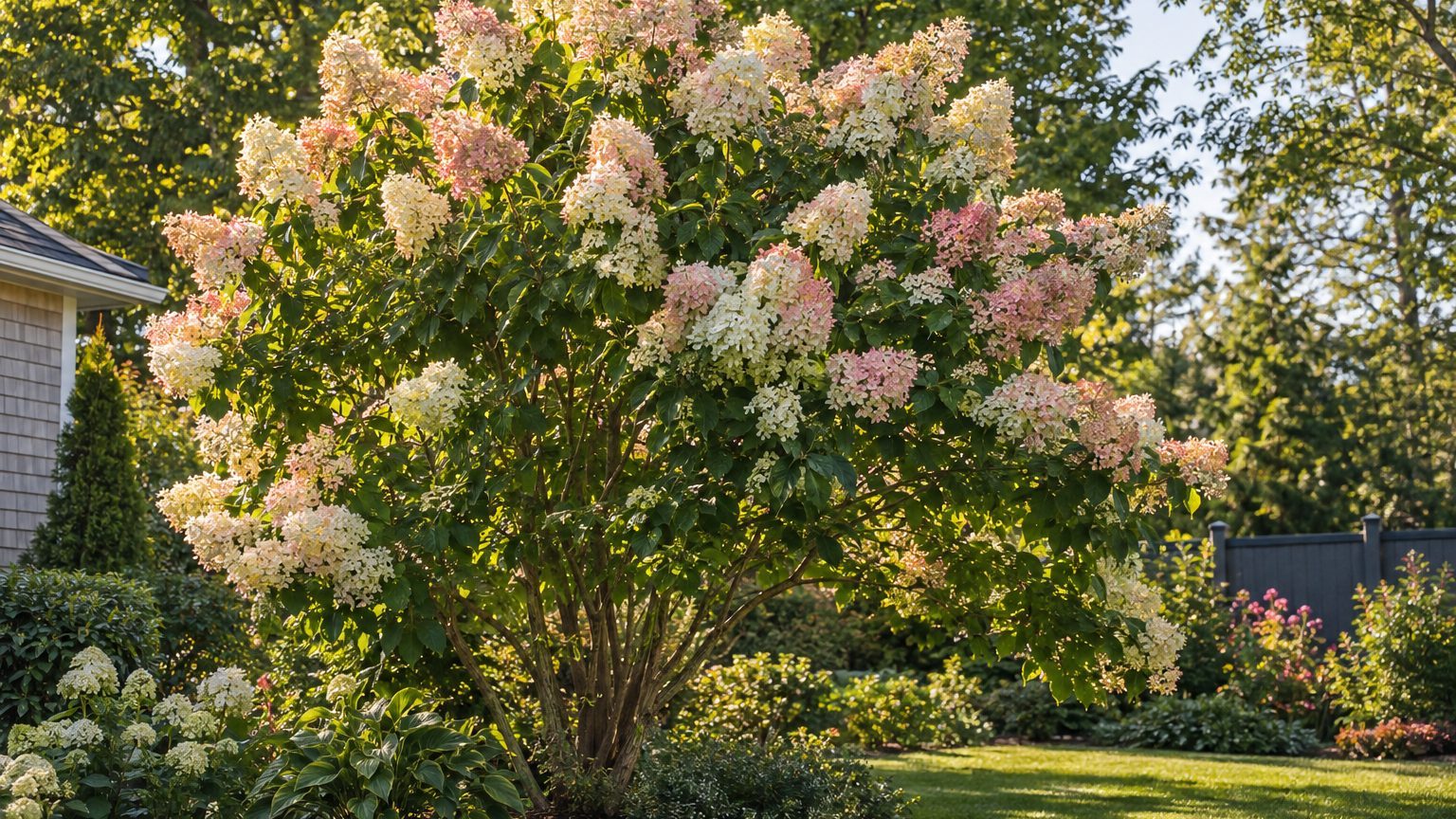
Pee Gee hydrangea is Hydrangea paniculata ‘Grandiflora’, a panicle type that survives colder winters and takes more sun than almost any other hydrangea sold in US nurseries. It grows 10 to 20 feet tall as a shrub or small tree, blooms white through summer on new wood, and asks for almost no disease spray once it’s past its first two years in the ground.
What This Variety Is
Pee Gee hydrangea is the old nickname for Hydrangea paniculata ‘Grandiflora’, a panicle type grown as a large shrub or trained as a small tree. Missouri Botanical Garden’s Plant Finder lists panicle hydrangea, the group Pee Gee belongs to, at USDA zones 3 to 8.
The flower heads open white in mid to late summer, then age to pink and bronze as the season turns. A mature plant reaches 10 to 20 feet tall in shrub form, taller when limbed up into a single trunk.
Three things set it apart from other hydrangeas in a yard:
- It blooms on new wood, the growth made that same spring, not on last year’s stems.
- It tolerates more sun and more cold than bigleaf or oakleaf types.
- It can be trained as a small flowering tree, something few other hydrangeas allow.
The bloom-on-new-wood habit is the one fact that decides how and when you prune it. Cut it back hard in late winter and it still flowers that summer.
From the almanac
Hydrangeas in your state
The dates on this page depend on where you live. Your state's page carries its frost dates, its USDA zones and the year laid out month by month.
Northeast
Southeast
- Alabama
- Arkansas
- Delaware
- Florida
- Georgia
- Kentucky
- Louisiana
- Maryland
- Mississippi
- North Carolina
- South Carolina
- Tennessee
- Virginia
- West Virginia
Midwest
Southwest
West
Pacific Northwest
Canada
Where It Grows: Zones and Regions
Panicle hydrangea is the toughest common hydrangea type, and Pee Gee carries that toughness into states where bigleaf hydrangea would freeze back every winter. Missouri Botanical Garden’s Plant Finder places panicle hydrangea at USDA zones 3 to 8, wider than any other type sold in most nurseries.
- Great Lakes and the North (Michigan, Minnesota, Wisconsin): it survives the zone 3 winters that International Falls, Minnesota sees most years, and it still flowers because the buds form on the current season’s growth, made well after the last hard freeze.
- Northeast and Mid-Atlantic (New York, Pennsylvania, Virginia): zone 5 to 6 conditions here suit it well, with a long bloom that runs from midsummer into fall and almost no winter dieback on established plants.
- The South (Georgia, Texas, the Carolinas): it handles the zone 7b to 8a heat that Atlanta, Georgia gets, though panicles open and brown faster in that warmth, and afternoon shade helps hold their color longer.
Above zone 8, along the Gulf Coast and through peninsular Florida, the shrub lives on but blooms less heavily, and gardeners there often get a better show from other panicle cultivars or from oakleaf hydrangea instead.
The state selector below this section leads to the exact frost dates and pruning window for where you garden.
The Year With It, Season by Season
Pee Gee follows the panicle hydrangea calendar, not the reblooming schedule of a modern bigleaf variety, and each stage below shapes how heavy the bloom turns out that year.
Planting
Set new plants out in spring or early fall, giving roots time to establish before the first freeze or before summer heat arrives. Water deeply through the first year, since a young Pee Gee without an established root system wilts fast during a dry week.
Spring
New growth starts once nights stay reliably above freezing, and this is the only pruning window the plant gets each year. Cut stems back to two or three buds before that growth begins, because this summer’s flowers form on whatever grows after the cut.
Summer
Panicles open white through the hottest stretch of the year and hold for weeks rather than fading in days like many perennials do. Full sun keeps the stems sturdy, while part shade in the warmest states slows the color from bleaching out by midsummer.
Fall
Flowers age from white to pink and then to a papery bronze that many gardeners leave standing through the cooler months. Cooling nights drive that color shift, not the soil, so it runs on the same schedule from a zone 3 yard down to a zone 8 one.
Winter
Stems and dried flower heads stay upright through snow load better than most garden shrubs, since panicle wood is stiffer than bigleaf or smooth hydrangea wood. No wrapping or mulch over the crown is needed once a plant is past its first two winters in the ground.
Diseases and Pests It Resists
Pee Gee carries a reputation as one of the lower-maintenance hydrangeas, and most of that reputation comes down to what it doesn’t catch. Clemson Cooperative Extension’s Home & Garden Information Center lists panicle hydrangea as having few serious pest or disease problems compared with bigleaf types.
Deer browse it less than they do bigleaf hydrangea, though a hungry herd in a dry year will still take a pass at new growth. Powdery mildew and leaf spot show up occasionally in wet, crowded plantings but rarely do lasting damage.
| Kind | Flowers on | USDA zones | Sun |
|---|---|---|---|
| Panicle (Pee Gee) | New wood | 3 to 8 | Full sun to part shade |
| Bigleaf | Old wood, mostly | 6 to 9 | Part shade |
| Smooth (Annabelle type) | New wood | 3 to 9 | Full sun to part shade |
The other kinds each carry their own tolerance and problem list, covered on their own pages, but few match Pee Gee for staying clean once it’s settled into full sun.
Where to Plant It in a Yard
Give Pee Gee room to become a small tree or a wide shrub, not a foundation plant kept tidy at three feet. It works well as a lawn specimen, a property-line hedge, or a trained standard by a front door.
- Your state page: the frost dates and the pruning window for where you live.
- Which hydrangeas hold up here: a side-by-side of panicle, bigleaf, smooth, and oakleaf for your zone.
- Hydrangea pruning by type: the old-wood versus new-wood cut, explained for each kind.
Plant it where a six-foot spread won’t crowd a walkway, then check your state page before the first cut.
Common questions
Does Pee Gee hydrangea bloom on old or new wood?
New wood. Buds form on the growth made that same spring, which is why a hard prune in late winter doesn’t cost you that year’s flowers.
How tall does Pee Gee hydrangea get?
Missouri Botanical Garden’s Plant Finder puts panicle hydrangea, the type behind Pee Gee, at 10 to 20 feet as a shrub, taller when trained to a single trunk as a small tree.
Can Pee Gee hydrangea change color like bigleaf hydrangea?
No. Its shift from white to pink to bronze comes from the flowers aging as nights cool, not from soil pH, so aluminum sulfate or lime won’t change the shade.
Sources : gardeningknowhow.com