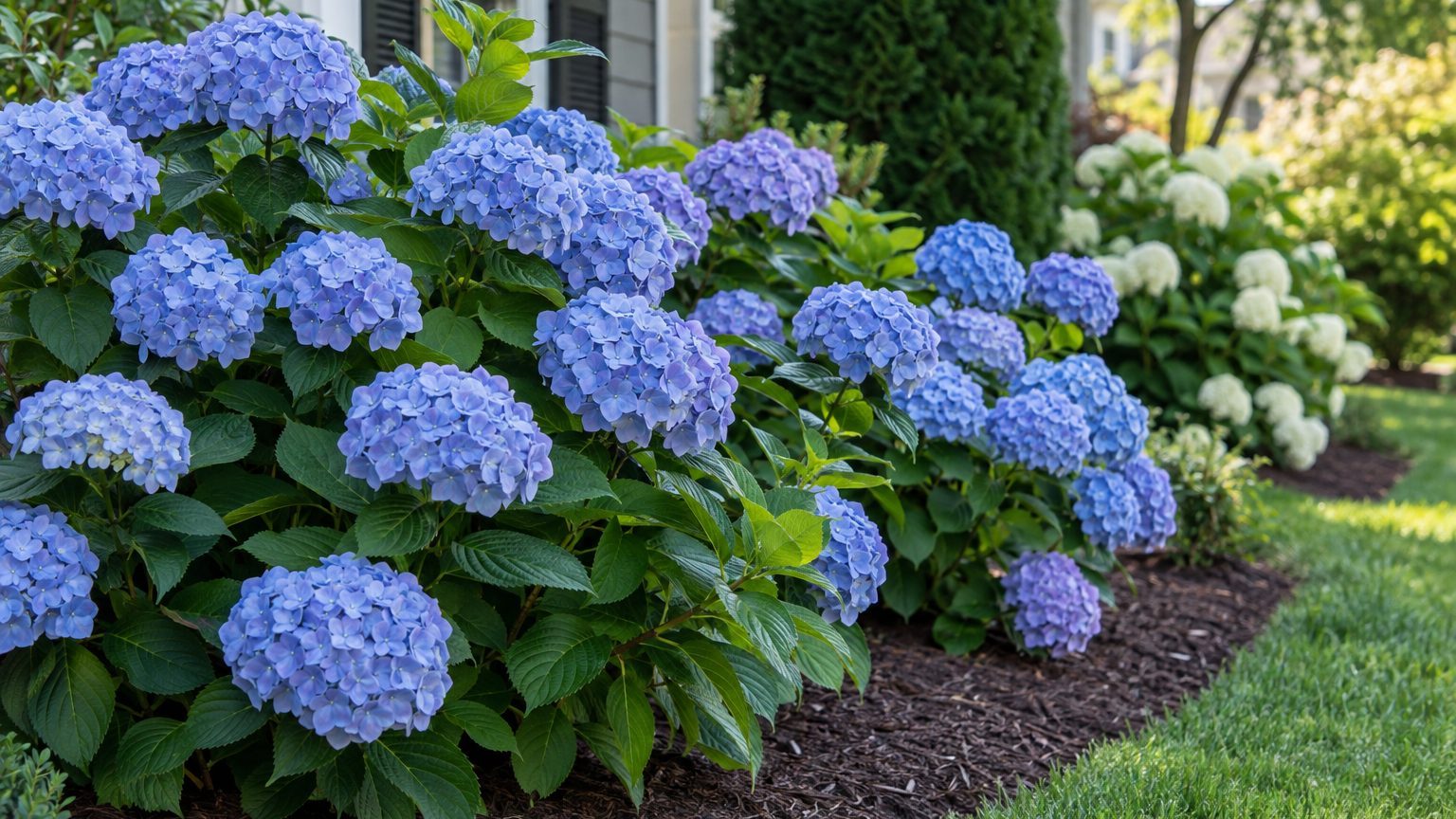
Masja is a dwarf mophead cultivar of Hydrangea macrophylla, bred to stay under 3 feet while opening the same red-to-blue flowerheads as full-size bigleaf hydrangeas. It suits small beds, containers, and foundation plantings in USDA zones 6a to 9b, and it blooms on last year’s wood, which decides both when to prune and why some plants skip a season.
What This Variety Is
Masja belongs to Hydrangea macrophylla, the bigleaf hydrangea family grown across the South and mid-Atlantic for its rounded mophead blooms. NC State Extension Gardener Plant Toolbox lists the species at zones 6a to 9b, and Masja stays inside that range at a compact size.
Full-size bigleaf types can reach 6 feet, but Masja tops out near 2 to 3 feet tall and wide. That makes it a dwarf form bred for small beds and pots, not the open border.
Flowers open red to pink in alkaline soil and shift toward purple or blue as soil turns acidic, the same pH response every bigleaf hydrangea shows. Masja blooms on old wood, meaning this year’s flowers set on stems grown last season.
That old-wood habit is the detail that decides pruning timing and explains a shrub that looks healthy but skips a bloom. It also separates Masja from panicle or smooth hydrangeas, which flower on new wood instead.
From the almanac
Hydrangeas in your state
The dates on this page depend on where you live. Your state's page carries its frost dates, its USDA zones and the year laid out month by month.
Northeast
Southeast
- Alabama
- Arkansas
- Delaware
- Florida
- Georgia
- Kentucky
- Louisiana
- Maryland
- Mississippi
- North Carolina
- South Carolina
- Tennessee
- Virginia
- West Virginia
Midwest
Southwest
West
Pacific Northwest
Canada
Where It Grows: Zones and Regions
NC State Extension Gardener Plant Toolbox places bigleaf hydrangea, and Masja with it, at zones 6a to 9b, a range that spans most of the country east of the Rockies plus the Pacific Northwest.
Inside that range, the same shrub behaves differently depending on how cold the winter gets and how hot the summer runs.
- The Northeast and Mid-Atlantic (Pennsylvania, Virginia, Maryland): gardens near Harrisburg sit close to zone 6a, where a hard freeze can kill the old-wood buds that carry next year’s flowers.
- The South and Gulf Coast (Georgia, Texas, the Carolinas): winter cold is rarely the problem, but full sun near Atlanta scorches leaves by midsummer without afternoon shade.
- The Pacific Northwest (Oregon, Washington): mild winters and steady rain near Portland suit Masja well, with less dieback than gardens further east see.
- The upper zone 9 edge (Florida, coastal Texas): heat and humidity push against the limit, and afternoon shade becomes non-negotiable rather than optional.
Outside 6a to 9b, winter kill or summer stress becomes routine rather than occasional, which is why the state selector below this section matters more than the national range. It leads to the frost dates and pruning window for wherever you garden.
The Year With It, Season by Season
Planting
Set Masja out in spring after the last frost, in a spot with morning sun and afternoon shade, and water it deeply for two to three weeks. Container plants establish fastest when the soil stays evenly moist through that stretch.
Spring growth
New leaves push out quickly, but the flower buds already sit inside stems grown the previous year. A late freeze that nips new growth rarely kills the shrub, though it can damage buds already set for that year’s bloom.
Bloom
Mophead flowers open in early to midsummer, red to pink in alkaline soil and blue to purple in acidic soil. Deadhead spent blooms right after they fade rather than waiting, since that is also the safe pruning window.
Summer heat
Afternoon sun scorches leaf edges fast once temperatures climb, especially in southern gardens near Atlanta. A layer of mulch over the root zone and steady watering keep the shrub from wilting hard in the heat.
Fall
Growth slows as the shrub sets next year’s flower buds on this season’s new stems, so pruning now removes wood that would bloom next summer. Leave spent flowerheads in place instead of cutting them back.
Winter
Zone 6 gardens near Harrisburg see old-wood buds most at risk from a hard freeze, and a loose mulch layer over the root zone helps buffer the cold. Zone 9b gardens rarely need this step at all.
Diseases and Pests It Resists
Masja carries the same disease profile as other bigleaf hydrangeas rather than a resistance bred into the cultivar itself. Humid summers bring leaf spot and powdery mildew more often than any pest problem.
Deer browse the leaves and flower buds readily, and aphids show up on new growth in spring, but neither one is usually fatal to an established shrub.
| Threat | This one | Source |
|---|---|---|
| Leaf spot | Common in humid, low-airflow summers | — |
| Powdery mildew | Shows up on crowded plantings | — |
| Deer browsing | Leaves and buds eaten readily | — |
| Aphids | Cluster on new spring growth | — |
Root rot from soggy soil is a bigger risk than any insect on this list, so the fix is usually drainage and spacing rather than a spray. Panicle and smooth hydrangeas carry their own separate risk profiles on their own pages.
Where to Plant It in a Yard
Masja’s small size makes it a foundation plant, a container specimen, or a low hedge along a walkway rather than a centerpiece for open lawn space. It needs morning sun and afternoon shade almost everywhere it grows.
- Your state page: the frost dates and the pruning window for wherever you live.
- Which ones hold up here: how Masja compares to other bigleaf cultivars in your climate.
- Hydrangea variety pages: panicle and smooth types for yards outside the 6a to 9b range.
Pair it with ferns or hostas that share the same shade and moisture, then check your state page before the first hard freeze of the year.
Common questions
Does Masja hydrangea bloom on new or old wood?
Old wood. Flower buds form on stems grown the previous year, which is why pruning right after bloom, not in fall or spring, protects next year’s flowers.
How big does Masja hydrangea get?
Most plants settle around 2 to 3 feet tall and wide, making it one of the more compact bigleaf cultivars for small beds or containers.
What zones can Masja hydrangea survive in?
It holds up in zones 6a to 9b. Gardens at the cold edge, like those near Harrisburg, risk losing flower buds to a hard freeze even when the shrub itself survives.
Sources : hydrangeasplus.com | gardenia.net