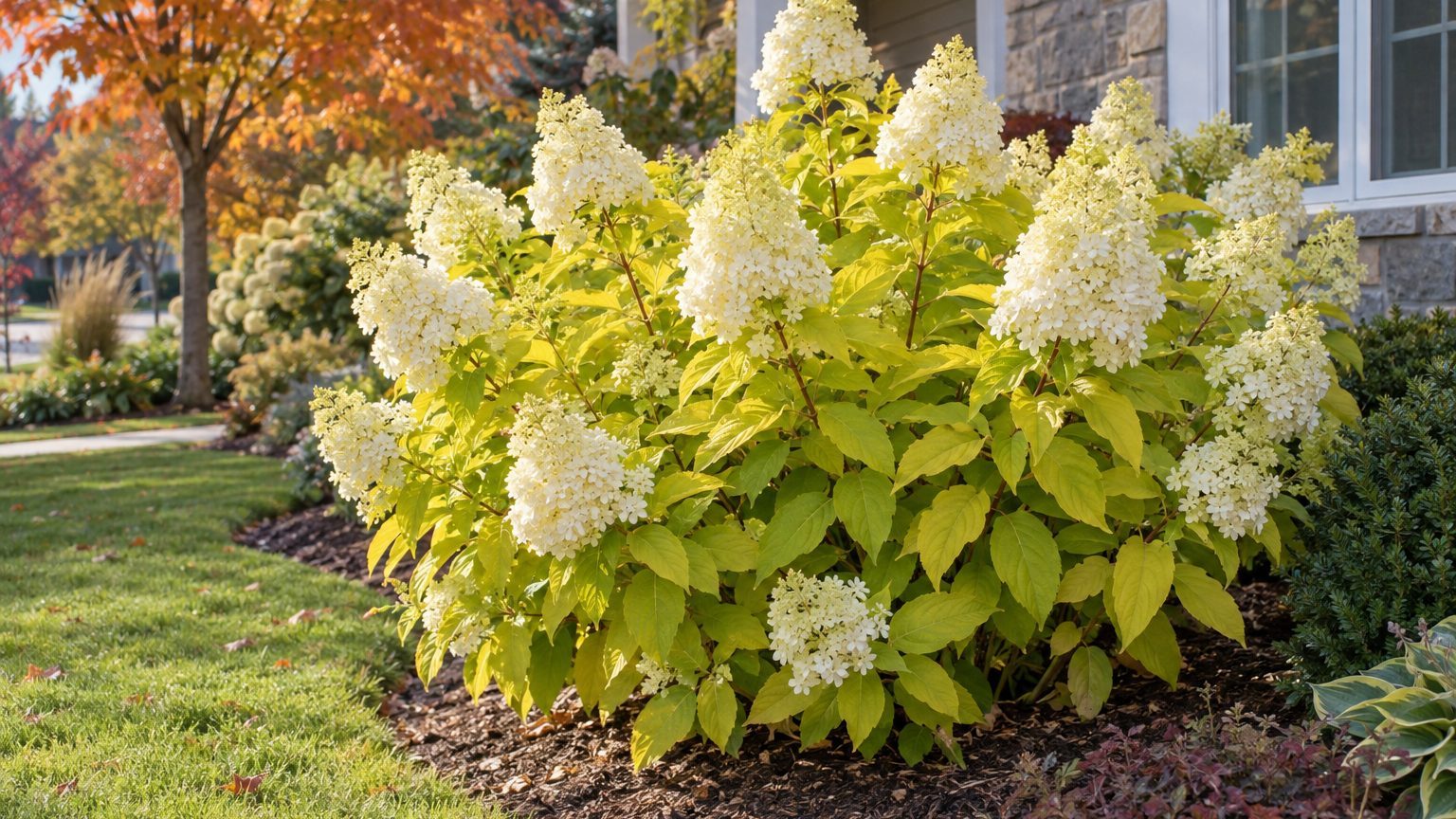
Lemon Daddy hydrangea is a panicle hydrangea (Hydrangea paniculata), grown for chartreuse to lemon yellow foliage that shifts through the season, with white cone flowers that age to soft pink. It suits USDA zones 3 through 8, stays compact enough for a foundation bed, blooms on new wood, and takes a hard prune in late winter without losing its summer show.
What This Variety Is
Lemon Daddy is a cultivar of Hydrangea paniculata, a panicle-type shrub bred for foliage that runs chartreuse in spring and shifts toward lemon yellow through summer. NC State Extension Gardener Plant Toolbox notes that panicle hydrangea sets its flower buds on new wood grown fresh each spring, not on stems left over from the year before.
That distinction changes the answer on pruning: a hard cut in late winter doesn’t erase this year’s flowers, unlike bigleaf types that bloom on old wood. The habit stays upright and rounded rather than sprawling, which keeps the shrub tidy near a foundation bed.
Cone-shaped panicles open white and fade to a soft pink as nights cool in fall, a shift many paniculata cultivars share. What sets this one apart is the leaf color, since most panicle hydrangeas keep plain green foliage from spring through frost.
Flower color here follows temperature and age, not soil pH. Gardeners chasing blue or pink by adjusting aluminum uptake are thinking of bigleaf hydrangea, not this one.
- Type: panicle hydrangea (Hydrangea paniculata).
- Bloom wood: new wood, so a hard prune skips a season of loss.
- Standout trait: chartreuse to lemon yellow foliage, not the bloom color.
From the almanac
Hydrangeas in your state
The dates on this page depend on where you live. Your state's page carries its frost dates, its USDA zones and the year laid out month by month.
Northeast
Southeast
- Alabama
- Arkansas
- Delaware
- Florida
- Georgia
- Kentucky
- Louisiana
- Maryland
- Mississippi
- North Carolina
- South Carolina
- Tennessee
- Virginia
- West Virginia
Midwest
Southwest
West
Pacific Northwest
Canada
Where It Grows: Zones and Regions
NC State Extension Gardener Plant Toolbox lists panicle hydrangea hardiness from zone 3 through zone 8, a wider band than the bigleaf hydrangeas most yards already have, and that range decides where Lemon Daddy holds up without special winter care.
- Great Lakes and the Northeast (Michigan, Minnesota, New York): winters sit right at the zone 3 edge, and stems above the snow line can die back before spring growth catches up.
- The Mid-Atlantic and Upper South (Virginia, Tennessee, North Carolina): zone 6 to 7 summers run warm enough for a full bloom, with winters mild enough that serious dieback is rare.
- The Deep South and Gulf Coast (Florida, Louisiana, coastal Texas): zone 9 and up runs past the top of the range, and heavy summer heat can thin out bloom quality even where the shrub survives.
- The Southwest and low desert (Arizona, southern Nevada, inland California): heat and alkaline soil work against panicle hydrangea no matter what the zone number says.
- The Pacific Northwest (Washington, Oregon): mild, damp summers sit well inside the range and rarely call for extra watering once a plant is established.
The state selector below this section opens the frost dates and pruning window for wherever you garden, so check that before reading a national zone map as the final word.
The Year With It, Season by Season
Planting
Early spring, once the ground has thawed and stopped freezing overnight, is the easiest planting window, though a container-grown shrub can go in through fall in milder zones too. Give it full sun to part shade and enough room to reach its mature width without crowding a walkway or a foundation.
Spring
New shoots push from the base and from any stems that made it through winter intact, and this fresh growth is what carries the summer’s flowers. Skip a fertilizer heavy in nitrogen at this point, since it pushes leafy growth at the expense of the flower buds forming later.
Summer
Panicles open white through the hottest weeks and hold their shape even as afternoon temperatures push past 90 degrees, since bloom happens on new wood grown that same spring rather than stored energy from last year. Deep watering during dry spells keeps the cone-shaped flowers from wilting before they color up toward pink.
Heat
Extended stretches above 90 degrees can wilt panicles by afternoon even with damp soil, since the broad leaves lose water faster than the roots can pull it back up. A layer of mulch over the root zone and a deep soak every few days carries it through a heat wave without lasting damage.
Fall
Blooms shift from white to a dusty pink as nights cool, and the yellow foliage that sets this variety apart starts fading back toward green before leaves drop for the season. This is not the time to prune, since cuts made now remove wood that should stay put through winter dormancy.
Winter
Stems go fully dormant and look bare next to nearby evergreens, which is normal for the type, and many gardeners leave the dried panicles standing through the coldest months for winter structure. Late winter, right before buds swell, is the real pruning window, when cutting back to a framework of strong stems sets up a fuller summer flush.
Diseases and Pests It Resists
Extension publications don’t carry pest or disease ratings specific to Lemon Daddy, so what follows applies to panicle hydrangea as a group, the closest documented match available.
As a species, panicle hydrangea deals with fewer serious diseases than bigleaf hydrangea and rarely needs a fungicide program in an average yard.
| Threat | This one | Source |
|---|---|---|
| Bacterial leaf spot | Occasional, cosmetic, worse in wet years | — |
| Powdery mildew | Shows up in humid, still air, rarely fatal | — |
| Deer browsing | Less favored than bigleaf foliage | — |
None of these threats is severe enough to plan a spray schedule around, and morning sun that dries leaves fast beats any fungicide here. The real risk to flowering is a late hard frost on new growth, and the other kinds, bigleaf and oakleaf included, have their own pest pages.
Where to Plant It in a Yard
Give it morning sun with afternoon shade in hot climates, full sun further north, and clear the mature width from a walkway or foundation so the heavy panicles don’t flop into foot traffic after a rain.
- Your state page: the frost dates and pruning window for wherever you garden.
- Hydrangea types compared: how panicle stacks up against bigleaf, oakleaf, and smooth for a mixed border.
- Pruning hydrangeas by type: the full cutting calendar if more than one kind shares the yard.
Mark the late-winter pruning window on next year’s calendar before the last of the foliage drops this fall.
Common questions
Does Lemon Daddy hydrangea bloom on old wood or new wood?
New wood, the growth it puts out each spring, which is why a hard prune in late winter doesn’t cost a season of flowers the way it would on a bigleaf hydrangea planted along the same fence line.
How big does Lemon Daddy hydrangea get?
Panicle hydrangea selections generally run from about 4 to 8 feet without pruning, and cutting back hard each late winter keeps a shrub like this on the smaller, tidier end of that range for a foundation bed.
What USDA zone works best for Lemon Daddy hydrangea?
Zone 6 to 7 is the sweet spot, with summers warm enough for a full bloom and winters mild enough to avoid the dieback that shows up closer to the zone 3 edge of its range.
Sources : hortmag.com