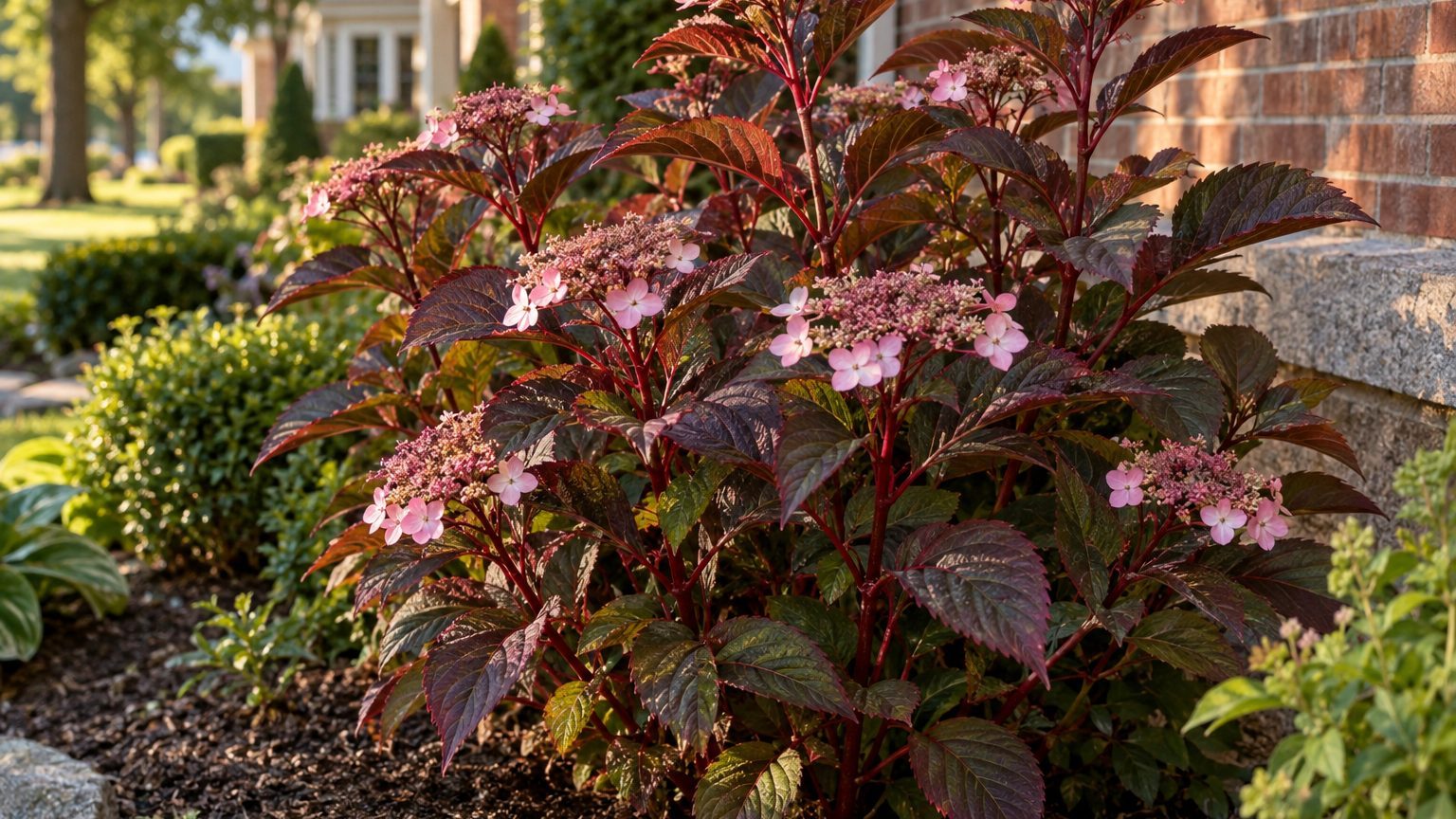
Lady in Red is a bigleaf hydrangea bred for red stems, red-veined leaves that turn burgundy in fall, and a compact frame that fits foundation beds without spilling over the walkway. It stays in the 3 to 4 foot range, holds USDA zones 5 to 9, blooms on last year’s wood, and needs pruning right after the flowers fade, not in fall or spring.
What This Variety Is
Lady in Red is a bigleaf hydrangea, Hydrangea macrophylla, bred at North Carolina State University for stems that stay red through the growing season. The lacecap flowers sit flat, ringed by sterile petals, and shift from pink toward blue as the soil turns acidic.
The leaves show red veins and red petioles even in July, then the whole plant turns burgundy to deep red once fall nights cool down. That color holds through several frosts before the leaves drop.
The flower form sets it apart from rounded mophead hydrangeas too: lacecap types show a ring of showy sterile flowers around a flat center of small fertile ones, rather than one solid ball of bloom.
NC State Extension Gardener Plant Toolbox lists it at 3 to 4 feet tall and wide, a foundation-bed scale next to the 6-foot spread of older mophead varieties.
It flowers only on old wood, the stems grown the prior season, so a hard spring cut removes the buds before they ever open. Growers plant it in part shade because full southern sun scorches the leaf edges by midsummer.
From the almanac
Hydrangeas in your state
The dates on this page depend on where you live. Your state's page carries its frost dates, its USDA zones and the year laid out month by month.
Northeast
Southeast
- Alabama
- Arkansas
- Delaware
- Florida
- Georgia
- Kentucky
- Louisiana
- Maryland
- Mississippi
- North Carolina
- South Carolina
- Tennessee
- Virginia
- West Virginia
Midwest
Southwest
West
Pacific Northwest
Canada
Where It Grows: Zones and Regions
NC State Extension Gardener Plant Toolbox puts Lady in Red at USDA zones 5 to 9, a wider hardiness window than most bigleaf hydrangeas carry.
- The Upper Midwest and Northeast (Ohio, Pennsylvania, New York): zone 5 winters can still nip flower buds on exposed stems, so a sheltered spot against a wall helps more here than farther south.
- The Mid-Atlantic and Southeast (Virginia, North Carolina, Georgia): this is the range it was bred for, with reliable bloom and the fall color running longest where autumn nights turn cool without a hard freeze.
- The West Coast (Oregon, Washington, coastal California): mild winters remove the bud-hardiness question, but afternoon shade still matters once summer heat sets in inland.
- The Interior West and high plains (Colorado, Utah, parts of New Mexico): low humidity and alkaline soil push flowers toward pink and can dry out the leaf margins without regular water.
The state selector below this section opens the frost dates and pruning window for wherever you garden.
The Year With It, Season by Season
Spring
New leaves break from buds set on last year’s red stems, so the pruning window has already closed by the time growth starts. A light feeding and a mulch refresh is the only work needed before the lacecap buds swell.
Summer
Flowers open flat and ringed, pink in alkaline soil and blue where the soil runs acidic, and they hold through the hottest weeks with steady watering. This is the window to deadhead, cutting just above the next bud pair once the color fades.
Fall
The foliage turns from green to burgundy and deep red as nights cool, a trait that runs longer here than on most bigleaf varieties. The color holds through several frosts before the leaves drop on their own.
Winter
Bare stems stay red through the cold months, adding color to an otherwise empty bed, while next summer’s flower buds already sit on that old wood. NC State Extension Gardener Plant Toolbox notes zone 5 winters put those buds most at risk, so mulch at the base helps most there.
Diseases and Pests It Resists
Lady in Red carries the same general susceptibilities as other bigleaf hydrangeas, and no separate resistance has been bred into this cultivar. NC State Extension Gardener Plant Toolbox lists powdery mildew and Cercospora leaf spot as the two disease pressures that show up most in humid, still-air conditions.
Neither problem is usually fatal, and both slow down once air moves freely between shrubs and watering stays at the roots instead of on the leaves.
| Threat | This one | Source |
|---|---|---|
| Powdery mildew | Susceptible in humid summers | — |
| Cercospora leaf spot | Susceptible, worse on crowded plants | — |
Deer browsing and the occasional aphid or spider mite outbreak are not specific to this variety, so those pages cover the controls that apply across bigleaf hydrangeas.
Where to Plant It in a Yard
Part shade near a foundation or along a walkway suits this shrub best, especially where afternoon sun would otherwise scorch the leaf edges by midsummer. Pair it with ferns or hostas that share the same moisture needs.
- Your state page: the frost dates and the pruning window where you garden.
- Which hydrangeas hold up here: a side-by-side of bigleaf, panicle, and smooth types for your zone.
- Bigleaf hydrangea care: the general pruning and watering rules this variety shares with its parent species.
Common questions
Does Lady in Red bloom on new wood or old wood?
It blooms on old wood, the stems grown the previous season, which is why a hard prune in fall or early spring removes next summer’s flowers.
Can I change the flower color on Lady in Red?
Yes, soil pH shifts the color the same way it does on other bigleaf hydrangeas, more acidic soil pulls toward blue and more alkaline soil pulls toward pink.
How cold hardy is Lady in Red compared to other bigleaf hydrangeas?
NC State Extension Gardener Plant Toolbox lists it at USDA zones 5 to 9, a wider range than many older bigleaf varieties that struggle below zone 6.
Sources : hydrangeasplus.com