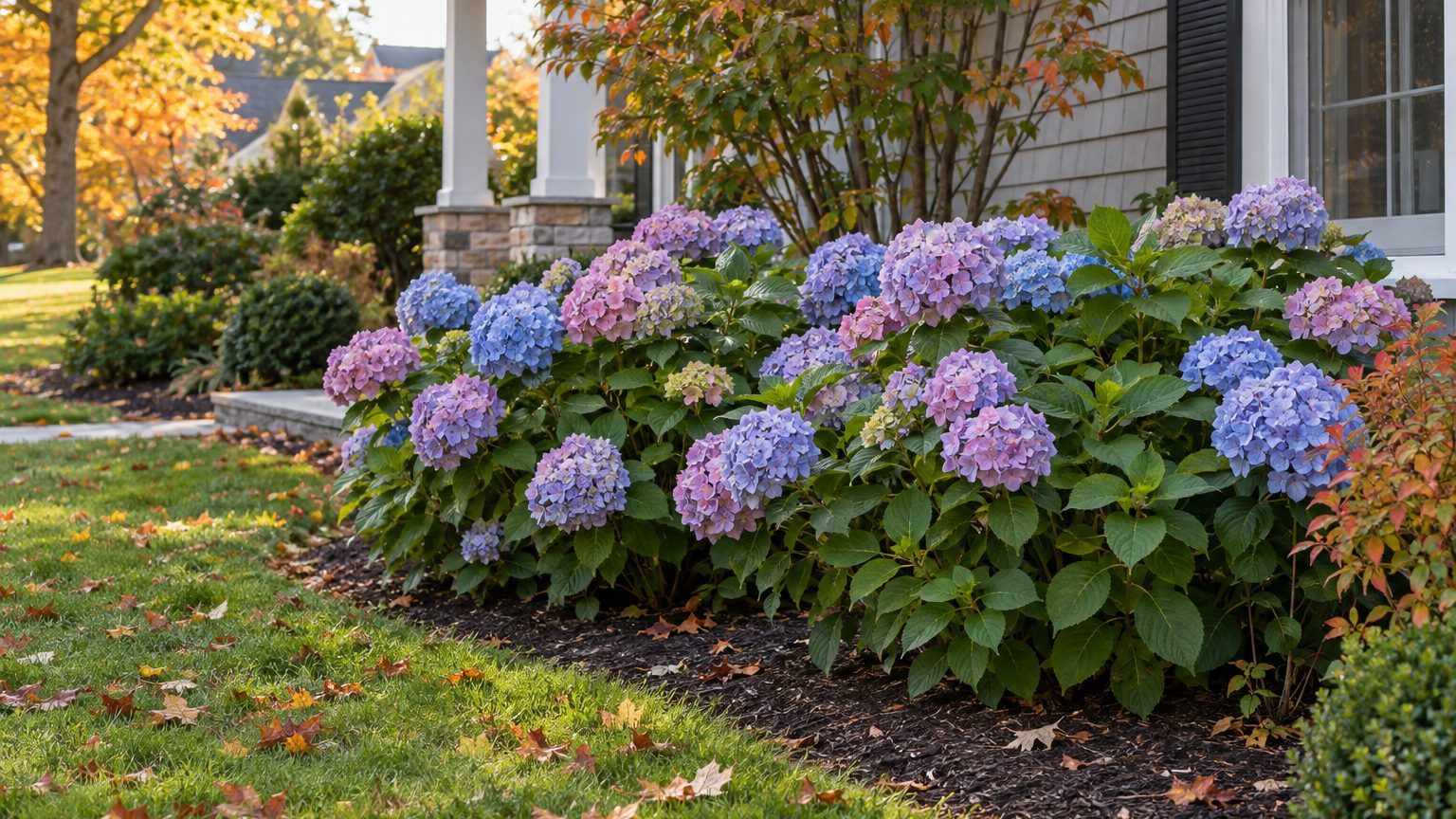
L.A. Dreamin is a compact, reblooming bigleaf hydrangea that tops out around 3 to 4 feet tall and wide, hardy across USDA zones 4 through 9. Its bicolor mophead blooms shift color with soil pH while the white edge holds steady, and because it flowers on both old and new wood, a rough winter costs weeks of bloom, not the whole season.
What This Variety Is
L.A. Dreamin belongs to Hydrangea macrophylla, the bigleaf group, and it’s part of the Endless Summer Collection developed by Bailey Nurseries, which puts mature size at 3 to 4 feet tall and wide. It grows as a rounded, dense mound rather than an open, leggy shrub.
The bloom is a mophead, not a lacecap, with a bicolor pattern: a saturated pink or blue-purple center ringed in white. That white edge holds its color regardless of soil pH, while the center shifts from pink toward blue as the soil turns more acidic.
What sets it apart from an older bigleaf shrub is where the flowers come from: it blooms on both old wood and new wood. A late frost that kills last year’s buds still leaves a summer flush coming from stems the plant grew this year.
The leaves are broad and glossy, dark green against the compact frame. That density is why growers slot it into foundation beds and mixed borders alike.
From the almanac
Hydrangeas in your state
The dates on this page depend on where you live. Your state's page carries its frost dates, its USDA zones and the year laid out month by month.
Northeast
Southeast
- Alabama
- Arkansas
- Delaware
- Florida
- Georgia
- Kentucky
- Louisiana
- Maryland
- Mississippi
- North Carolina
- South Carolina
- Tennessee
- Virginia
- West Virginia
Midwest
Southwest
West
Pacific Northwest
Canada
Where It Grows: Zones and Regions
Zone alone doesn’t tell the whole story with a reblooming bigleaf, since the new-wood flowers act as a backup when a cold snap wipes out the old-wood buds.
- Cold winters (Minnesota, Wisconsin, Michigan): Bailey Nurseries rates the Endless Summer Collection, including L.A. Dreamin, for USDA zones 4 through 9, and in these states the old-wood buds routinely die back, so summer flowers come almost entirely from new growth.
- Mixed winters (Ohio, Pennsylvania, Virginia): both old and new wood usually survive, which means two waves of bloom, an early one in late spring and a second flush into fall.
- Mild winters (Georgia, South Carolina, coastal North Carolina): old wood buds almost always make it through, and the shrub can bloom nearly continuously from late spring into fall with steady water.
- Hot, humid Gulf states (Louisiana, Florida, Texas): afternoon sun turns punishing here, and the plant does better tucked where it gets shade after midday.
The state selector below this section links to the frost dates and hardiness numbers for where you garden.
The Year With It, Season by Season
Planting
Early spring or early fall works best, while soil is workable but summer heat hasn’t arrived. Dig the hole twice as wide as the root ball, and water deeply right after planting so roots settle before the first bloom cycle starts.
Spring growth
New leaves emerge on stems that made it through winter, and this is the pruning window if any wood is clearly dead. Cut only stems with no green under the bark, since live old wood carries the first flush of bicolor blooms.
Summer bloom
Mophead flowers open from old wood first, then new-wood stems add a second round as the season goes on. Deadheading spent blooms encourages more flower production without risking next year’s buds, since new growth continues through summer.
Summer heat
Bigleaf hydrangeas wilt fast once soil dries out in high heat, and L.A. Dreamin is no exception. A deep soak two or three times a week beats a daily sprinkle, and afternoon shade keeps leaves from scorching on the hottest days.
Fall
Blooming slows as days shorten, but new-wood stems set the buds that will open as old-wood flowers the following spring. This is not the time to prune, since cutting now removes next year’s earliest color.
Winter
Dormant stems and swollen buds sit through cold weather, and in the coldest parts of its range those old-wood buds can die back. A four-inch layer of mulch over the root zone protects the crown, and because the shrub reblooms on new wood too, a hard winter costs a few weeks of bloom, not the season.
Diseases and Pests It Resists
NC State Extension Gardener Plant Toolbox lists several common weak points for bigleaf hydrangea, and L.A. Dreamin hasn’t been bred with special resistance to any of them.
Deer will browse the buds and leaves too, since bigleaf hydrangeas carry no natural deer resistance. A wire cage over young plants in fall protects the buds that carry next year’s old-wood bloom.
| Threat | This one | Source |
|---|---|---|
| Aphids and spider mites | Susceptible, worse in dry heat | NC State Extension |
| Leaf spot (Cercospora) | Susceptible in humid, wet-leaf spells | NC State Extension |
| Powdery mildew | Susceptible late in the growing season | NC State Extension |
| Deer browsing | Not resistant | NC State Extension |
Panicle, oakleaf, and smooth hydrangeas carry different pest profiles, and those are covered on their own pages.
Where to Plant It in a Yard
L.A. Dreamin works best as a foundation planting or a mixed-border anchor, somewhere it gets morning sun and afternoon shade. Its compact frame also does well in a large container on a patio.
- Your state page: the frost dates and pruning window for where you garden.
- Hydrangea types compared: how bigleaf stacks up against panicle, oakleaf, and smooth for your yard.
- Companion plants for hydrangeas: what holds up next to the same moisture needs and part-shade spot.
Common questions
How big does L.A. Dreamin hydrangea get?
Bailey Nurseries puts mature size at 3 to 4 feet tall and wide, a compact, rounded shape suited to foundation beds and large containers.
Does L.A. Dreamin hydrangea bloom on old or new wood?
Both. That’s what makes it a reblooming hydrangea, so it keeps producing flowers even if a late frost kills the old-wood buds.
What zones does L.A. Dreamin hydrangea grow in?
Bailey Nurseries rates it for USDA zones 4 through 9, though old-wood blooms show up more reliably in the milder end of that range.
Sources : mrmaple.com