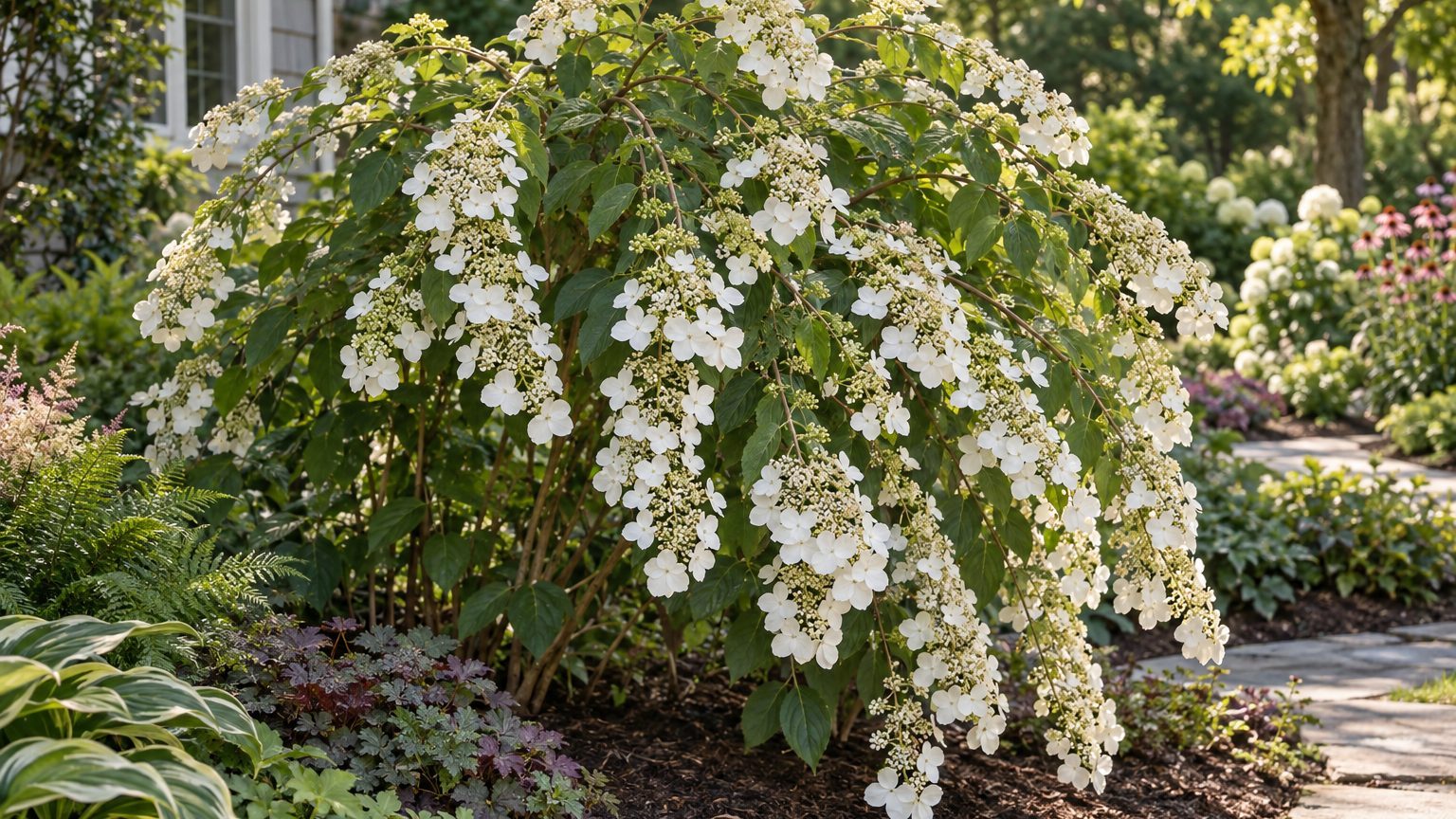
Fuji Waterfall is a lacecap-style panicle hydrangea, not the mophead most people picture. It tops out at 4 to 6 feet with a similar spread, holds up in USDA zones 4 through 8, and blooms on new wood, so late-winter pruning won’t cost you a single flower. Full sun keeps the canes strong enough to carry the cascading white heads without staking.
What This Variety Is
Fuji Waterfall belongs to the panicle group, Hydrangea paniculata, not the bigleaf mopheads that fill most garden centers. NC State Extension Gardener Plant Toolbox places the species at USDA zones 3 to 8, and this cultivar sits comfortably inside that range.
The bloom itself sets it apart. Each flower head is a lacecap, a ring of large sterile florets around a flat center of small fertile ones, and the whole cluster arches downward on slender stems.
That drooping habit is where the name comes from. The canes lean under the weight of the flowers, so the shrub reads as a cascade rather than a solid mound.
Growers point to three traits that separate it from other panicle types:
- Lacecap bloom instead of the dense cone shape of other panicle cultivars
- New-wood flowering, so winter damage never erases a season
- An arching, weeping cane structure rather than upright growth
The new-wood habit is the detail that decides how you prune it, and it carries through everything in the next few sections.
From the almanac
Hydrangeas in your state
The dates on this page depend on where you live. Your state's page carries its frost dates, its USDA zones and the year laid out month by month.
Northeast
Southeast
- Alabama
- Arkansas
- Delaware
- Florida
- Georgia
- Kentucky
- Louisiana
- Maryland
- Mississippi
- North Carolina
- South Carolina
- Tennessee
- Virginia
- West Virginia
Midwest
Southwest
West
Pacific Northwest
Canada
Where It Grows: Zones and Regions
Panicle hydrangeas cover more ground than any other type in this genus, and Fuji Waterfall follows that pattern, though a few regions call for small adjustments.
- New England and the Upper Midwest (Maine, Vermont, Wisconsin): winters routinely dip into zone 4, and since this cultivar flowers on new wood, a hard freeze that kills the top growth still leaves a full bloom season ahead.
- The Mid-Atlantic and Ohio Valley (Virginia, Ohio, Pennsylvania): the middle of the range, zones 6 and 7, where full sun all day is the standard advice without the afternoon scorch some warmer states see.
- The Deep South (Georgia, Alabama, South Carolina): zone 8 pushes the upper edge of the plant’s tolerance, and afternoon shade keeps the lacecap heads from bleaching out in July and August.
- The Pacific Northwest (Oregon, Washington, northern California): mild summers and reliable rainfall make this one of the easiest regions to grow it in, with little supplemental water needed once established.
Zone 9 and up, the low desert stretches of Arizona and inland Nevada, sits outside the documented range, and the plant struggles there regardless of shade or irrigation. The state selector below this section narrows all of this down to your own frost dates and pruning window.
The Year With It, Season by Season
Planting
Spring or early fall both work, set in well-drained soil with full sun to light afternoon shade in warmer zones. A wide, shallow hole beats a deep one for getting the roots to spread.
Spring growth
New canes push from the crown as soil warms, and since flowers form on this new growth, a late frost that nips the tips only delays bloom by a few weeks rather than skipping the season.
Bloom time
Lacecap heads open in midsummer and hang from arching stems through the season. The color stays white to cream throughout, since panicle types don’t shift blue or pink with soil pH the way bigleaf hydrangeas do.
Summer heat
Long dry stretches show up first as wilting by mid-afternoon, even in well-watered soil, simply from the leaf surface losing moisture faster than roots can replace it. A deep soak once a week beats frequent shallow watering.
Fall
Spent blooms age from white to a soft pink or tan and hold their shape on the stem. Leaving them through autumn adds structure to the yard and doesn’t cost next year’s flowers.
Winter
Some cane dieback is normal in colder zones and isn’t a sign of a dying shrub. Wait until late winter, just before new growth resumes, to cut back to live wood.
Diseases and Pests It Resists
Panicle hydrangeas as a group tend to shrug off the diseases that hit bigleaf types hardest, and Fuji Waterfall follows that pattern in a general sense rather than through cultivar-specific testing.
Deer tend to pass over panicle types more often than bigleaf or oakleaf hydrangeas, though no browsing is ever guaranteed in a hungry winter.
| Threat | This one | Source |
|---|---|---|
| Deer browsing | Rarely a preferred target among panicle types | — |
| Bacterial leaf spot | Less prone than bigleaf hydrangeas | — |
| Aphids | Occasional on new spring growth | — |
Powdery mildew and other cultivar-specific pest data for Fuji Waterfall aren’t documented at this level of detail.
Where to Plant It in a Yard
Give it a spot where the weight of the flower heads can drape over an edge, a slope, the top of a low wall, or a raised bed, so the lacecap clusters cascade into view rather than folding onto the ground.
- Your state page: the frost dates and the pruning window where you live.
- Panicle hydrangea pruning guide: the cut lines and timing for new-wood bloomers like this one.
- Hydrangea companion plants: what holds its color and bloom time alongside a cascading panicle type.
Set it where you’ll walk past it in August, when the arch is heaviest and the color is at its peak.
Common questions
Does Fuji Waterfall change color like a bigleaf hydrangea?
No. As a panicle type, its white to cream bloom color comes from genetics, not soil pH, so aluminum sulfate or lime won’t shift it blue or pink.
When is the right time to prune it?
Late winter, before new growth starts, since flowers form entirely on the current season’s wood. Pruning in fall only removes canes that would have carried next summer’s blooms.
Can it handle a full day of sun?
In most of its range, yes, and full sun actually keeps the canes sturdier under the weight of the flowers. In zone 8 gardens, afternoon shade helps the blooms hold their color longer.
Sources : rhs.org.uk | motherearthnursery.com.au