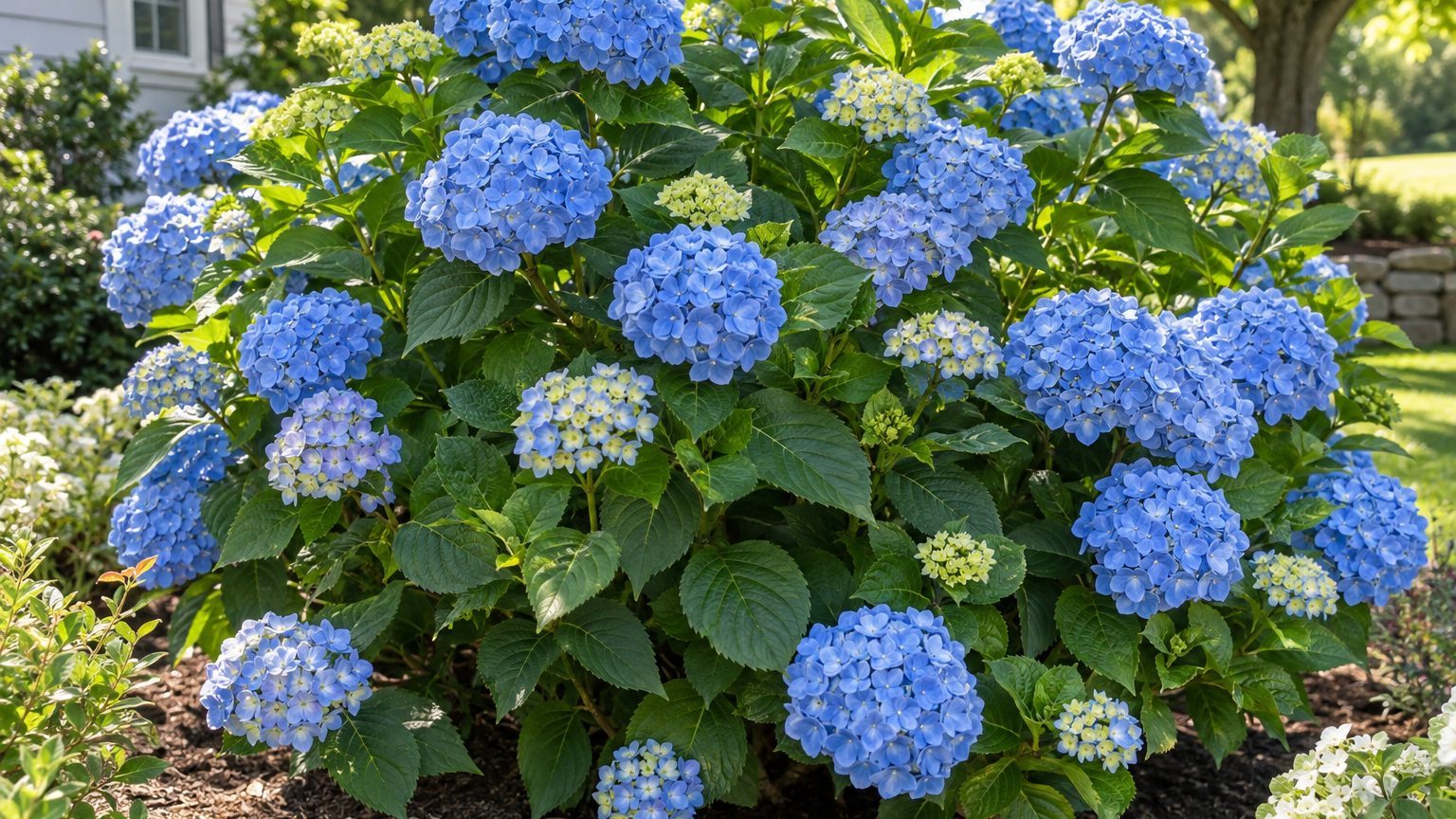
Endless Summer hydrangea is a bigleaf shrub, Hydrangea macrophylla ‘Bailmer’, that grows 3 to 5 feet tall and wide and blooms in USDA zones 4 through 9. It sets flower buds on both old and new wood, so it reblooms even after a hard freeze kills the first flush. Pruning stays light, mostly deadwood removal, and flower color tracks soil pH rather than the plant itself.
What This Variety Is
Endless Summer hydrangea is a bigleaf hydrangea, Hydrangea macrophylla ‘Bailmer’, bred as the first reliably reblooming variety in the group. NC State Extension Gardener Plant Toolbox lists it as hardy in zones 4 to 9, a wider range than most older bigleaf cultivars.
It forms a rounded mound, 3 to 5 feet tall and about as wide, topped with large mophead flower clusters. The shrub sets buds on both old wood and new growth, which is what lets it push a second bloom after a cold snap kills the first.
Flower color follows soil chemistry, not the variety itself. Acidic soil turns blooms blue, while alkaline soil turns the same shrub pink.
Three things set it apart from older bigleaf types:
- Rebloom on new wood after a hard prune or a late frost
- A hardiness range that reaches into zone 4, colder than most bigleaf cultivars
- A compact, rounded form suited to foundation beds rather than woodland borders
From the almanac
Hydrangeas in your state
The dates on this page depend on where you live. Your state's page carries its frost dates, its USDA zones and the year laid out month by month.
Northeast
Southeast
- Alabama
- Arkansas
- Delaware
- Florida
- Georgia
- Kentucky
- Louisiana
- Maryland
- Mississippi
- North Carolina
- South Carolina
- Tennessee
- Virginia
- West Virginia
Midwest
Southwest
West
Pacific Northwest
Canada
Where It Grows: Zones and Regions
NC State Extension Gardener Plant Toolbox puts the range at zones 4 to 9, and each end of that range comes from a different kind of stress, cold in the north and heat in the south.
- Cold edge (Minnesota, Wisconsin, upstate New York): winters that dip toward zone 3 can kill stems to the ground, and the shrub then reblooms only on new wood that emerges after the last frost.
- Mid-Atlantic and Midwest (Ohio, Pennsylvania, Illinois): this is the sweet spot, with enough winter chill and a long enough season for two flushes of bloom.
- The South (Georgia, Texas, the Carolinas): afternoon shade keeps leaves from scorching once temperatures pass the mid 90s.
- Pacific Coast (Washington, Oregon, coastal California): mild winters and cool summers stretch the bloom season longer than almost anywhere else.
- Mountain West (Colorado, Utah): dry air and alkaline soil push blooms toward pink and stress the shrub without regular irrigation.
Zone 9 heat in inland Texas or Florida pushes past what the shrub tolerates without steady watering. Your state page, linked from the selector below this section, sets the exact frost dates and pruning window for where you live.
The Year With It, Season by Season
Planting
Spring or early fall planting gives roots time to settle before summer heat or winter cold arrives. Dig a hole twice the width of the root ball and no deeper, then water deeply and keep the soil evenly moist through the first season.
Growth

New growth emerges from the base and from stem tips that made it through winter, showing exactly which wood survived. Cut back only the bare, brittle stems to living tissue, since the lower buds on those same stems often carry the first bloom.
Bloom
The first flush opens on old wood by early summer, then a second flush follows on new growth through late summer in most regions. That double bloom window is the trait that gave the series its name and its long season in the bed.
Heat
Afternoon sun above the mid 90s wilts the large leaves by midday even when soil moisture is fine, a normal response rather than a sign of drought stress. A deep morning watering and a spot with afternoon shade keep the leaves upright through the hottest weeks.
Fall
Bloom slows as day length shortens, and spent flower heads can stay on the shrub through the season without hurting next year’s buds. Skip any pruning now, since cuts made in fall remove the very wood that flowers first next spring.
Winter
Stems above ground can die back in a hard freeze, especially at the cold edge of the range, while the crown below the mulch line usually survives. A 2 to 3 inch layer of mulch over the root zone protects the buds that carry next year’s first flush.
Diseases and Pests It Resists
Endless Summer carries the same disease profile as other bigleaf hydrangeas, since breeding for rebloom did not change leaf tissue or resistance genes. Fungal leaf spot and powdery mildew show up in humid summers, especially where air can’t move through a crowded planting.
Deer resistance is inconsistent. Deer browse the leaves and flower buds in many yards, particularly in a hard winter when other food is scarce, and spider mites or aphids turn up on plants stressed by heat or drought.
| Threat | How common | What helps |
|---|---|---|
| Leaf spot (fungal) | Common in humid climates | Water at the base, not overhead |
| Powdery mildew | Common late summer | Space plants for airflow |
| Deer browsing | Frequent, not resistant | Fencing or repellent in winter |
| Aphids, spider mites | Occasional, on stressed plants | Deep watering in heat |
Bacterial wilt and root rot are not well documented on this specific cultivar, and the risk there comes mostly from soil that stays soggy rather than from the plant itself.
Where to Plant It in a Yard
A spot with morning sun and afternoon shade suits it best in most yards, close enough to a path or patio to catch the mophead color up close. Pair it with hostas or ferns that share its taste for moist, well-drained soil.
- Your state page: the frost dates and the exact pruning window for where you garden.
- Hydrangea types compared: how this bigleaf variety stacks up against panicle and smooth types for size and bloom.
- Soil pH and bloom color: the acidity range that shifts blooms from pink toward blue.
Set the root ball level with the surrounding soil, mulch to hold moisture, and water deeply for the first season while roots reach into native ground.
Common questions
Why didn’t it bloom this year?
A late frost after budbreak, a fall or winter prune that removed old wood, or too much shade are the three usual reasons. Since it blooms on both old and new wood, one bad flush from frost still leaves a second chance later in summer.
Can I change the flower color?
Yes, by adjusting soil pH rather than the plant. Lowering pH with a soil sulfur amendment shifts blooms toward blue, while raising pH with garden lime shifts them toward pink, though the change takes a full season to show.
How much pruning does it actually need?
Very little. Remove only dead or winter-damaged stems in spring, cutting back to the first set of live, green buds, and leave the rest of the shrub alone through the growing season.
Sources : jardindupicvert.com