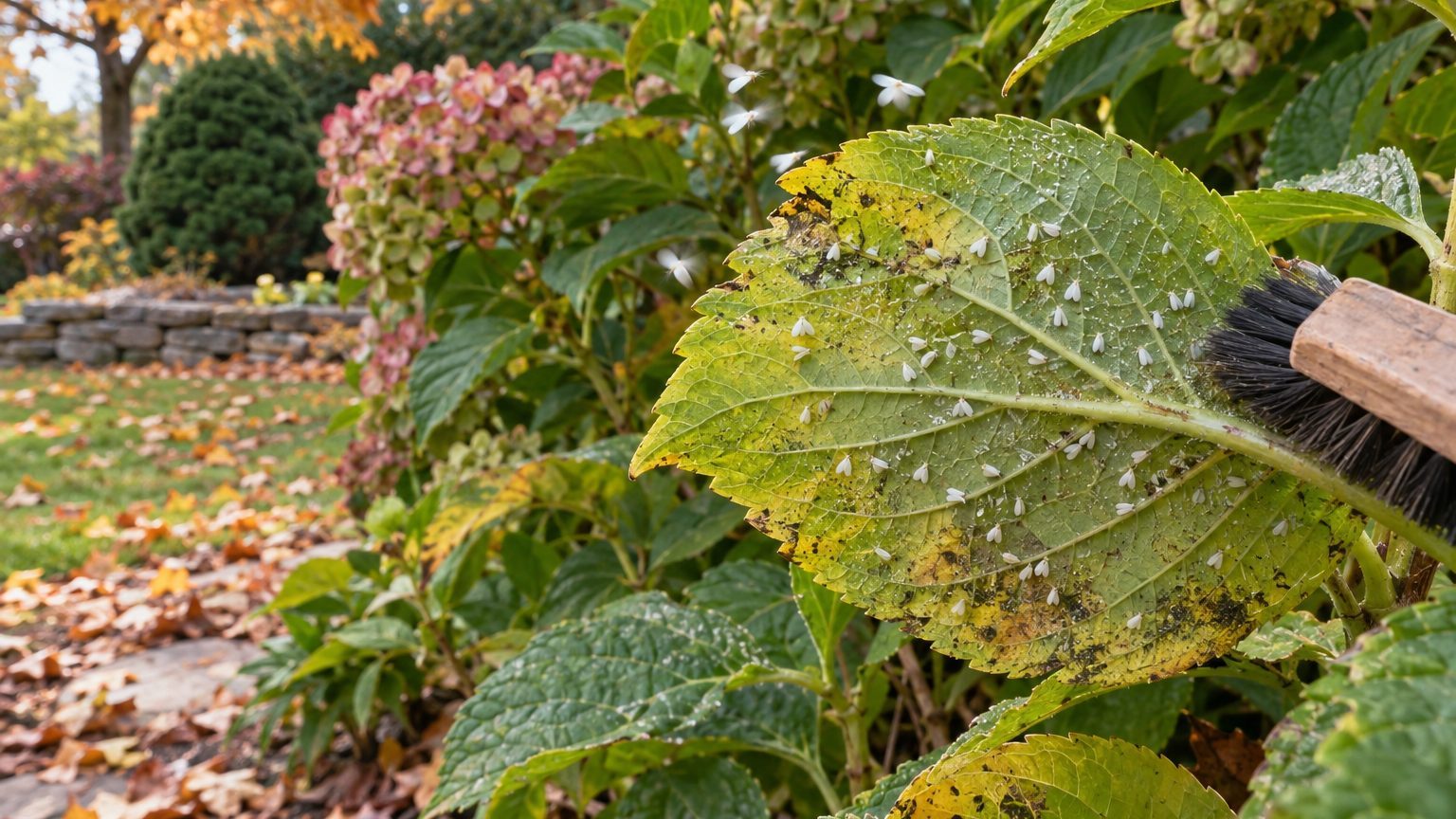
Whiteflies on hydrangeas show up as tiny white insects that flutter off the leaf undersides when you brush a branch, leaving sticky, shiny leaves behind. A firm water spray on the undersides, repeated as adults return, handles most yards. Treatment is the same for every hydrangea type, but the pruning that follows is not, so check your type and state page first.
Whiteflies: What You See

The NC State Extension Gardener Plant Toolbox lists aphids, scales, nematodes and mites as hydrangea pests, all “rarely a problem,” and does not name whiteflies, so this sheet sticks to what your eye can confirm.
- Tiny white, moth-like insects, smaller than a gnat, resting on the undersides of leaves.
- A cloud of white flakes that lifts when you brush or shake a branch, then settles again.
- Pale, flat, oval specks that do not move, clustered close to the leaf veins.
- A shiny, sticky film on the leaves below, sometimes followed by a black, sooty coating.
- Leaves that turn yellow and speckled during warm weather.
The largest species has its own sheet at Giant Whitefly on Hydrangeas, and the wider list of trouble sits under Hydrangea Pests.
From the almanac
Hydrangeas in your state
The dates on this page depend on where you live. Your state's page carries its frost dates, its USDA zones and the year laid out month by month.
Northeast
Southeast
- Alabama
- Arkansas
- Delaware
- Florida
- Georgia
- Kentucky
- Louisiana
- Maryland
- Mississippi
- North Carolina
- South Carolina
- Tennessee
- Virginia
- West Virginia
Midwest
Southwest
West
Pacific Northwest
Canada
Whiteflies or Something Else?
Three insects get mistaken for whiteflies, and the extension source names all three as hydrangea pests. One shake of the branch and one look at the leaf underside sorts them out.
A hand lens helps if you own one. Without it, your fingernail and a sheet of white paper do most of the work.
| Looks like | The sign that tells them apart |
|---|---|
| Aphids: small soft insects clustered on new growth | They stay put or crawl when you shake the stem, and nothing flies up in a cloud |
| Mites: pale speckling across the leaf surface | Fine webbing on the underside, with no flying insects at all |
| Scales: small bumps on stems and leaf veins | The bumps never move, and a fingernail flicks them off as a hard shell |
Nematodes work underground, and deer leave torn leaves and browsed tips, so neither mimics a white cloud. Aphids get a full sheet at Aphids on Hydrangeas, and the other kinds are on their own pages.
What Causes Whiteflies, and Where It Is Worst
Whiteflies feed on leaf sap and multiply through warm weather, and since the NC State Extension Gardener Plant Toolbox puts hydrangeas at USDA zones 3a through 9b without mapping whiteflies, the split below follows the types you grow, not an invented infestation chart.
- Great Lakes and the North (Michigan, Minnesota, Wisconsin): panicle and smooth, the hardiest types, dominate, so check the undersides during the warmest stretches.
- Northeast and Mid-Atlantic (New York, Pennsylvania, Virginia): bigleaf reaches its northern limit at USDA 6a, so look hardest at sheltered, shaded plantings.
- The South (Georgia, Texas, the Carolinas): bigleaf, oakleaf and panicle share a long warm season, which gives any pest more time to build.
- West and Mountain (California, Oregon, Colorado): irrigated beds and walls hold warmth, so scout the plants tucked against them.
Your state page carries the pruning window and zone verdict for your type, which this national sheet leaves out on purpose.
How to Treat Whiteflies
Start this week, and work in this order, because the first two steps cost nothing and often solve the problem.
- Confirm with a shake: tap a branch over white paper, and if white flakes lift and settle back, you have adults to deal with.
- Rinse the undersides: use a firm spray from the hose in the morning, aimed upward, so the leaves dry before evening.
- Bag the worst leaves: remove heavily coated ones and put them in the trash, not the compost pile.
- Repeat the rinse each time adults return: a single pass leaves eggs behind, and the next wave hatches after you have stopped looking.
- Hang yellow sticky cards nearby: they show you when adults are flying, and they tell you when to rinse again.
- Ask your state extension service: only they know which products are registered where you live, so I name none here.
Keep the shears in the shed while you fight them. Pruning timing depends on type, and a bigleaf cut in spring loses its flowers because its buds form the previous summer.
How to Prevent Whiteflies Coming Back
Prevention here follows the year, from the nursery bench through the winter cleanup.
- Before you buy: flip a few leaves on any new plant and keep it apart from your others for a while.
- Spring and early summer: check the undersides on a regular schedule so you catch the first adults, not the tenth generation.
- Summer dry spells: water at the base and mulch, because bigleaf and panicle are both shallow-rooted, and dry leaves also cut the risk of leaf spot and powdery mildew.
- Fall: rake fallen leaves from under the plant, and when you tidy dead hollow stems, the NC State Extension Gardener Plant Toolbox says to cut them back to 12-24 inches and leave them standing for native bees.
- Late winter: panicle and smooth types can take a hard cutback, while bigleaf, mountain, oakleaf and climbing types wait.
Deer browsing stresses plants too, so a fence pays off twice.
Where this comes from
This sheet leans on the NC State Extension Gardener Plant Toolbox entry for Hydrangea, which names the pests and diseases above and does not list whiteflies. Confirm what is registered and timely for your yard with your state’s cooperative extension service before you treat.
Common questions
Do whiteflies kill hydrangeas?
The extension source calls hydrangea pests rarely a problem. Whiteflies drain sap and coat leaves with sticky residue, so a healthy established plant usually tolerates light numbers. Act when you see clouds lifting from the branches.
Does treatment change by hydrangea type?
The rinse-and-repeat routine stays the same for all of them. What changes is pruning, hardiness and flowering wood, so look up your type and your state page before you cut anything.
Is bigleaf hydrangea safe around pets while I treat it?
Only bigleaf is documented as toxic, and only when large quantities are eaten, with nausea, stomach pain and vomiting. It affects cats, dogs and horses. Keep animals from chewing on it, and there is no need for alarm.