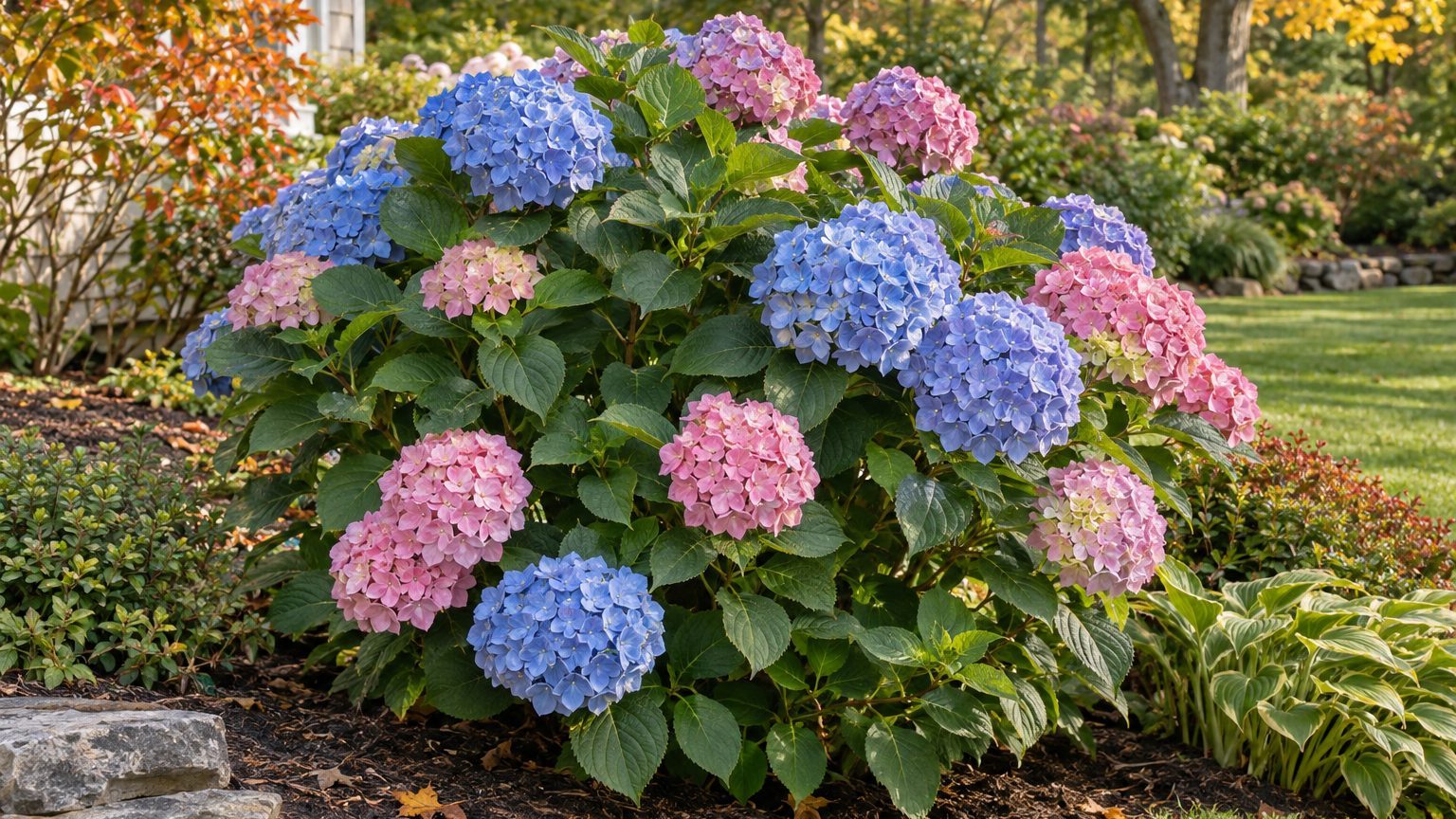
Penny Mac is a reblooming bigleaf hydrangea with round mophead flowers, and it earns its place where winters are hard on ordinary bigleafs. It flowers on old wood and on new growth, so one cold snap rarely wipes out a whole summer. Everything below follows the calendar, from planting to the winter rest.
What This Variety Is
Penny Mac is a bigleaf hydrangea, Hydrangea macrophylla, sold as a mophead with round flower clusters. It grows as a rounded, multi-stemmed deciduous shrub that drops its leaves each winter.
What sets it apart is rebloom: it flowers on old wood and on new growth. A hard winter that kills the upper stems does not cancel the season’s flowers outright.
Flower color follows soil chemistry, and the same plant can open blue in one yard and pink in another. Acidic soil pushes blooms toward blue, alkaline soil toward pink, and ground near neutral tends to give purples.
Rather than guess, I point you to the state page, where local frost dates do more work than a zone label.
From the almanac
Hydrangeas in your state
The dates on this page depend on where you live. Your state's page carries its frost dates, its USDA zones and the year laid out month by month.
Northeast
Southeast
- Alabama
- Arkansas
- Delaware
- Florida
- Georgia
- Kentucky
- Louisiana
- Maryland
- Mississippi
- North Carolina
- South Carolina
- Tennessee
- Virginia
- West Virginia
Midwest
Southwest
West
Pacific Northwest
Canada
Where It Grows: Zones and Regions
Bigleaf hydrangeas behave differently from one region to the next, and rebloom is what makes this one worth trying at the cold edge of the range.
- Great Lakes and the North (Michigan, Minnesota, Wisconsin): winter dieback is the risk, and a plant that also flowers on new growth gives you a second chance when buds on old stems freeze.
- The Northeast (New York, Massachusetts, Connecticut): shelter from winter wind and a spot where snow settles around the base make the difference.
- The South (Georgia, Texas, the Carolinas): heat and dry spells set the limit, so morning sun, afternoon shade and steady water keep the leaves from scorching.
- The Pacific Northwest (Oregon, Washington): mild, wet winters suit bigleafs, and the often acidic soils lean blooms toward blue.
- The dry Southwest (Arizona, New Mexico, Nevada): alkaline soil and low humidity are the obstacles, and a container with acidic mix is easier to manage than open ground.
The state selector just below this section takes you to the page for your state, with local frost dates and the pruning window.
The Year With It, Season by Season
Spring
New leaves can emerge on stems that looked dead, so patience beats the pruning shears. Wait until buds swell, then cut only wood that stays brown and brittle. Plant new shrubs once hard frost risk has passed, in soil that drains but holds moisture. Your state page gives the frost window.
Summer
The first flush opens on old wood, and new growth carries later flowers if the plant is not stressed. Water deeply at the base in dry weeks and give afternoon shade in strong heat. Snip spent heads above a healthy leaf pair to encourage more. Your state page shows the last safe cutting date.
Fall
Buds for next year’s first flush are set on stems by autumn, so late pruning trades flowers for tidiness. Stop feeding nitrogen early so growth can harden before frost, and mulch the base with shredded leaves. Fall planting works where winters are mild, and your state page gives the window.
Winter
Old stems are the insurance policy, so leave them standing through winter even if they look rough. Mound mulch or shredded leaves over the base after the ground cools, and shelter stems where winds are harsh. Cut back in spring, using the window on your state page.
Diseases and Pests It Resists
A sourced scorecard would list each threat, how this plant fares and who reported it. That table does not exist here yet.
Bigleaf hydrangeas as a group can get powdery mildew, leaf spots and bud damage from late frost. Those are tendencies of the group, not a verdict on this shrub.
Treat it as you would any bigleaf: space plants for airflow, water at the base rather than over the leaves, and clear fallen foliage in autumn. The other kinds of hydrangea are on their own pages.
Where to Plant It in a Yard
Morning sun with afternoon shade suits a bigleaf best, whether along a foundation, beside a fence, or at the front of a mixed border. Pair it with evergreens behind it and shade perennials at its feet.
- Hydrangea Varieties Compared: the types side by side, so you can see where a bigleaf fits among the others.
- Twist-n-Shout Hydrangea: Size, Zones, Pruning and Care: a neighboring bigleaf profile with its own size, zones and pruning notes.
- All Summer Beauty Hydrangea: Size, Zones, Pruning and Care: another bigleaf to read alongside this one when you compare how each handles pruning.
Before you dig, pick your state in the selector and check the frost dates and the pruning window there.
Common questions
Does Penny Mac bloom on old wood or new wood?
Both. Flowers open on stems that survived winter, and new growth adds later blooms. That is why a cold winter or a wrong-time cut hurts less than it would on a hydrangea that flowers only on old wood.
Why are my blooms pink when I wanted blue?
Soil chemistry decides. Acidic soil tends to give blue, alkaline soil pink. Test the soil before adding anything, because changing color takes patience, and the result differs from yard to yard.
When should I prune it?
Wait until buds swell in spring, then remove only dead wood. Light shaping after the first flush is safer than a hard cut. The exact window depends on your climate, so check your state page.
Sources : hydrangeasplus.com | myperfectplants.com