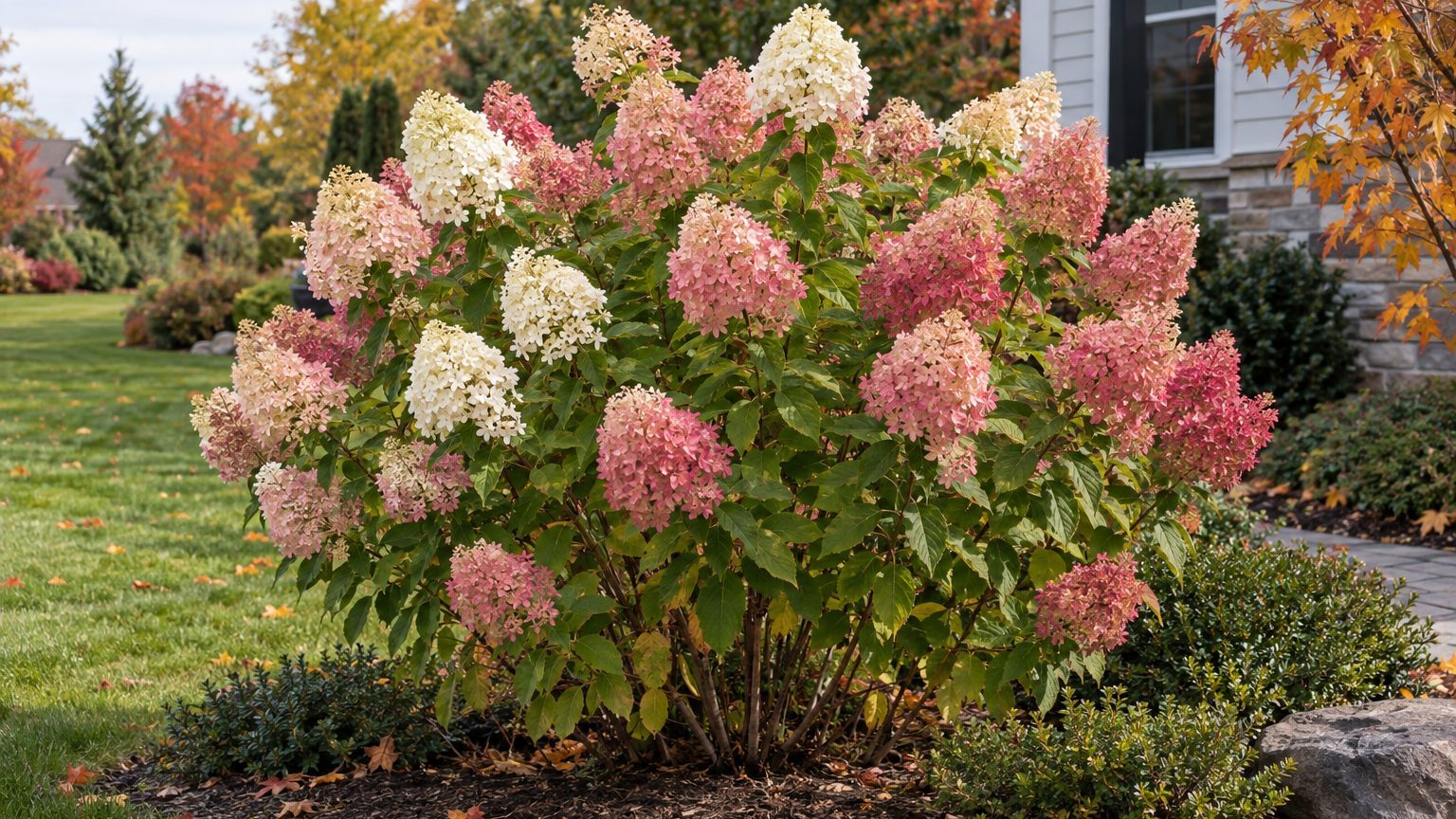
Pink Diamond hydrangea is a panicle hydrangea, a large deciduous shrub whose white summer cones turn pink as fall nights cool. It flowers on new wood, so a hard late-winter cut costs you no blooms. It also tolerates cold far better than the bigleaf types many gardeners struggle with. Here is how the year runs.
What This Variety Is
Pink Diamond is a panicle hydrangea, Hydrangea paniculata, a woody shrub that drops its leaves in winter. It grows upright and vase-shaped, with cone-shaped flower clusters held above the foliage.
What sets it apart is the color change. The cones open creamy white in summer, then blush pink as nights cool, and soil chemistry does not change that fade, so no aluminum or lime is needed.
Because it flowers on the current season’s growth, spring pruning does not cost you blooms. The Fire Light Hydrangea: Size, Zones, Pruning and Care page covers a close relative with the same habit.
Plan on a large shrub, commonly listed at 6 to 8 feet tall and about as wide, and sometimes bigger in a long warm season. Give it that room on day one.
From the almanac
Hydrangeas in your state
The dates on this page depend on where you live. Your state's page carries its frost dates, its USDA zones and the year laid out month by month.
Northeast
Southeast
- Alabama
- Arkansas
- Delaware
- Florida
- Georgia
- Kentucky
- Louisiana
- Maryland
- Mississippi
- North Carolina
- South Carolina
- Tennessee
- Virginia
- West Virginia
Midwest
Southwest
West
Pacific Northwest
Canada
Where It Grows: Zones and Regions
Pink Diamond is generally listed for roughly USDA zones 3 to 8, which covers most of the country except the hottest and driest corners. Here is how that plays out by region.
- Great Lakes and the North (Michigan, Minnesota, Wisconsin): this is home turf, since panicle types shrug off hard winters and re-grow from new wood.
- Northeast and Mid-Atlantic (New York, Pennsylvania, Maryland): reliable in full sun to part shade, with steady moisture through July.
- Midwest and Plains (Ohio, Missouri, Nebraska): it does well, but wind and dry summers mean deep watering matters more than fertilizer.
- The South (Georgia, Texas, the Carolinas): this sits at the warm edge of its range, so give it morning sun and afternoon shade and expect quicker fading in heat.
- The West (Washington, Oregon, Colorado): fine in the Pacific Northwest and in irrigated Colorado yards, but not a fit for the low desert of Arizona or Nevada.
The state selector just below this section leads to the page for your state, with local frost dates and the pruning window where you live.
The Year With It, Season by Season
Planting
A root ball that dries out in its first summer is the usual cause of a slow start. Plant in spring or early fall, set the crown level with the soil, mulch 2 to 3 inches, and water deeply once a week without rain.
Spring
New shoots leaf out late, and that is normal, not dieback. Since blooms form on this year’s wood, prune in late winter to early spring before buds swell, cutting back about a third of last year’s growth to keep stems sturdy.
Summer
Cones open white and get heavy after rain, which can bend stems on young plants. Water at the base during dry spells, skip late nitrogen, and prune lightly if a stem flops. Full sun gives the strongest bloom, though afternoon shade helps in hot regions.
Fall
Pink deepens as nights cool, and the cones hold on the shrub well past the first frost. Leave them for color and for winter interest. Stop feeding by midsummer so new growth can harden before the cold arrives.
Winter
The bare frame is hardy in the cold zones and needs no wrapping. Cut it back only when the coldest weeks have passed. Refresh the mulch after the ground freezes so the roots stay evenly cold, not thawing and refreezing.
Diseases and Pests It Resists
Nothing here says it is immune to leaf spot, mildew or insects.
The sensible default applies. Hydrangeas in crowded, humid plantings tend to get leaf spots and mildew, so spacing, sun and watering at the base do most of the work. Avoid overhead sprinklers late in the day.
For a comparison of how the other kinds handle cold, pruning and sun, they are on their own pages, and the Hydrangea Varieties Compared guide sets them side by side.
Where to Plant It in a Yard
Pink Diamond works as a back-of-border anchor, a foundation corner with real room, or a loose summer hedge. Pair it with shorter perennials in front so the bare lower stems stay hidden.
- Your state page: the frost dates and the pruning window where you live.
- Hydrangea Varieties Compared: Hydrangea Varieties Compared sets each species side by side on cold hardiness and sun.
- All Summer Beauty: All Summer Beauty Hydrangea: Size, Zones, Pruning and Care covers a bigleaf, which follows different pruning rules.
Common questions
When should I prune Pink Diamond hydrangea?
Prune in late winter to early spring, before buds swell. It blooms on new wood, so cutting then removes no flowers. Avoid heavy cuts in late summer or fall.
Will the flowers change color with soil pH?
No. The shift from white to pink is a natural fade tied to cooling weather. Soil amendments that turn bigleaf hydrangeas blue or pink do not apply here.
How much room does it need?
Plan for a shrub commonly listed at 6 to 8 feet tall and about as wide. Space it accordingly from walls, walks and neighboring plants.
Sources : gardenia.net | hydrangeasplus.com | landscapeplants.oregonstate.edu