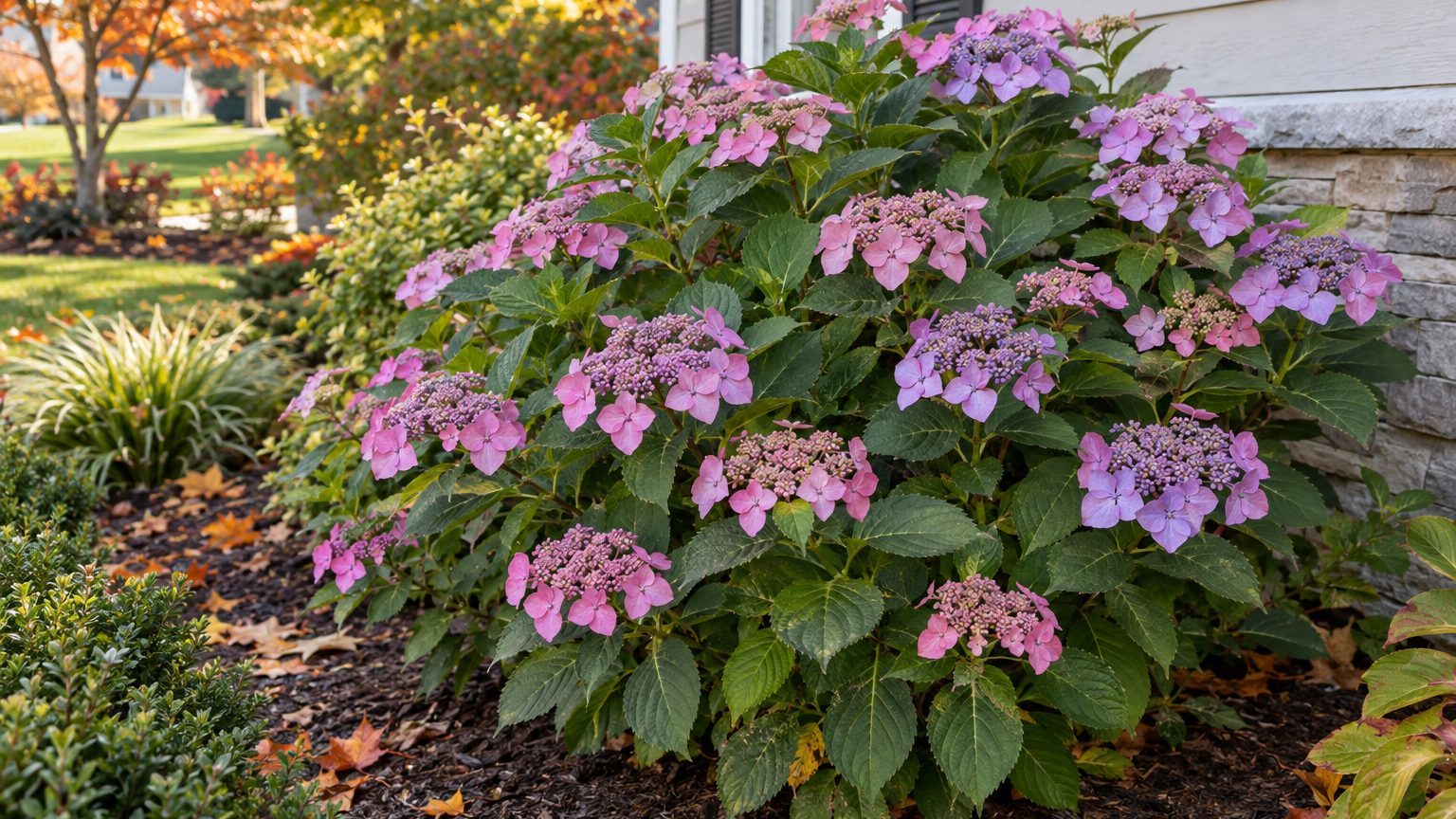
Twist-n-Shout is a reblooming bigleaf hydrangea with flat lacecap flowers, sold under the Endless Summer name. It forms a compact, rounded shrub that flowers on old wood and on new growth, so a late freeze that ruins other bigleaf types rarely leaves it bare. Here is how it behaves through the year, and where it fits.
What This Variety Is
Twist-n-Shout is a Hydrangea macrophylla, the bigleaf species, in the lacecap form: a flat disc of small fertile flowers ringed by larger showy ones. It stays a compact, mounded, deciduous shrub that suits foundation beds and borders.
What sets it apart is the bloom habit. Buds form on last year’s stems and again on the current season’s growth, so a hard winter costs you the first flush but not the whole summer.
Flower color follows soil chemistry, not the label on the pot. Acidic soil pushes the ring toward blue, alkaline soil toward pink, and neutral ground often lands on purple somewhere in between.
If you are still choosing between bigleaf, panicle and smooth types, Hydrangea Varieties Compared lines them up side by side. This one sits firmly in the bigleaf group.
From the almanac
Hydrangeas in your state
The dates on this page depend on where you live. Your state's page carries its frost dates, its USDA zones and the year laid out month by month.
Northeast
Southeast
- Alabama
- Arkansas
- Delaware
- Florida
- Georgia
- Kentucky
- Louisiana
- Maryland
- Mississippi
- North Carolina
- South Carolina
- Tennessee
- Virginia
- West Virginia
Midwest
Southwest
West
Pacific Northwest
Canada
Where It Grows: Zones and Regions
Because it blooms on new wood as well as old, this hydrangea reaches farther north than a classic mophead, but it still dislikes both deep cold and dry desert heat.
- Great Lakes and the North (Michigan, Minnesota, Wisconsin): it can work here, though winter kills much of the old wood and the summer bloom comes from new growth. A sheltered spot and a mulch blanket help.
- The Northeast and Mid-Atlantic (New York, Pennsylvania, Massachusetts): a dependable choice, with old-wood buds surviving in milder winters and new-wood buds covering the rest.
- The South (Georgia, Texas, the Carolinas): it grows well, but afternoon sun scorches the leaves, so it needs shade after midday and steady water.
- The Pacific Northwest (Oregon, Washington): mild, damp summers suit it, and it blooms for a long stretch.
- The dry West (Arizona, Nevada, inland California): the hardest place to keep it. It needs shade, irrigation and soil that holds moisture.
The state selector just below this section leads to the page for your state, with the frost dates and pruning window for your area.
The Year With It, Season by Season
Spring
Buds swell early, and a warm March followed by a frost is the classic trap. Cover the shrub on frost nights instead of cutting it back. Plant new shrubs once the ground is workable, in soil that has been loosened and amended with compost.
Early summer
The first flush opens from overwintered buds, and the flat blooms take on the color your soil dictates. To shift toward blue, add aluminum sulfate in small doses. To favor pink, add garden lime. Change color gradually, because a heavy hand burns roots.
Midsummer
New shoots keep producing flowers into the hot months, which is the reason to grow this one. Heat wilts the leaves by afternoon, so water deeply at the base in the morning. Deadhead spent blooms just above a healthy pair of leaves.
Fall
Blooming continues until frost, so stop pruning by midsummer. Late cuts remove the buds that carry next year’s first flush. Leave the faded flower heads on the plant, since they protect the buds beneath them through winter.
Winter
Old-wood buds are the vulnerable part. After the ground cools, pile shredded leaves or bark around the base, and in cold regions wrap the stems loosely in burlap. Skip pruning until spring growth reveals which stems survived.
Diseases and Pests It Resists
I would rather say so than promise resistance it may not have.
Bigleaf hydrangeas as a group can get powdery mildew and leaf spot, and spider mites in dry heat. Those are species-level tendencies, not a rating for this cultivar. Airflow between shrubs and morning watering at the soil line cut most of the risk.
A comparison table belongs here only once the ratings exist for this cultivar. The other kinds of hydrangea are on their own pages, each with the traits that matter for them.
Where to Plant It in a Yard
Give it morning sun and afternoon shade, moist soil that drains, and room to spread. It works in a foundation bed, along a walkway or in a mixed border. Check your state page for frost dates and the pruning window.
- Ruby Slippers Hydrangea: Size, Zones, Pruning and Care: a smooth hydrangea whose blooms age from white to pink, a good partner for a colder or sunnier bed.
- Everlasting Amethyst Hydrangea: Size, Zones, Pruning and Care: a panicle type with a different bloom habit and a different pruning schedule.
- Hydrangea Varieties Compared: the full comparison to read before you buy a second shrub, so the bloom times overlap.
Common questions
Does Twist-n-Shout need pruning?
Very little. Remove dead stems in spring once leaves show, and deadhead spent flowers in summer. Avoid heavy cutting late in the season, because that removes the buds that produce the earliest blooms.
Can I change the flower color?
Yes, within limits. Soil acidity decides the color: blue in acidic soil, pink in alkaline soil. Test the soil first, then adjust slowly over a full season instead of in one heavy application.
Why did mine bloom late this year?
A hard winter or a spring frost likely killed the old-wood buds. The shrub then flowered on new growth, which comes later. Protect the base with mulch next winter to keep more of the first flush.
Sources : jardiland.com | rhs.org.uk