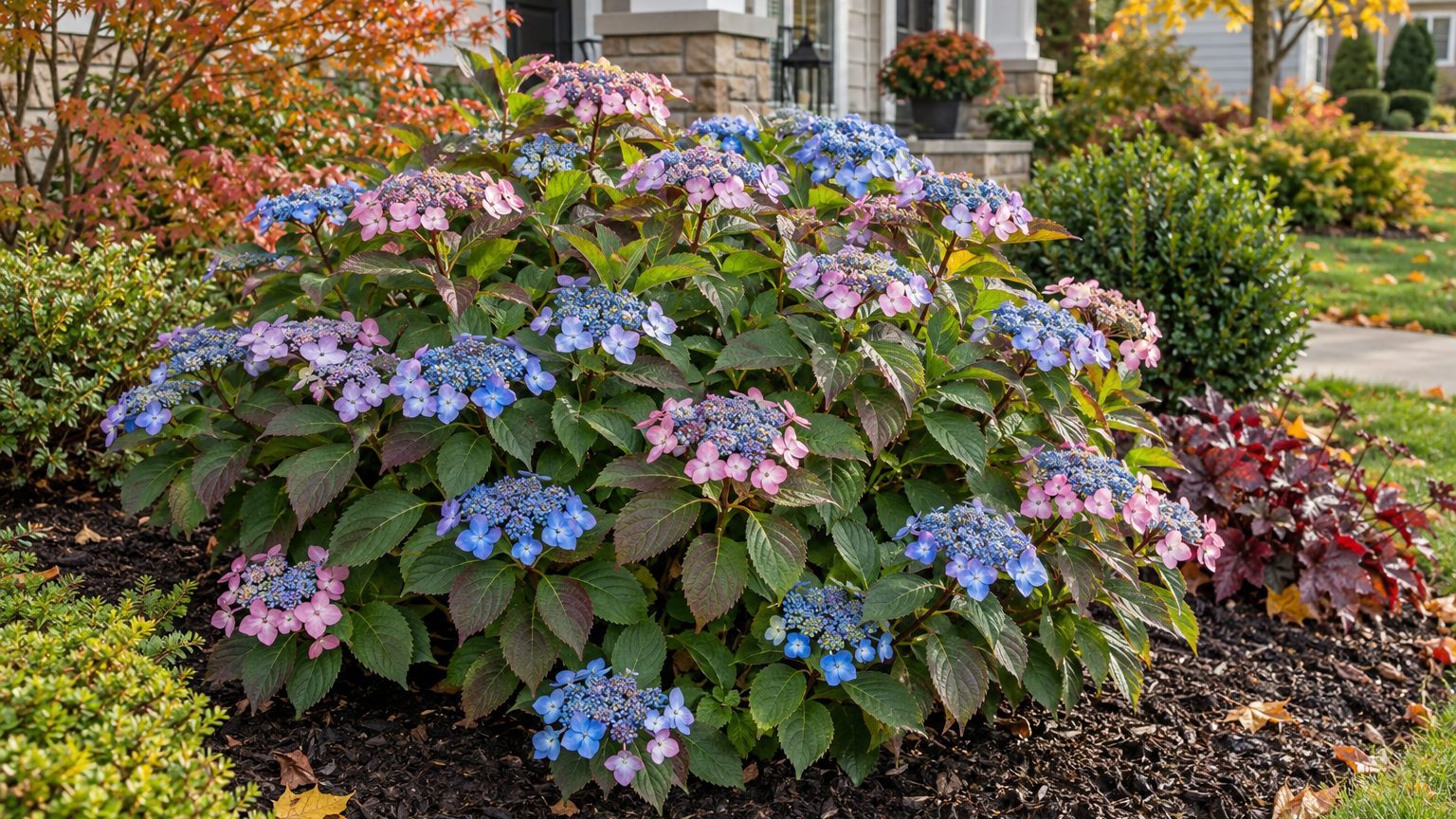
Tuff Stuff hydrangea is a compact mountain hydrangea that flowers on both old and new wood, so a hard winter rarely wipes out the whole season. It is hardier than the bigleaf types it resembles and stays small enough for a front bed. Gardeners who lost bigleaf buds to a late freeze benefit most.
What This Variety Is
Tuff Stuff belongs to the mountain hydrangea group, Hydrangea serrata, a close cousin of bigleaf with finer leaves and a tidier, mounded habit. It is a deciduous shrub, so it drops its leaves in fall and leafs out again in spring.
The flowers are lacecaps: a flat disc of small fertile blooms ringed by larger showy florets. Color follows soil chemistry, leaning blue in acid ground and pink where the soil is closer to neutral or alkaline.
What sets it apart is rebloom, the habit of flowering more than once in a season. Buds form on last year’s stems and on fresh growth, so one bad freeze does not cancel the show.
Size stays modest next to panicle types, and the habit is dense rather than floppy. Exact height and width shift with climate and pruning.
Leaves are smaller and more toothed than a mophead’s, and many take on a burgundy tone in cool fall weather. That color is a small bonus, not a reason to plant it.
From the almanac
Hydrangeas in your state
The dates on this page depend on where you live. Your state's page carries its frost dates, its USDA zones and the year laid out month by month.
Northeast
Southeast
- Alabama
- Arkansas
- Delaware
- Florida
- Georgia
- Kentucky
- Louisiana
- Maryland
- Mississippi
- North Carolina
- South Carolina
- Tennessee
- Virginia
- West Virginia
Midwest
Southwest
West
Pacific Northwest
Canada
Where It Grows: Zones and Regions
Mountain hydrangeas favor cool summers and reliable moisture, and Tuff Stuff stretches that range north of where bigleaf gives up. Match your USDA zone to the plant, then read your region below.
- Northeast and Great Lakes (New York, Vermont, Michigan): the sweet spot, where cold-hardy buds and a rebloom habit pay off after unpredictable winters.
- Mid-Atlantic and Upper South (Virginia, Kentucky, Maryland): it does well with morning sun and afternoon shade, and it handles humid summers better than most bigleaf types.
- Pacific Northwest (Washington, Oregon): cool summers and mild winters suit it, and it needs little beyond mulch and steady moisture.
- Deep South and Gulf Coast (Georgia, Alabama, Texas): heat is the limit, so give it dappled shade and consistent water, or expect scorched leaves and a short bloom.
- Mountain West and Southwest (Colorado, Utah, Arizona): dry air, strong sun and alkaline soil work against it, so plant it where buildings or trees block the harshest light.
- Northern Plains and far north (Minnesota, North Dakota, Montana): it can die back to the ground in the coldest winters, and the new-wood buds are what save the season.
The state selector just below this section takes you to the page for your state, with local frost dates and pruning windows.
The Year With It, Season by Season
Planting
Roots need time to settle before extremes hit, which is why spring or early fall beats midsummer. Loosen the soil, set the crown level with the ground, and mulch the root zone. Your state page shows the planting window for your area.
Spring growth
New shoots leaf out fast, and late frost can nip the tips. Because buds sit on both old and new wood, the shrub recovers. Wait until growth shows which stems are dead, then cut only those back. The calendar ribbon marks local frost timing.
Bloom
Lacecaps open first on old wood, and a second flush follows on new stems. Removing spent flowers pushes energy toward that second round, so cut just above a pair of healthy leaves. A light feeding after the first flush helps. Your state page has the pruning window.
Summer heat
Fine leaves lose water quickly, so afternoon sun and dry spells cause drooping and brown edges. Water deeply at the base rather than overhead, and keep the mulch layer in place. Your state page lists the hot months to watch closely.
Fall
Cooling nights bring burgundy tones to the foliage. Stop fertilizing so stems can harden off, and hold off on heavy pruning, since cutting now removes next year’s old-wood buds. Leave the stems up and let the leaves drop naturally.
Winter
Cold can kill old-wood buds, but new growth still carries the shrub into bloom. Mulch over the crown once the ground has frozen, and wrap the plant in the coldest areas. Save all pruning for spring, when dead wood is easy to spot.
Diseases and Pests It Resists
Nursery tags sometimes promise more than trial data supports.
What holds for hydrangeas generally: leaf spot and powdery mildew show up in crowded, humid beds with poor airflow, and aphids or spider mites appear in dry, stressed plantings. Spacing the plants and watering at the base do more than any spray.
The other kinds have their own pages, and Hydrangea Varieties Compared lines up how they differ, so you can weigh this one against panicle and smooth types before you buy.
Where to Plant It in a Yard
Give it a bed with morning sun and afternoon shade, near a downspout or hose bib. It suits foundation plantings, walkway edges and the front of a mixed border.
- Pink Diamond Hydrangea: Size, Zones, Pruning and Care: a panicle type to plant behind it for late-summer color once the lacecaps fade.
- Phantom Hydrangea: Size, Zones, Pruning and Care: a larger panicle for the back of the bed, with sturdy stems and big blooms.
- Your state page: the frost dates and the pruning window where you live.
Common questions
Does Tuff Stuff hydrangea bloom on new wood?
Yes, on both. It sets buds on last year’s stems and again on fresh growth, which is why it reblooms and why a cold winter rarely erases the season. Avoid heavy pruning so the old-wood buds survive.
Can I change the flower color?
Soil chemistry drives it. Acid soil leans blue and near-neutral or alkaline soil leans pink. Test the soil first, then adjust slowly over a full season, because quick fixes tend to burn roots and rarely last.
Should I cut it back in fall?
No. Fall cuts remove buds that formed on old wood and would open next season. Wait until spring, see which stems are dead, and remove only those. Light deadheading during the growing season is the one exception.
Sources : jardin2m.com | provenwinners.com | pepiniere.ca