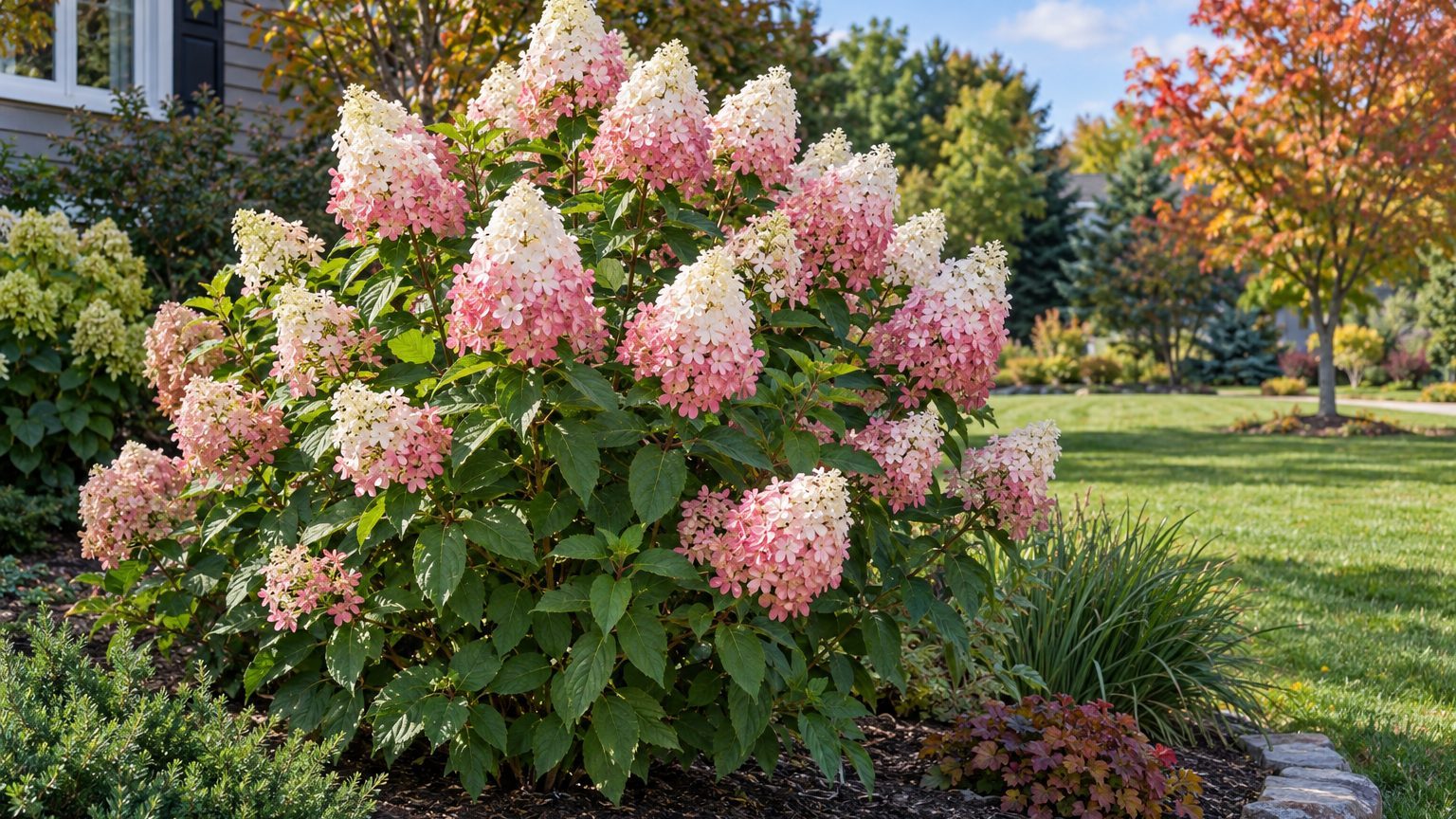
Pinky Winky hydrangea is a panicle hydrangea, a tough deciduous shrub whose cone-shaped flower heads open white and turn pink from the bottom up. It flowers on new wood, so a hard winter rarely costs you the show. It suits cold northern yards and much of the South, with a few conditions that decide how well it does.
What This Variety Is
Pinky Winky is a cultivar of Hydrangea paniculata, a deciduous shrub with an upright, vase-shaped habit. Woody stems hold large cone-shaped flower clusters well above the foliage.
The two-tone effect is what sets it apart. Each cluster opens white at the tip while the older base flushes pink, so one shrub carries both colors at once.
The flowers form on the current season’s growth, and that rule governs almost everything else. Pruning timing, winter losses and bloom failure all trace back to it.
Mature size and the hardiness range appear in the plate for your state. Read those before you pick a spot.
From the almanac
Hydrangeas in your state
The dates on this page depend on where you live. Your state's page carries its frost dates, its USDA zones and the year laid out month by month.
Northeast
Southeast
- Alabama
- Arkansas
- Delaware
- Florida
- Georgia
- Kentucky
- Louisiana
- Maryland
- Mississippi
- North Carolina
- South Carolina
- Tennessee
- Virginia
- West Virginia
Midwest
Southwest
West
Pacific Northwest
Canada
Where It Grows: Zones and Regions
Panicle hydrangeas handle cold better than most of their relatives, and Pinky Winky follows that pattern. Heat and dry air set its limits, not winter.
- Great Lakes and the North (Michigan, Minnesota, Wisconsin): a dependable choice, since frozen stem tips don’t cancel a bloom that forms on new wood.
- Northeast and Mid-Atlantic (New York, Pennsylvania, Virginia): grows without fuss in sun, with mulch over the roots for the coldest winters.
- The South (Georgia, Texas, the Carolinas): it grows, but this is the hot edge of its range, so afternoon shade and steady water matter.
- Pacific Northwest (Washington, Oregon): mild summers suit it and it needs little beyond a sunny site.
- Mountain West and Southwest (Colorado, Utah, Arizona): dry air and wind scorch the flowers, so plan on regular irrigation and shelter, and expect a struggle in the desert.
The state selector just below this section leads to the page for your state, with the frost dates and pruning window that apply there.
The Year With It, Season by Season
Planting
Roots come first and flowers second, so a new plant may sit quietly through its first season. Set it in sun with room to spread, water deeply until it settles, and mulch the base. Spring and fall planting both work where winters allow.
Spring
New stems race up after the last hard frost, and that is where the flowers are made. Prune in late winter or very early spring, before buds swell, shortening last year’s stems just above strong buds. Your state page gives the window.
Summer
Flower heads open white in mid to late summer, then blush pink. Heavy heads can bend stems after rain, so thin crowded stems in spring. In hot spells, water at the base and give afternoon shade in the South.
Fall
Pink deepens as nights cool, and the heads dry on the branch to tan and rose. Leave them for color, or cut some for dried arrangements. Skip fertilizer now, because it pushes soft growth that winter will burn.
Winter
Because the flowers come on new wood, cold-killed tips do no harm to next summer’s bloom. Leave stems standing through winter, then cut in late winter. In the far North, mulch the roots once the ground freezes.
Diseases and Pests It Resists
What holds for hydrangeas in general is that crowded stems and wet leaves invite trouble. Air flow and watering at the base are the two habits worth building, whatever the resistance turns out to be.
The other hydrangea kinds are on their own pages, each with its own known weak points.
Where to Plant It in a Yard
Give it a sunny spot with space to reach full size, such as a back border, a foundation corner, or a informal screen. Pair it with lower perennials and evergreens that hold the bed together after the flowers fade.
- Hydrangea Varieties Compared: how the main hydrangea kinds differ on bloom wood, sun and hardiness.
- Incrediball Hydrangea: Size, Zones, Pruning and Care: a smooth hydrangea with round white heads, useful beside a panicle.
- Mariesii Hydrangea: Size, Zones, Pruning and Care: a lacecap type that flowers earlier in a different style.
Before you dig, open your state page and check the frost dates and pruning window where you live.
Common questions
When should I prune Pinky Winky hydrangea?
Prune in late winter or very early spring, before buds begin to swell. Since it blooms on new wood, this timing protects the flowers. Your state page shows the window for your area.
Why is mine staying white instead of turning pink?
The pink comes with flower age and cool nights, not with soil chemistry as in bigleaf hydrangeas. Young heads open white. Wait for late summer and fall, and expect more color where nights cool early.
Does it need shade in a hot climate?
In the South and other hot regions, afternoon shade limits petal scorch and wilting. Deep watering and mulch help too. In cooler northern yards, full sun is the better choice for the heaviest bloom.
Sources : heritagehillnurseryinc.com