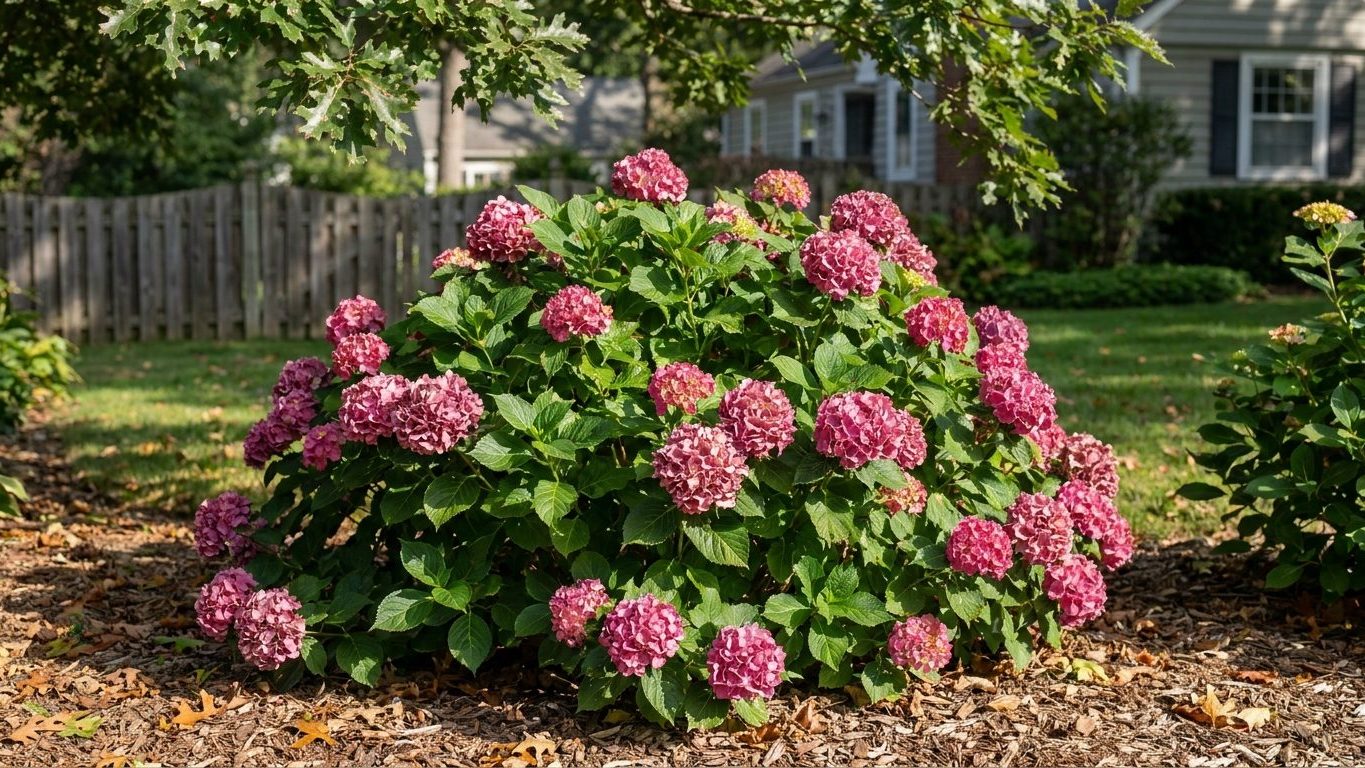
Cityline Paris answers a simple problem: full-size bigleaf hydrangeas outgrow small yards and patio pots. This cultivar tops out under two feet, keeps the same mophead flower and pH-driven color shift as its bigger cousins, and fits foundation beds, planters, and tight side yards without the annual fight against a shrub that wants to be six feet wide.
What This Variety Is
Cityline Paris belongs to Hydrangea macrophylla, the bigleaf group, inside a series bred specifically for compact scale rather than hedge-height growth. NC State Extension Gardener Plant Toolbox puts bigleaf hydrangea at 6a to 9b, and Paris performs reliably through most of that range.
The plant forms a rounded mound closer to a compact shrub rose than a typical hydrangea. Mature size runs about 18 to 24 inches tall and roughly as wide, a fraction of what many bigleaf types reach.
Flowers are true mopheads, dense round heads rather than the flatter lacecap form. Color still follows soil chemistry, blue in acidic soil and pink in alkaline, exactly like its full-size relatives.
Three things separate it from a generic bigleaf hydrangea:
- A fixed dwarf habit that doesn’t stretch much with age
- Old-wood blooming with little to no rebloom on new growth
- Breeding aimed at containers and small beds, not cutting gardens
From the almanac
Hydrangeas in your state
The dates on this page depend on where you live. Your state's page carries its frost dates, its USDA zones and the year laid out month by month.
Northeast
Southeast
- Alabama
- Arkansas
- Delaware
- Florida
- Georgia
- Kentucky
- Louisiana
- Maryland
- Mississippi
- North Carolina
- South Carolina
- Tennessee
- Virginia
- West Virginia
Midwest
Southwest
West
Pacific Northwest
Canada
Where It Grows: Zones and Regions
NC State Extension Gardener Plant Toolbox lists bigleaf hydrangea at 6a to 9b, and Cityline Paris sits inside that window without stretching it, since the compact series wasn’t bred for extra cold tolerance. What changes the outcome from state to state isn’t survival, it’s whether the flower buds on old wood make it through winter.
- The Mid-Atlantic and Southeast (Virginia, North Carolina, Georgia): winter lows rarely reach the point that kills stems to the ground, so old-wood buds carry through and bloom shows up most years.
- The Pacific Northwest (Washington, Oregon): mild, wet winters and cool summers suit the shrub well, with Portland acting as a reasonable reference for the milder end of the range.
- The Upper Midwest and New England (Minnesota, Wisconsin, Maine): winter lows drop well below the tolerance line, killing old wood most years even where the roots themselves survive.
- The Deep South and Gulf Coast (Florida, Louisiana, Texas): heat above the upper end of the range stresses the plant in open sun, making afternoon shade the deciding factor rather than cold.
The state selector below this section opens the page built around your own frost dates, not a national average.
The Year With It, Season by Season
Planting in spring or fall
Cityline Paris settles best in spring after the last frost or in early fall while soil is still warm. Dig the hole wide, not deep, and hold off on high-nitrogen fertilizer that pushes leaves over roots.
New growth stays low and dense
Unlike full-size bigleaf types, the first push of stems doesn’t lengthen much past the plant’s mature spread. Resist pruning it like a taller hydrangea, since there’s little spare wood to cut back.
Buds open on last year’s stems
Flower buds formed the previous summer open through late spring into early summer, which is why a late hard frost can erase a season’s bloom entirely. Skip any pruning until after flowering finishes.
Leaves wilt in afternoon heat
Bigleaf foliage droops fast once temperatures climb, even with adequate soil moisture on hand. It usually recovers by evening, so check soil before assuming the plant needs more water.
Color and foliage shift into fall
Spent flower heads dry in place and leaves pick up bronze tones as nights cool down. Leave the dried heads on the plant, since removing them risks cutting into next year’s buds.
Buds need cover through winter
Old-wood flower buds sit exposed above ground all winter, unlike the roots below. A loose mulch layer or burlap wrap over the crown protects them where lows dip toward the edge of its range.
Diseases and Pests It Resists
Cityline Paris carries the same disease profile as bigleaf hydrangea generally, since breeding for this series focused on size and flower form rather than resistance. NC State Extension Gardener Plant Toolbox lists Cercospora leaf spot and botrytis blight as common fungal problems on bigleaf hydrangea in humid, low-airflow spots.
Bud drop from late frost counts as its biggest working weakness in the ground, more than any single insect or fungus. Watch for aphids and spider mites on new growth, especially on container plants kept near a warm wall.
| Threat | This one | Source |
|---|---|---|
| Cercospora leaf spot | Susceptible in humid, low-airflow spots | NC State Extension |
| Botrytis blight | Shows on damaged or crowded flower heads | NC State Extension |
| Aphids and spider mites | Common on new growth and containers | NC State Extension |
| Late frost bud kill | Main cause of a no-bloom year | NC State Extension |
Deer browsing and powdery mildew aren’t well documented for this specific cultivar, so treat the general bigleaf hydrangea page as the fuller reference.
Where to Plant It in a Yard
Cityline Paris fits spots a full-size bigleaf hydrangea never would: a foundation bed under a window, a large patio pot, or the front edge of a border. Give it morning sun and afternoon shade, and keep it away from reflected heat off pavement or south-facing brick.
- Your state page: the frost dates and the pruning window where you live.
- Bigleaf hydrangea care: the fuller profile of the species this cultivar belongs to.
- Hydrangea pruning by type: which stems to cut and when, since old-wood bloomers punish a wrong-season cut.
Plant it where the old wood can ride out winter untouched, then let it fill the spot without expecting it to grow past its own footprint.
Common questions
Does Cityline Paris bloom on new wood?
Mostly no. It sets flower buds on the previous season’s stems, so a hard late frost or a wrong-season pruning cut can erase that year’s bloom entirely.
Can I keep Cityline Paris in a container year-round?
Yes, and many gardeners do exactly that given its small size, but container roots freeze faster than roots in the ground. Move pots against a sheltered wall or into an unheated garage where winter lows run hardest.
Why did my Cityline Paris turn from blue to pink?
Soil pH shifted toward alkaline, cutting off the aluminum uptake that makes bigleaf hydrangea flowers blue. Adding sulfur or an acidifying fertilizer nudges it back over a season, not overnight.
Sources : provenwinners.com | rhs.org.uk