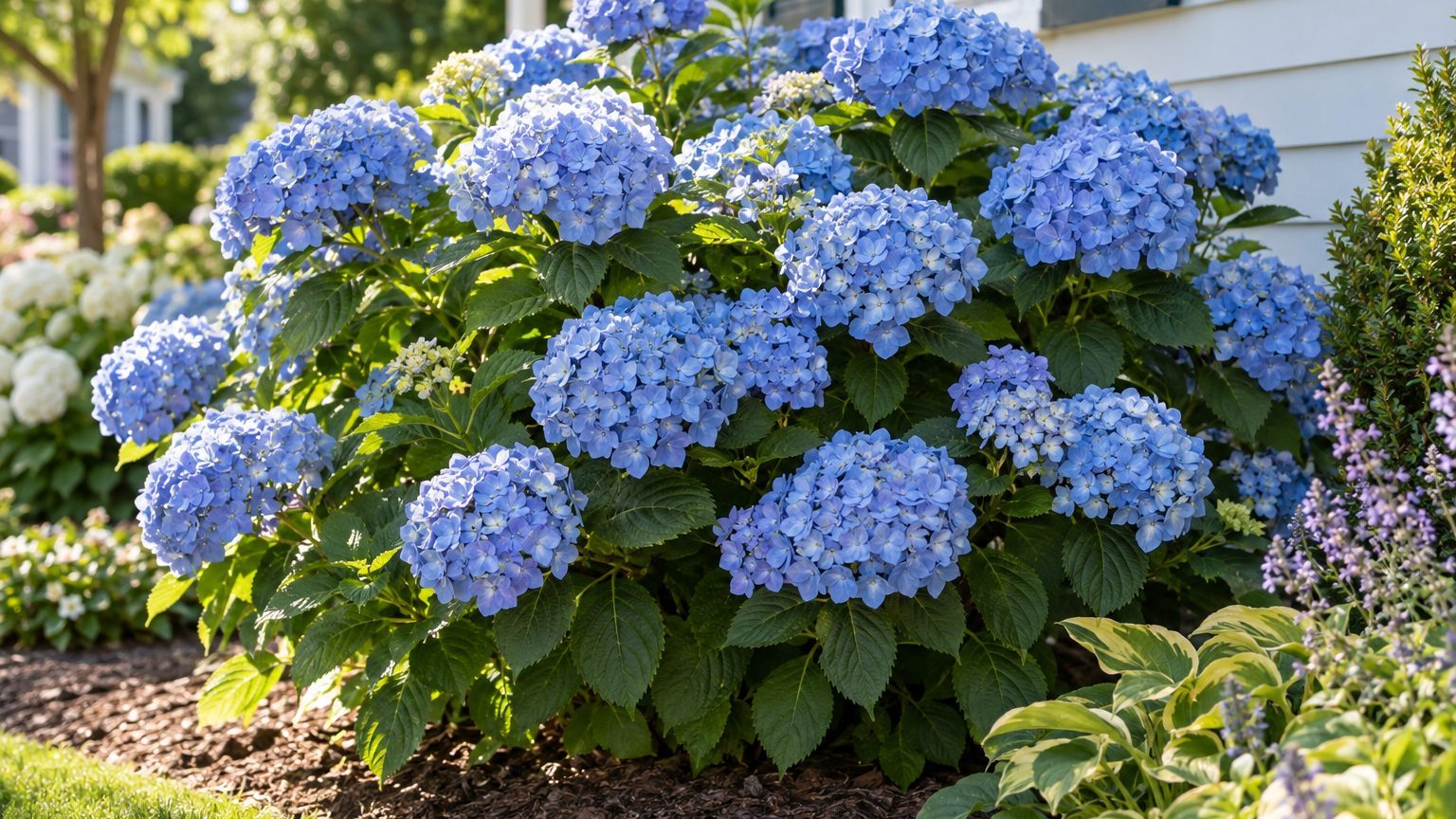
Nantucket Blue is a compact bigleaf hydrangea that reblooms on old and new wood, so a warm week after a rough winter still delivers mophead flowers by summer. Hardy roughly zones 6 to 9, it grows into a 3 to 4 foot mound and needs only light, well-timed pruning. Soil pH still decides whether those flowers open blue or pink.
What This Variety Is
Nantucket Blue is a bigleaf hydrangea, Hydrangea macrophylla, bred as a mophead that flowers on both old and new wood. That habit sets it apart from older bigleaf cultivars that bloom only on stems grown the year before.
The plant forms a rounded, dense mound rather than an open, spreading shrub. Height and spread land around 3 to 4 feet, which keeps it in scale with a foundation bed or a mixed border.
NC State Extension Gardener Plant Toolbox lists bigleaf hydrangea’s hardiness at 6a to 9b, and nurseries sell Nantucket Blue inside that same window. Bloom color still swings with soil chemistry, not with the cultivar name on the tag.
Three traits set it apart in a nursery row:
- Rebloom on new growth after a hard winter or a bad prune
- A tight, rounded habit that holds shape without staking
- Large mophead clusters that shift blue to pink with soil pH
From the almanac
Hydrangeas in your state
The dates on this page depend on where you live. Your state's page carries its frost dates, its USDA zones and the year laid out month by month.
Northeast
Southeast
- Alabama
- Arkansas
- Delaware
- Florida
- Georgia
- Kentucky
- Louisiana
- Maryland
- Mississippi
- North Carolina
- South Carolina
- Tennessee
- Virginia
- West Virginia
Midwest
Southwest
West
Pacific Northwest
Canada
Where It Grows: Zones and Regions
Nantucket Blue’s flower buds are what limit it, not the roots. NC State Extension Gardener Plant Toolbox puts bigleaf hydrangea’s range at 6a to 9b, and a late frost after bud swell can erase a season’s old-wood flowers even where the shrub itself survives the winter.
- New England and the coast (Massachusetts, Connecticut, Rhode Island): this is the plant’s namesake ground, with mild winters and humid summers that keep buds intact through spring frost.
- Mid-Atlantic (Virginia, Maryland, New Jersey): reliable in most yards, though a hard freeze after an early warm spell can still cost the first flush of blooms.
- The Deep South (Georgia, South Carolina, Texas): heat and bright afternoon sun push it toward part shade, since full summer sun on clay soil scorches the leaf edges.
- Upper Midwest and interior cold pockets (Minnesota, Wisconsin, Michigan): winters routinely drop past the shrub’s tolerance, so buds need mulch or a wrap to make it through.
- Pacific Northwest (Oregon, Washington): mild, wet winters and cool summers suit it about as well as the coastal Northeast does.
The state selector below this section leads to the frost dates and pruning window for where you live, since one national range hides a lot of local variation.
The Year With It, Season by Season
Spring
Plant after the last frost date and before summer heat sets in, so roots settle before the plant pushes stem growth. Old wood buds swell first, and a late cold snap now is the single biggest threat to that first bloom.
Early summer
Flowers open on last year’s stems first, usually the biggest mophead clusters of the year. Deadhead spent blooms just below the flower head, cutting to the first healthy pair of leaves, without touching the buds forming lower on the stem.
Midsummer
New-wood flowers follow through the hottest weeks, which is why the shrub keeps color even after a rough winter. Water deeply during dry stretches, since bigleaf hydrangea wilts fast in afternoon sun once soil dries out.
Fall
Bloom color fades and flower production slows as day length shortens. Leave the last flush of flowers on the stem through fall, since cutting now removes wood that could carry next year’s earliest buds.
Winter
Old wood buds are the vulnerable part of the plant, not the roots or the stems below ground. Mulch the base a few inches deep, and in the coldest pockets of its range, wrap the top growth before the first hard freeze.
Diseases and Pests It Resists
Bigleaf hydrangeas share a short list of common problems, and Nantucket Blue doesn’t stand apart from the species on that score. Clemson Cooperative Extension Home & Garden Information Center lists Cercospora leaf spot and Botrytis blight as the two fungal issues to watch on wet foliage.
Deer browse the leaves and flower buds when hungrier options run out, though the shrub isn’t a preferred target the way hostas are. Aphids show up on new growth in spring but rarely do lasting damage.
| Threat | This one | Source |
|---|---|---|
| Cercospora leaf spot | Common on wet leaves | Clemson HGIC |
| Botrytis blight | Common in humid, still air | Clemson HGIC |
| Aphids | Occasional on new growth | Clemson HGIC |
| Deer browsing | Occasional, not a preferred target | Clemson HGIC |
Powdery mildew and root rot in soggy soil round out the list, but neither is documented as a particular weakness of this cultivar, and the other kinds are on their own pages.
Where to Plant It in a Yard
Give it morning sun and afternoon shade anywhere south of the Mid-Atlantic, and fuller sun further north where summers run cooler. Rich, evenly moist soil with steady drainage keeps the mophead clusters from wilting by midday.
- Your state page: the frost dates and the pruning window for where you live.
- Hydrangea pruning guide: when to cut old wood back and when to leave it alone.
- Hydrangea soil pH and bloom color: how to nudge flowers toward blue or pink over a season.
Pair it with hostas or ferns along a shade edge, or mass a few plants along a foundation where the afternoon sun breaks early.
Common questions
Does Nantucket Blue always bloom blue?
No. Flower color follows soil pH, not the cultivar name, so the same plant can open pink in alkaline soil and blue in acidic soil within the same yard.
Can I prune it hard in fall?
A hard fall prune removes the old wood buds that would have opened first next spring. Light deadheading and removing dead stems is safer than a full cutback.
Will it survive a zone 5 winter?
The shrub itself often does, but flower buds are less cold hardy than the roots. Expect fewer old-wood blooms and a later, new-wood-only display in the coldest part of its range.