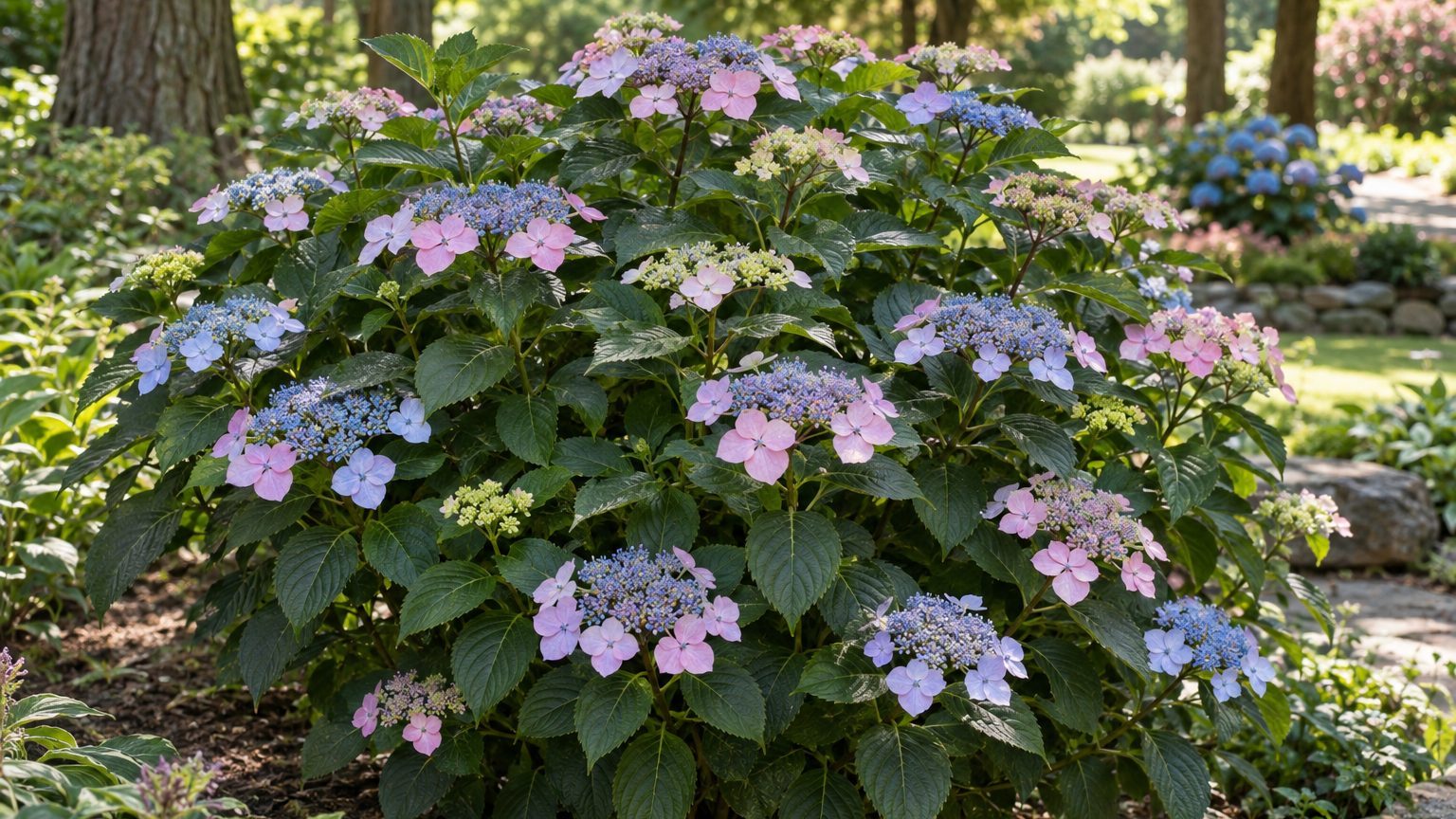
Mariesii hydrangea is a lacecap-flowered cultivar of the bigleaf hydrangea, Hydrangea macrophylla. It grows as a rounded, mounding shrub with flat flower heads and holds in USDA zones 6a to 11b. It blooms on old wood, wants part shade, and its color shifts with soil pH.
What This Variety Is
Mariesii belongs to the lacecap group of bigleaf hydrangeas. NC State Extension Gardener Plant Toolbox puts bigleaf at 6a to 11b, and Mariesii sits inside that same range.
A lacecap head is flat, not round. A ring of large, showy sepals surrounds a center of tiny, fertile florets.
The shrub keeps a mounding, rounded shape through the growing season. It blooms on old wood, meaning the flower buds form on last year’s stems, not on new spring growth.
Part shade suits it best, especially where afternoon sun runs hot. Morning sun with afternoon cover keeps the leaves from wilting midday.
From the almanac
Hydrangeas in your state
The dates on this page depend on where you live. Your state's page carries its frost dates, its USDA zones and the year laid out month by month.
Northeast
Southeast
- Alabama
- Arkansas
- Delaware
- Florida
- Georgia
- Kentucky
- Louisiana
- Maryland
- Mississippi
- North Carolina
- South Carolina
- Tennessee
- Virginia
- West Virginia
Midwest
Southwest
West
Pacific Northwest
Canada
Where It Grows: Zones and Regions
NC State Extension Gardener Plant Toolbox puts bigleaf hydrangea, the species behind Mariesii, at zones 6a to 11b, and that range sorts the country into clear winners and losers.
- Great Lakes and the North (Minnesota, Wisconsin, Maine): Minneapolis sits around zone 4, well below 6a, so Mariesii will not overwinter reliably outdoors here without heavy protection.
- Mid-Atlantic and Southeast (Virginia, North Carolina, Georgia): Raleigh’s zone 7b falls comfortably inside the range, and this belt is close to the sweet spot for the plant.
- Deep South and Gulf Coast (Louisiana, Texas, Florida): the range stretches up near Miami’s zone 10b, but the heat means afternoon shade and steady water matter more than the cold does.
- Pacific Northwest and coastal California (Washington, Oregon, California): Seattle’s zone 8b sits mid-range, and the milder, damper summers there suit a lacecap hydrangea well.
The state selector below turns this into your own numbers, your zone, your frost dates, and your safe pruning window, instead of a national guess.
The Year With It, Season by Season
Spring
Leaf and flower buds swell along last year’s stems as the soil warms. A late freeze can blacken those swelling buds before they open, so cover the shrub if frost threatens once buds show color.
Summer
Flat lacecap heads open, with a ring of large sepals framing a center of small, fertile florets. Soil chemistry decides the color, and aluminum sulfate worked into acidic soil pulls the ring toward blue.
Fall
Skip pruning entirely this season. Next year’s flower buds are already set along the stems by now, and cutting back removes them, which is the one mistake that costs a full year of bloom.
Winter
The shrub goes dormant, but next year’s buds sit exposed on old wood through the cold months. A hard freeze near the low end of the range can kill those buds outright even when the roots survive underground.
Diseases and Pests It Resists
Mariesii carries no special resistance to deer. The broad, tender leaves and the flower buds are both readily browsed where deer pressure is high.
Fungal trouble shows up mostly where air can’t move through the shrub. Crowded plantings against a fence or wall see it more than open, well-spaced beds.
| Threat | This one | Source |
|---|---|---|
| Deer browsing | Foliage and flower buds are readily eaten | NC State Extension Gardener Plant Toolbox |
| Leaf spot (Cercospora) | Common in humid spots with poor airflow | NC State Extension Gardener Plant Toolbox |
| Powdery mildew | Shows on shaded leaves late in the season | NC State Extension Gardener Plant Toolbox |
| Aphids | Minor, rarely needs treatment | NC State Extension Gardener Plant Toolbox |
Panicle and oakleaf hydrangeas handle deer and heat differently, and the other kinds are on their own pages.
Where to Plant It in a Yard
Give Mariesii morning sun and afternoon shade, room for a rounded mound at maturity, and shelter from drying wind, near a woodland edge or a shaded foundation bed works well.
- Your state page: the frost dates and the pruning window where you live.
- Bigleaf hydrangea zones and care: how Mariesii compares to mophead types in the same species.
- Hydrangea pruning by type: the old-wood versus new-wood rule laid out side by side.
Match the site to the shade first, the color debate over soil pH can wait until the shrub is settled in.
Common questions
Does Mariesii hydrangea bloom on new growth?
No. It blooms on old wood, so pruning in fall, winter, or early spring cuts off the buds already set for the coming season.
Can I change the flower color?
Yes. Soil pH and available aluminum control it, acidic soil pulls the sepals toward blue, and alkaline soil shifts them toward pink.
Is a lacecap the same as a mophead hydrangea?
No. A lacecap head is flat with a ring of large sepals around tiny fertile florets, while a mophead is a full, rounded ball of showy sepals.
Sources : rhs.org.uk