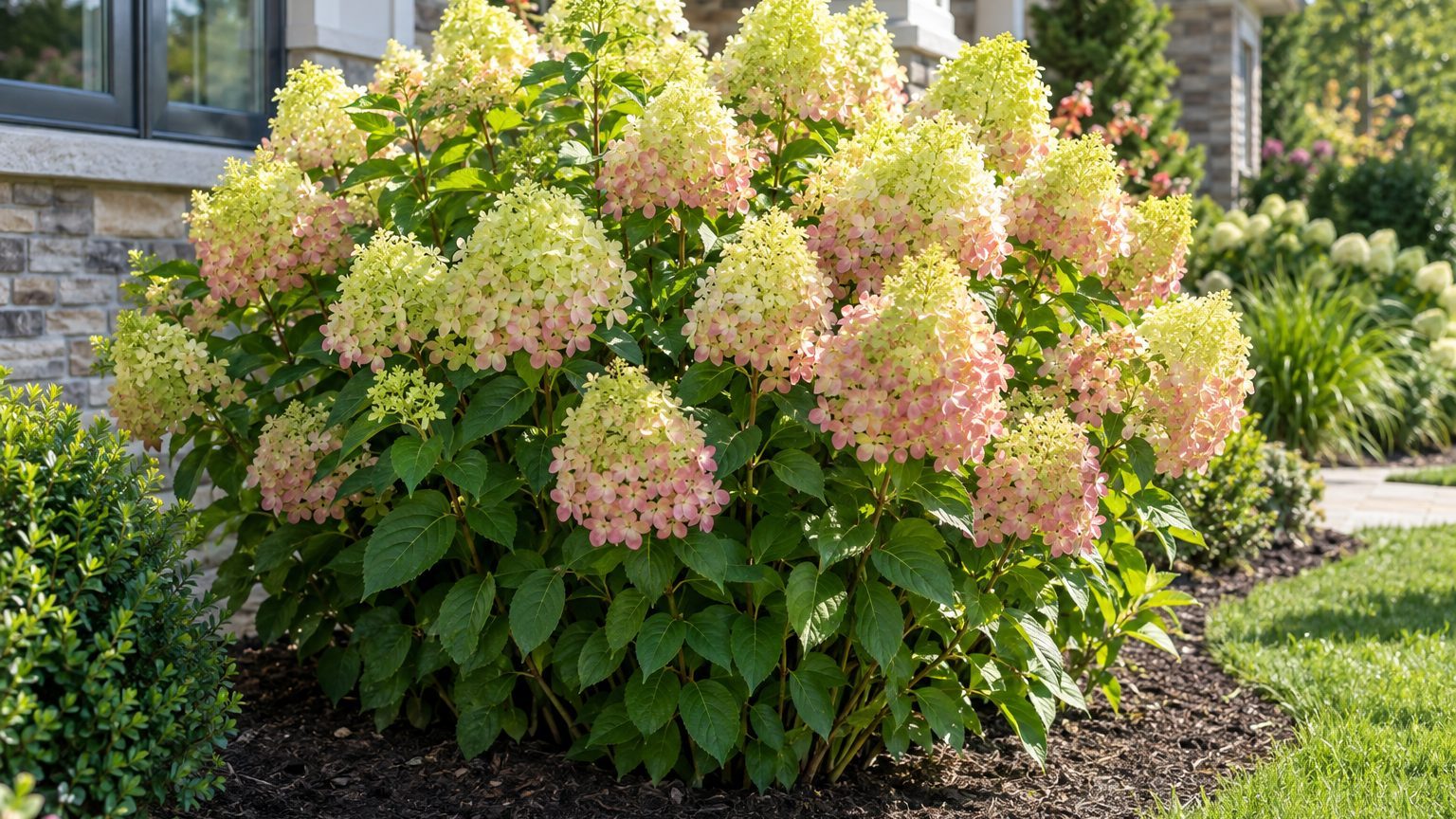
Little Lime hydrangea is a compact panicle type, hardy in USDA zones 3 through 8, that grows 3 to 5 feet tall and wide. It blooms on new wood from summer into fall, opening lime green and aging to a pink blush, and gets a hard cut back in late winter before new growth starts. It takes more sun and more cold than a bigleaf hydrangea.
What This Variety Is
Little Lime is a dwarf sport of the panicle hydrangea Limelight, bred to fit a foundation bed instead of a background border. NC State Extension Gardener Plant Toolbox lists Hydrangea paniculata as hardy from zone 3 to zone 8, a wider range than most bigleaf types manage.
The shrub reaches 3 to 5 feet tall and about as wide, roughly half the mature size of the straight species. Its stems stay sturdy enough to hold the flower heads upright through a summer downpour, which is not true of every hydrangea on the market.
Flowers open a clear lime green during the hottest weeks of summer, then shift toward rose pink as fall nights cool. It blooms on the current season’s growth, not on wood left over from last year.
Three things separate it from a bigleaf hydrangea in a front yard bed:
- Blooms on new wood, so a hard late winter cut does not cost a season of flowers
- Soil pH does not shift the color, unlike a bigleaf mophead
- It handles full sun, with water, in a way a bigleaf plant cannot
From the almanac
Hydrangeas in your state
The dates on this page depend on where you live. Your state's page carries its frost dates, its USDA zones and the year laid out month by month.
Northeast
Southeast
- Alabama
- Arkansas
- Delaware
- Florida
- Georgia
- Kentucky
- Louisiana
- Maryland
- Mississippi
- North Carolina
- South Carolina
- Tennessee
- Virginia
- West Virginia
Midwest
Southwest
West
Pacific Northwest
Canada
Where It Grows: Zones and Regions
This shrub covers more of the US map than most hydrangeas sold at a garden center, because a panicle type shrugs off cold that stops a bigleaf cold. NC State Extension Gardener Plant Toolbox lists Hydrangea paniculata as hardy from zone 3 to zone 8, and that range is what draws the lines below.
- Great Lakes and the North (Michigan, Minnesota, Wisconsin): winters run zone 3 to 5 here, and this is often the only reblooming hydrangea worth planting without winter protection.
- The Northeast and Mid-Atlantic (New York, Pennsylvania, Virginia): zone 5 to 7, full sun works fine except in the hottest inland counties, where afternoon shade helps.
- The South (Georgia, North Carolina, Tennessee): zone 7 to 8, and part shade in the afternoon keeps leaves from scorching in a place like Atlanta.
- The Plains and Mountain West (Nebraska, Colorado, Montana): zone 4 to 5, wind shelter matters more than shade in these open sites.
- The Gulf Coast and Deep South edge (Florida, Texas, Louisiana): zone 9 and warmer sits past its comfort range, without enough winter chill the plant struggles and blooms poorly.
The state selector below this section opens straight to the frost dates and pruning window for the state you actually garden in, instead of a national average that fits nobody’s yard.
The Year With It, Season by Season
Spring
New growth breaks from the base once soil warms, right after a late winter cut removed last season’s dead wood. Flower buds form on this same spring growth, so the timing of that cut decides how heavy the bloom will be.
Summer
Flower heads open lime green through the hottest weeks, and they hold that color better in full sun than in heavy shade. Six or more hours of direct sun a day, with steady water, keeps the panicles dense instead of thin and floppy.
Fall
Cooler nights turn the green panicles toward a rose pink blush that can hold on the stem well into fall in milder zones. Leave the flower heads in place through this stretch, cutting them now removes wood the plant needs over winter.
Winter
Stems and dried flower heads stay upright through snow, giving the bed winter structure that most perennials cannot offer. Leave them alone until late winter, then cut the whole plant back hard before new buds swell.
Diseases and Pests It Resists
Panicle hydrangeas carry a lighter disease load than bigleaf types, part of why growers keep pushing them for foundation plantings. NC State Extension Gardener Plant Toolbox notes Hydrangea paniculata as generally free of serious pest or disease problems under normal care.
Problems that do show up trace back to crowding or wet foliage, not to the plant itself. Space plants for air movement and water at the base instead of overhead, and most of the table below stays theoretical.
| Threat | This one | Source |
|---|---|---|
| Powdery mildew | Occasional in humid, crowded beds | NC State Extension |
| Bacterial leaf spot | Rare, more common on bigleaf types | — |
| Deer browsing | Not a preferred plant, but not immune | — |
| Aphids | Occasional on soft new growth | — |
Bigleaf and oakleaf hydrangeas carry their own separate set of leaf spot and mildew pressures, covered on their own pages.
Where to Plant It in a Yard
This shrub earns its keep as a low hedge along a foundation, or as a repeating anchor down a front walk, since it holds its shape without staking. Give it morning sun and afternoon shade where summers run hot.
- Your state page: the frost dates and the exact pruning window for where you live
- Which hydrangeas hold up here: a side by side of panicle, bigleaf, and oakleaf types by zone
- Pruning by type: the difference between cutting an old wood bloomer and a new wood bloomer like this one
Check the state page before the first frost date on the calendar, that date is what sets the cut.
Common questions
Does Little Lime hydrangea need full sun?
It tolerates full sun with regular water, though afternoon shade helps in the hottest southern zones, where leaf scorch shows up on the sunniest side of the plant.
When should I prune Little Lime hydrangea?
Late winter, before new buds swell. It blooms on the current season’s growth, so a hard cut at that point does not cost a single flower.
Can I change the color of Little Lime hydrangea blooms?
No. Soil pH does not affect panicle hydrangea color the way it does a bigleaf mophead, the shift from green to pink is seasonal, not chemical.
Sources : provenwinners.com | plantfinder.mobot.org