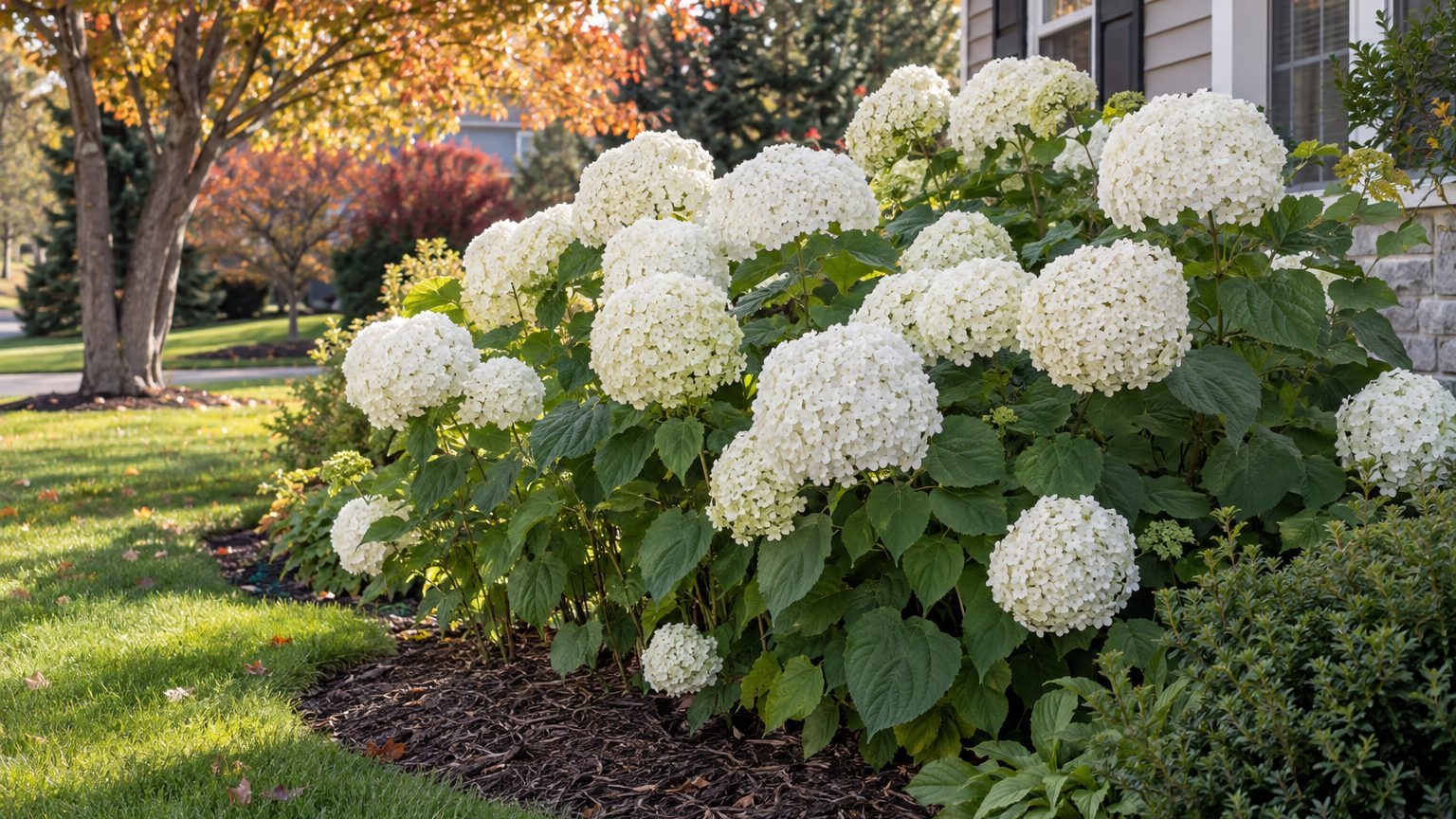
Incrediball hydrangea is a smooth hydrangea cultivar bred for stronger stems than Annabelle, holding blooms up to 12 inches across without flopping over after rain. It grows in USDA zones 3 to 8, reaches 4 to 5 feet tall and wide, and flowers on new wood from early summer into fall. Below: zones, the season-by-season calendar, resistance, and where to plant it.
What This Variety Is
Incrediball is a cultivar of Hydrangea arborescens, the smooth hydrangea native to the eastern United States. Missouri Botanical Garden Plant Finder lists it as reaching 4 to 5 feet tall and 4 to 5 feet wide, with a rounded, mounding habit.
Its defining trait is stem strength. Bred to correct the floppy stems of older smooth hydrangea varieties like Annabelle, Incrediball holds blooms that can reach 12 inches across upright through wind and heavy rain.
Blooms open lime green, turn pure white, and can pick up a blush tone as nights cool in fall. A pink-flowered sport, Incrediball Blush, exists for gardeners who want color from the start.
Three things separate it from other hydrangeas grown nearby:
- It blooms on new wood, not last year’s growth.
- Its stems are thick enough to skip staking in most yards.
- It tolerates more sun than bigleaf hydrangea without wilting by afternoon.
From the almanac
Hydrangeas in your state
The dates on this page depend on where you live. Your state's page carries its frost dates, its USDA zones and the year laid out month by month.
Northeast
Southeast
- Alabama
- Arkansas
- Delaware
- Florida
- Georgia
- Kentucky
- Louisiana
- Maryland
- Mississippi
- North Carolina
- South Carolina
- Tennessee
- Virginia
- West Virginia
Midwest
Southwest
West
Pacific Northwest
Canada
Where It Grows: Zones and Regions
Missouri Botanical Garden Plant Finder puts Incrediball’s hardiness at USDA zones 3 to 8, a wider range than most bigleaf hydrangeas manage.
- Great Lakes and the North (Michigan, Minnesota, Wisconsin): zone 3 and 4 winters kill the top growth back most years, but since Incrediball blooms on new wood, that costs height, not flowers.
- Northeast and Mid-Atlantic (New York, Pennsylvania, Virginia): zone 5 to 7 is where this shrub performs closest to its full size, with minimal stem dieback and full-size blooms.
- The South (Georgia, Texas, the Carolinas): zone 7 and 8 still work well, though afternoon shade helps blooms hold their color and last longer through a hot summer.
- Pacific Northwest and interior West (Oregon, Washington, Colorado): coastal zone 7 to 8 sites need little extra care, while drier interior spots need regular watering to keep the wide leaves from wilting by midday.
Past zone 8, in the Gulf Coast counties and peninsular Florida, the heat cuts bloom size and shortens the display. The state selector below this section leads to the planting dates and pruning window for where you live.
The Year With It, Season by Season
Spring
New growth pushes from the base as soil warms, and this is the safe window to cut stems back to 12 to 18 inches since next season’s blooms form entirely on this new wood, not on anything left from last year.
Summer
Blooms open lime green early in the season and turn white by midsummer, holding their shape on thick stems even after a heavy storm, though a deep soak during dry stretches keeps the wide leaves from drooping by afternoon.
Fall
Flower heads age to a papery tan or pick up a blush tint as nights cool, and many gardeners leave them standing rather than cutting them, since the dried heads add structure to the yard once everything else has faded.
Winter
Top growth can die back hard in the coldest zones, but because next year’s flowers come from new wood, a rough winter costs nothing but height, and the shrub still blooms on schedule once spring growth resumes.
Diseases and Pests It Resists
Missouri Botanical Garden Plant Finder lists Incrediball as having no serious insect or disease problems, a shorter list of concerns than many hydrangeas grown in the same bed.
It also earns a deer tolerant rating, useful in yards where browsing pressure has ended other flowering shrubs planted nearby.
| Threat | This one |
|---|---|
| Deer browsing | Rated tolerant |
| Insects | None serious reported |
| Disease | None serious reported |
Occasional leaf spot can show up in a wet, humid summer, but it rarely spreads far on this variety. The other kinds, including bigleaf and oakleaf hydrangea, are on their own pages with their own pest lists.
Where to Plant It in a Yard
Incrediball’s rounded 4 to 5 foot frame works as a stand-alone specimen, a low hedge along a foundation, or a repeated block bordering a patio where its white blooms catch evening light.
- Your state page: the frost dates and the pruning window for where you garden.
- Which ones hold up here: how Incrediball compares with the other hydrangeas rated for your zone.
- Hydrangea care basics: watering and soil notes that apply across every type in this family.
Pair it with hostas or ferns at its feet, since both like the same afternoon shade and even moisture, and let the shrub’s size do the work near a porch or mailbox bed.
Common questions
How big does Incrediball hydrangea get?
It reaches 4 to 5 feet tall and 4 to 5 feet wide at maturity, holding a rounded shape without staking thanks to its thick stems.
Does Incrediball hydrangea need full sun?
It handles full sun to part shade. In the South, part shade during the hottest afternoon hours keeps blooms from fading as fast.
When should I prune Incrediball hydrangea?
Prune in late winter or early spring, before new growth starts, since every bloom forms on wood grown that same season.
Sources : provenwinners.com