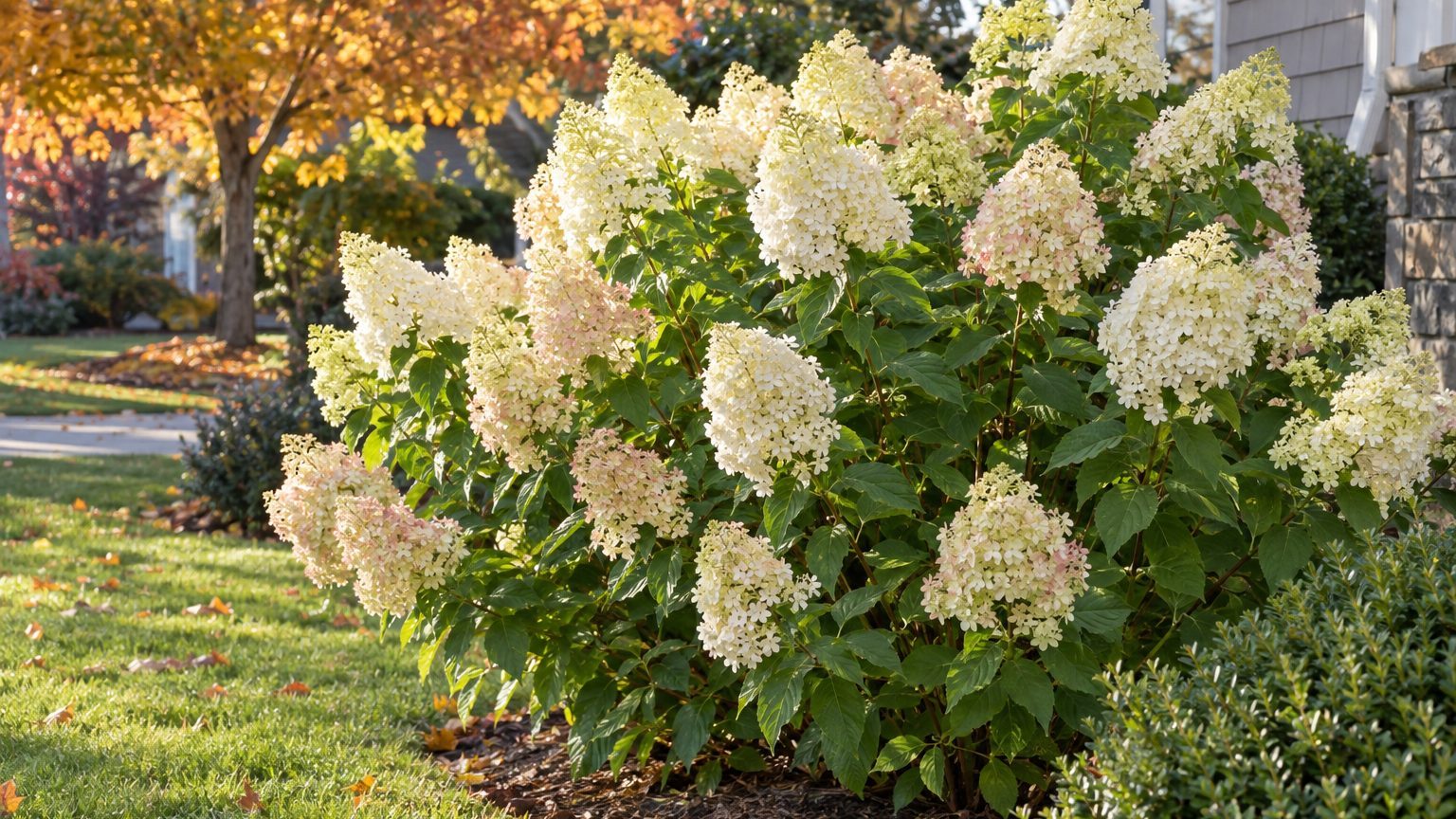
Grandiflora hydrangea is the classic panicle type, sold for generations as the PeeGee hydrangea, hardy from USDA zone 3 to 8 and reaching 10 to 25 feet depending on whether you train it as a small tree or let it grow as a multi-stem shrub. It blooms on new wood, so a hard late-winter cut never costs you a season of flowers.
What This Variety Is
Grandiflora is the classic cultivar of Hydrangea paniculata, sold for over a century as the PeeGee hydrangea. It grows as a multi-stem shrub or a trained small tree, never as the mounding bigleaf type most yards already have.
NC State Extension Gardener Plant Toolbox lists panicle hydrangea at USDA zones 3 to 8, the widest range of any hydrangea sold at garden centers. That range is what separates Grandiflora from bigleaf and mophead types that struggle north of zone 6.
The flower is a dense cone, not a ball, opening white in summer and aging to pink, rose, or bronze by fall. It blooms on new wood, so a hard late-winter cut does not cost you the season’s flowers.
Left alone, height depends entirely on how you train it:
- 25 feet as a single-trunk tree form
- 10 to 15 feet as an untrimmed multi-stem shrub
- 6 to 8 feet where cut back hard each year
From the almanac
Hydrangeas in your state
The dates on this page depend on where you live. Your state's page carries its frost dates, its USDA zones and the year laid out month by month.
Northeast
Southeast
- Alabama
- Arkansas
- Delaware
- Florida
- Georgia
- Kentucky
- Louisiana
- Maryland
- Mississippi
- North Carolina
- South Carolina
- Tennessee
- Virginia
- West Virginia
Midwest
Southwest
West
Pacific Northwest
Canada
Where It Grows: Zones and Regions
Panicle hydrangea’s zone 3 to 8 range means it grows in almost every part of the continental United States, which is unusual for a hydrangea most yards know as a shade lover. Where it struggles is the deep South and the low desert, where summer heat can stall bloom size and stress shallow roots even with regular water.
- Great Lakes and the North (Michigan, Minnesota, Wisconsin): this is the one hydrangea reliably hardy here, since it blooms on new wood and shrugs off a winter that kills flower buds on other types.
- Mid-Atlantic and the Northeast (Pennsylvania, New York, Virginia): full sun works without scorch, and the plant reaches full size in a normal growing season without much fuss.
- The South (Georgia, Texas, the Carolinas): afternoon shade keeps the panicles from bleaching and the roots from drying out in clay soil that bakes through July and August.
- The Mountain West and high plains (Colorado, Montana, Wyoming): cold tolerance holds up fine, but wind and low humidity call for a sheltered spot and steady water the first two summers.
Your state page, reached through the selector rendered below this section, carries the exact frost dates and pruning window for where you live.
The Year With It, Season by Season
Grandiflora’s calendar runs on one rule: everything it blooms on this year, it grew this year. That single fact decides when you cut, when you feed, and how much winter cold you ever need to worry about.
Late winter
New flower buds haven’t formed yet, so this is the only pruning window that matters for Grandiflora. Cut stems back by a third to a half before growth starts, and the plant still blooms on schedule because every flower forms on wood made this year.
Spring
Fresh shoots push fast once soil warms, often a foot or more before the first buds show. Feed lightly and refresh mulch now, since a dry spring stresses the shallow roots more than a cold winter ever does.
Summer
Panicles open white in the first real heat of the season and hold their cone shape through the hottest weeks. Give it a deep soak weekly in dry stretches, because panicle hydrangea forgives poor soil far more than it forgives drought.
Fall
Color shifts from white to pink, rose, or a dusty bronze as nights cool, and those spent panicles look good left on the stem into winter. Cut a few for drying now, before frost turns them brittle.
Winter
Dormant wood rides out cold that would kill flower buds on a bigleaf hydrangea, which is the whole reason this variety succeeds where others fail. No wrapping or burlap needed here, just a layer of mulch over the root zone.
Diseases and Pests It Resists
NC State Extension Gardener Plant Toolbox lists panicle hydrangea as having no serious disease or pest problems, a shorter list than almost any other hydrangea in the genus. That is part of why it shows up in commercial plantings, not just home yards.
The one real threat is not a bug or a fungus. It is a hard freeze right after a false spring, which can nip the soft new growth that would have carried the season’s buds.
| Threat | This one | Source |
|---|---|---|
| Bacterial leaf spot | Occasional, cosmetic only | — |
| Powdery mildew | Rare, mainly in shaded, still air | — |
| Deer browsing | Seldom severely damaged | — |
| Winter bud loss | Not a factor, blooms on new wood | — |
Bigleaf and mountain hydrangea carry a longer list, including the leaf blight that can defoliate a plant by late summer. Those problems belong on their own pages, since Grandiflora simply does not share most of them.
Where to Plant It in a Yard
Grandiflora earns its keep as a specimen, not a filler shrub, since a mature plant needs room to become a small tree or a wide multi-stem mass. Give it eight feet of clearance from the foundation and let it anchor a corner or a fence line.
- Your state page: the frost dates and the pruning window where you live.
- Which hydrangea holds up here: a side-by-side of panicle, bigleaf, smooth, and oakleaf for your zone.
- Pruning by type: the cut that fits a plant that blooms on new wood, not old.
Plant it where you’ll walk past the panicles in late summer, since that is when this variety earns the space you gave it.
Common questions
Is Grandiflora hydrangea the same as PeeGee hydrangea?
Yes. Grandiflora is the formal cultivar name for Hydrangea paniculata, and PeeGee is the old nursery nickname for the same plant, both referring to the same white cone-shaped bloom.
How big does Grandiflora hydrangea get?
Anywhere from 6 feet to 25 feet, depending entirely on training. Cut hard every year and it stays a compact shrub, leave it alone or train a single trunk and it becomes a small tree.
Does Grandiflora hydrangea bloom on new wood or old wood?
New wood. That means pruning in late winter, before growth starts, never removes the buds that will carry this year’s flowers, unlike bigleaf hydrangea where the same cut can strip the season bare.
Sources : plantdatabase.uconn.edu | provenwinners.com | jacksonsnurseries.co.uk