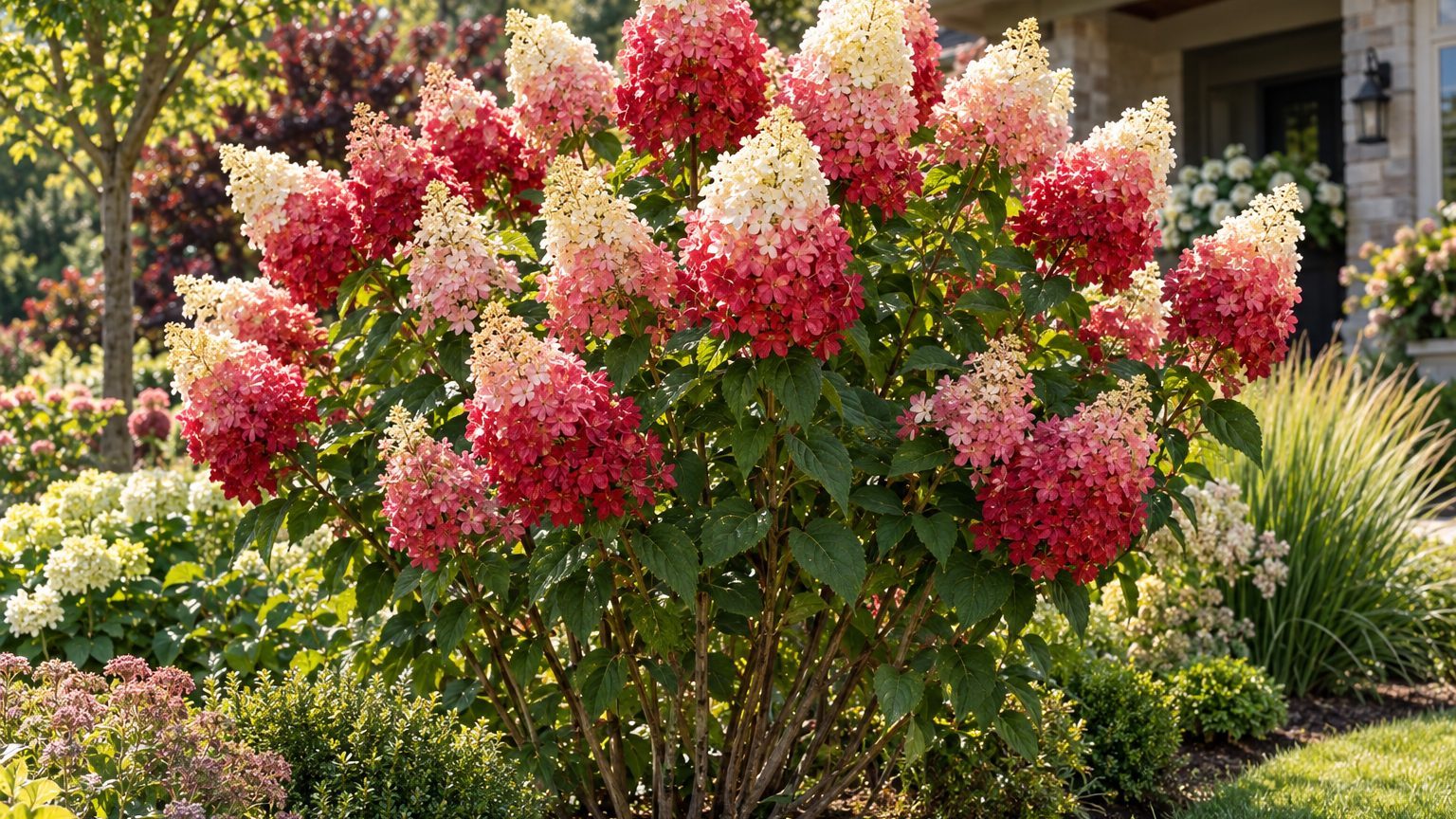
Fire Light is a panicle hydrangea, Hydrangea paniculata, bred for sturdy stems that hold up a red-turning bloom without flopping. It grows in USDA zones 3 through 8, blooms on new wood every year regardless of winter dieback, and reaches roughly 6 to 8 feet tall in most yards.
What This Variety Is
Fire Light is a cultivar of Hydrangea paniculata, the panicle group that sets flower buds on the current season’s growth. NC State Extension Gardener Plant Toolbox lists the species hardy from zone 3 to zone 8, a wider range than any bigleaf hydrangea on the same garden center bench.
The shrub grows rounded and multi-stemmed, and the canes stay upright under a full bloom instead of arching over like older panicle types. That stiffness is the trait breeders selected it for.
Flower cones open white in midsummer, then shift through pink toward a deep red as nights cool. Full sun sharpens that color change, while shade fades it toward a duller rose.
Mature plants settle at about 6 to 8 feet tall and 4 to 6 feet wide, with a medium growth rate of a foot or two a year.
From the almanac
Hydrangeas in your state
The dates on this page depend on where you live. Your state's page carries its frost dates, its USDA zones and the year laid out month by month.
Northeast
Southeast
- Alabama
- Arkansas
- Delaware
- Florida
- Georgia
- Kentucky
- Louisiana
- Maryland
- Mississippi
- North Carolina
- South Carolina
- Tennessee
- Virginia
- West Virginia
Midwest
Southwest
West
Pacific Northwest
Canada
Where It Grows: Zones and Regions
Fire Light carries the same zone 3 to 8 range as the species, which puts it in yards that most other hydrangeas skip entirely.
- Great Lakes and the North (Michigan, Minnesota, Wisconsin): winters here can kill stems back to the snow line some years, but new wood still carries a full bloom by late summer.
- Mid-Atlantic and the Northeast (Pennsylvania, New York, Ohio): the plant reaches its full size without any winter wrapping or extra protection.
- The South (Georgia, Texas, the Carolinas): zone 8 is the upper edge of the range, and afternoon shade keeps the blooms from bleaching out under July sun.
The state selector below this section opens the frost dates and planting window for the state you actually garden in.
The Year With It, Season by Season
Spring
New shoots emerge later than on bigleaf hydrangeas, and a late frost rarely does damage since the flower buds haven’t formed yet. This is the pruning window, cutting stems back hard before leaves fully open, without losing a single bloom.
Summer
Flower heads open white in midsummer and hold that shade for weeks before the color shift starts. Full sun keeps the cones dense and upright, and a deep soaking twice a week during dry stretches keeps the largest heads from wilting by afternoon.
Fall
Color moves from white to pink to a deep red as nights cool, and the shift happens right on the plant. Spent blooms can stay through the season for winter structure, since next year’s flowers will form on wood that grows fresh in spring.
Winter
Stems stay upright under snow load better than older panicle varieties, though a heavy wet snow can still bow the outer canes. Zone 3 gardens sometimes see stems die back hard, but the shrub regrows and blooms that same year regardless.
Diseases and Pests It Resists
Missouri Botanical Garden Plant Finder notes no serious insect or disease problems for the species, which covers Fire Light as a cultivar of it. That record is part of why it shows up in low-maintenance foundation plantings more than bigleaf types do.
What trouble does turn up tends to be cosmetic rather than deadly, and it’s usually tied to a crowded, humid planting site rather than the plant itself.
| Threat | This one | Source |
|---|---|---|
| Bacterial leaf spot | Rare, minor cosmetic spotting | Missouri Botanical Garden Plant Finder |
| Powdery mildew | Occasional in crowded, humid sites | Missouri Botanical Garden Plant Finder |
| Deer browsing | Light browsing on new shoots, not a preferred plant | Missouri Botanical Garden Plant Finder |
Bigleaf and oakleaf hydrangeas carry their own separate disease pressures, and the other kinds are on their own pages rather than in this table.
Where to Plant It in a Yard
Fire Light works best where it gets a half day of direct sun or more, with room to spread to its full width without crowding a walkway or a foundation.
- Your state page: the frost dates and the pruning window where you live.
- Which ones hold up here: how Fire Light compares to bigleaf and smooth types for your zone.
- Companion plants: what fills in around the base while the shrub is still young and small.
Check your state page before you dig, since the safe planting window shifts by several weeks between the Great Lakes and the South.
Common questions
Does Fire Light hydrangea bloom on old or new wood?
It blooms on new wood, which is why hard pruning in late winter doesn’t cost you flowers the following summer.
How tall does Fire Light hydrangea get?
Most plants settle at around 6 to 8 feet tall and 4 to 6 feet wide once mature.
Will Fire Light hydrangea grow in full shade?
It tolerates part shade, but full shade weakens stems and fades the fall color shift toward a dull pink instead of deep red.
Sources : le-chatel-des-vivaces.com