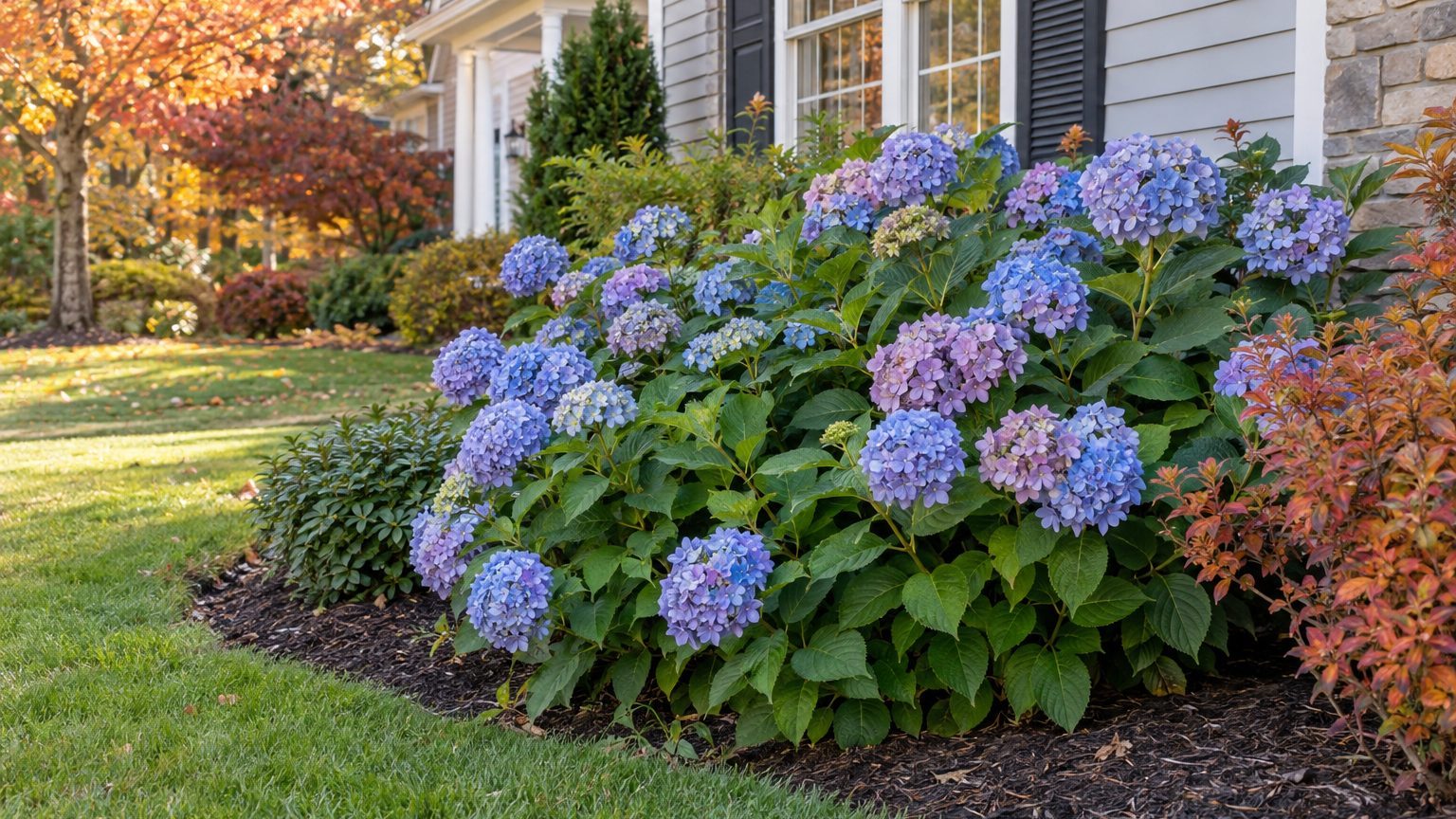
Everlasting Amethyst is a bigleaf hydrangea from Proven Winners’ Everlasting Series, bred to hold its rounded mophead blooms as they shift color with age, from cream and green to blush pink and finally deep amethyst. It stays compact, tops out around 3 to 4 feet, blooms on old and new wood, and suits USDA zones 5 to 9 with part sun to part shade.
What This Variety Is
Everlasting Amethyst is a bigleaf hydrangea, Hydrangea macrophylla, part of Proven Winners’ Everlasting Series bred for blooms that age instead of just fading. The flowers open cream and lime green before shifting through rose to a deeper amethyst purple.
Proven Winners lists mature size at 3 to 4 feet tall and 3 to 4 feet wide, small enough for a foundation bed. The habit stays rounded and mounding rather than sprawling wide like older bigleaf varieties.
What sets it apart from older bigleaf types is the flowering wood. It sets buds on old wood from last season and on new wood the same year, so a late frost that kills one round still leaves a second bloom coming.
That reblooming habit is the trait most catalog descriptions skip past. It is also the reason pruning timing matters more here than on a one-bloom hydrangea.
From the almanac
Hydrangeas in your state
The dates on this page depend on where you live. Your state's page carries its frost dates, its USDA zones and the year laid out month by month.
Northeast
Southeast
- Alabama
- Arkansas
- Delaware
- Florida
- Georgia
- Kentucky
- Louisiana
- Maryland
- Mississippi
- North Carolina
- South Carolina
- Tennessee
- Virginia
- West Virginia
Midwest
Southwest
West
Pacific Northwest
Canada
Where It Grows: Zones and Regions
Proven Winners rates Everlasting Amethyst for USDA zones 5 to 9, a wider band than most rebloomers get away with, but the two edges of that range behave differently depending on how cold the ground gets and how long the summer heat holds on.
- Upper Midwest and the Northeast (Minnesota, Wisconsin, Michigan): zone 5 marks the cold edge of the range, and stems left exposed above the snow line often die back partway, trimming the old-wood flush down to whatever new wood manages to open by late summer.
- Mid-Atlantic and the Upper South (Virginia, Maryland, North Carolina): this band sits near the middle of the range, where winters are cold enough to satisfy dormancy but rarely harsh enough to kill stems to the ground, so both bloom flushes tend to show up on schedule.
- Deep South and Gulf Coast (Georgia, Florida, Texas): at zone 9 the limiting factor flips from cold to heat, and unshielded afternoon sun can wilt blooms and scorch leaves by early afternoon.
The state selector below this section opens the page built for where you garden, with the frost window and pruning dates set to your zone.
The Year With It, Season by Season
Planting
Spring and early fall are the two windows for putting a new shrub in the ground, since the roots get time to settle before summer heat or winter cold arrives. Water deeply through the first growing season while the root system is still shallow.
Spring
New growth pushes from both old stems and the base once nights stay above freezing, and this is when winter-killed tips show up as blackened, soft wood. Cut back only to the first live, green bud and leave the rest of the framework standing.
Summer
Mophead clusters open cream and green through early summer, then shift toward pink and amethyst as the flowers age on the stem, the trait the whole Everlasting Series is built around. Consistent soil moisture keeps that color change even instead of blotchy.
Fall
New-wood buds set in late summer carry the second bloom flush into early fall, so this is the wrong season for a hard cutback no matter how tired the shrub looks. Deadhead spent heads if you want, but leave the stems alone.
Winter
Buds for next year’s old-wood flowers are already set on the stems by the time the shrub goes dormant, which is why an ill-timed cut in late winter can erase half the coming season’s blooms. Mulch the root zone rather than the stems.
Diseases and Pests It Resists
Proven Winners does not publish a formal pest or disease resistance rating for Everlasting Amethyst the way some breeders do for turf or roses. What shows up in grower notes instead are the same pressures that affect bigleaf hydrangeas as a group.
Powdery mildew shows up as a white film on leaves in humid, still air, and it rarely kills the shrub outright. Deer browse the leaves and flower buds readily, since hydrangeas are often the softest, greenest thing left by midsummer.
| Threat | This one | Source |
|---|---|---|
| Powdery mildew | Not resistant, common in humid shade | — |
| Deer browsing | Not resistant, foliage and buds eaten | — |
| Formal cultivar rating | Not published | Proven Winners |
Aphids and leaf spot turn up on stressed plants of any bigleaf variety, and the other pests and diseases common to hydrangeas as a group are covered on their own pages rather than repeated here.
Where to Plant It in a Yard
A rounded, 3 to 4 foot mophead like this one reads well as a low hedge along a walkway or grouped in a foundation bed where afternoon shade breaks up the hottest part of the day.
- Your state page: the frost dates and the pruning window set for where you live.
- Hydrangea types compared: how this bigleaf rebloomer stacks up against panicle and smooth types for size and bloom timing.
- Hydrangea pruning by type: the old-wood, new-wood distinction that decides when to cut this one back.
Plant it where a late frost that takes out the first flush still leaves a second one to look forward to.
Common questions
Does Everlasting Amethyst bloom the first year after planting?
It can, since it sets buds on both old and new wood, but a shrub planted from a small container in spring often puts more energy into roots than flowers the first season.
Why did the amethyst color not show up on my blooms?
Color depth follows how long the flower head stays on the stem and how much sun and heat it gets while aging, so blooms cut early or grown in deep shade often stall at pink instead of reaching the deeper purple.
Can I grow Everlasting Amethyst in a container?
Its compact 3 to 4 foot size makes it workable in a large pot, though container roots freeze faster than roots in the ground, so gardeners at the cold edge of the range need to move pots somewhere sheltered for winter.
Sources : pepiniere.ca