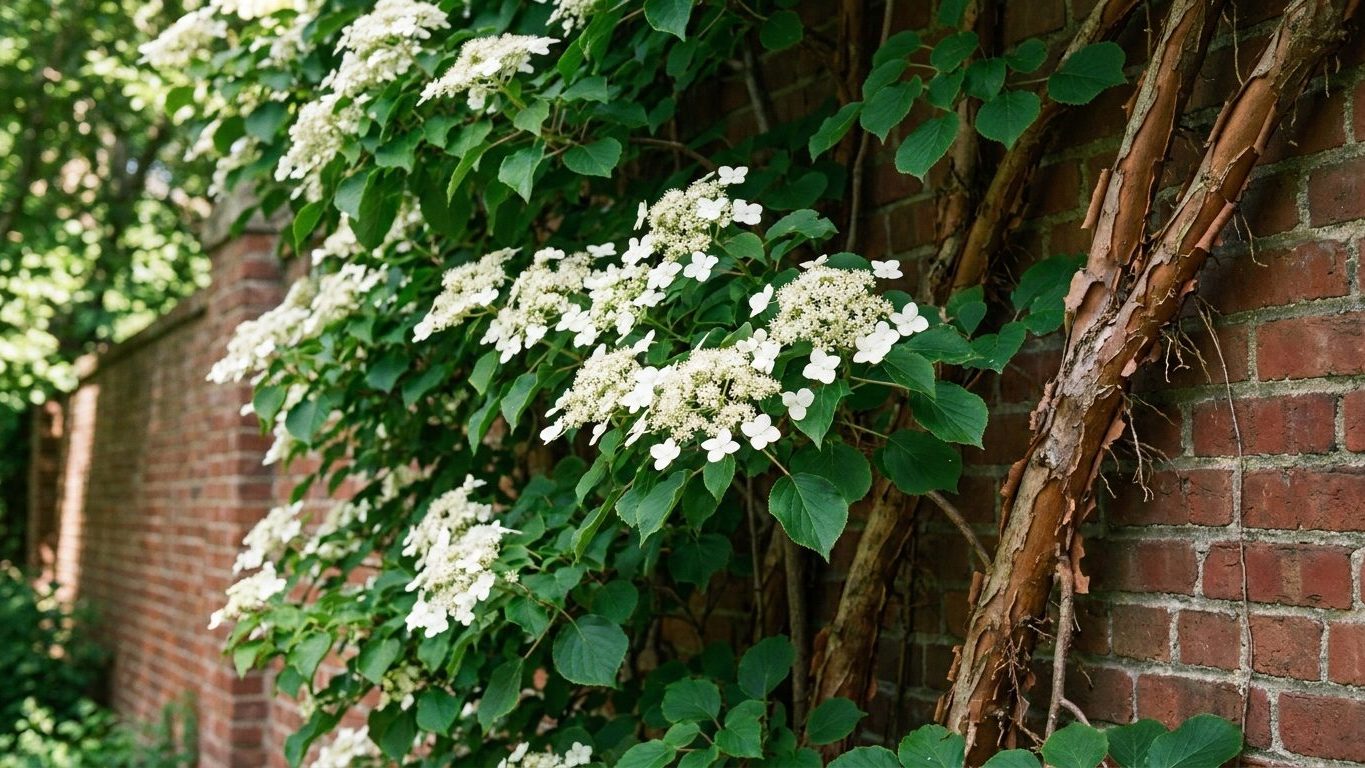
Climbing hydrangea grows as a self-clinging, deciduous vine, not a shrub, reaching 30 to 50 feet on a sturdy wall across USDA zones 4 to 8. It blooms on old wood in white lacecap clusters, needs almost no pruning beyond shaping right after bloom, and takes three to four years to establish before it climbs in earnest and its bark begins to peel.
What This Variety Is
Climbing hydrangea (Hydrangea anomala subsp. petiolaris) is a deciduous, self-clinging vine, not a shrub trained upward. Missouri Botanical Garden Plant Finder lists it hardy from USDA zone 4 to zone 8.
It climbs by aerial rootlets that grip masonry, bark, or wood, and needs no wire or trellis. Mature stems shed to reveal cinnamon-brown bark, a trait few other climbing vines offer in a winter yard.
Growth is slow at first, then fast: three to four years pass before the vine puts on real length. Once established it can add several feet a season and reach 30 to 50 feet on a strong wall.
Three traits set it apart from a shrub-form hydrangea:
- flowers on old wood, in flat white lacecap clusters
- bark that exfoliates on mature growth
- no staking, ties, or cages needed once rootlets take hold
From the almanac
Hydrangeas in your state
The dates on this page depend on where you live. Your state's page carries its frost dates, its USDA zones and the year laid out month by month.
Northeast
Southeast
- Alabama
- Arkansas
- Delaware
- Florida
- Georgia
- Kentucky
- Louisiana
- Maryland
- Mississippi
- North Carolina
- South Carolina
- Tennessee
- Virginia
- West Virginia
Midwest
Southwest
West
Pacific Northwest
Canada
Where It Grows: Zones and Regions
Missouri Botanical Garden Plant Finder puts climbing hydrangea at zone 4 to zone 8, a range that stretches from the cold pockets of northern New England to the humid summers of the coastal South.
- Northern New England and the Upper Midwest (Maine, Vermont, Minnesota): Minneapolis sits at the zone 4 edge of the range, and the vine needs a sheltered wall and a layer of mulch through its first two winters there.
- Mid-Atlantic and the Ohio Valley (Pennsylvania, Virginia, Ohio): Philadelphia and Richmond fall in zone 7, comfortably inside the range, and the vine grows without winter protection once past its third year.
- The Pacific Northwest (Washington, Oregon, Idaho): Seattle and Portland sit at zone 8, and the cool, damp summers there suit the part shade this vine prefers better than almost anywhere else in the country.
- The Deep South and the Gulf Coast (Georgia, South Carolina, Florida): Atlanta at zone 7b to 8a is near the upper edge of the range, while Miami’s zone 10b puts it out of range entirely.
The state selector below this section opens the frost dates and planting window for your own zip code, so check it before choosing a wall.
The Year With It, Season by Season
Spring
Plant climbing hydrangea in spring, after the last frost, at the base of masonry, a wood fence, or a sturdy trellis, in part shade. Water weekly through the first growing season, since the young aerial rootlets need steady moisture to find a grip and start climbing.
Early Summer
Growth stays modest for the first two to three years while the plant builds roots below ground, a stretch some gardeners call sleep and creep. Once established, it sends out long climbing shoots and can add several feet of new growth in a single season.
Midsummer
White lacecap flowers open in June and July on wood grown the previous year, so pruning has to wait until after bloom. Missouri Botanical Garden Plant Finder lists flower clusters at 6 to 10 inches across, held flat against the glossy green foliage.
Late Summer Heat
In zone 7 and 8 gardens, afternoon shade keeps leaves from scorching during the hottest stretch of July and August. A vine planted against a north or east-facing wall handles heat far better than one on a south-facing brick face that radiates warmth after sunset.
Fall
Leaves turn a soft yellow before they drop, and the bark on stems more than a few years old begins to peel into cinnamon-brown strips. Skip pruning in fall, since cuts made now remove the buds that would have opened as next year’s flowers.
Winter
The peeling bark stands out against bare walls and snow once the leaves are down, a trait few climbing vines offer in the coldest months. In zone 4 gardens, wrapping the base in burlap for the first two winters protects young plants while their roots finish establishing.
Diseases and Pests It Resists
Climbing hydrangea carries a short list of problems compared to shrub-form hydrangeas. Missouri Botanical Garden Plant Finder reports no serious insect or disease problems on this vine.
Deer tend to pass it by, and the thick, leathery leaves shrug off the leaf spot and powdery mildew that trouble bigleaf hydrangea in humid summers. The main risk is root rot in soil that stays wet, not a pest or a fungus on the leaves.
| Threat | This one | Source |
|---|---|---|
| Insects | No serious pests reported | — |
| Leaf disease | No serious disease reported | — |
| Deer browsing | Rarely damaged | — |
| Root rot | Risk in poorly drained soil | — |
Bigleaf and panicle hydrangeas carry their own separate pest and disease pages, since their risks differ enough to need their own tables.
Where to Plant It in a Yard
This vine wants something solid to grip: a brick or stone wall, a masonry chimney, a heavy wood fence, or a metal arbor built to carry real weight once it matures.
- Your state page: the frost dates and planting window for the zip code where you garden.
- Bigleaf hydrangea: a shrub-form option for a spot near a patio where a vine would need a wall.
- Panicle hydrangea: a sun-tolerant choice for the open, unshaded side of a yard this vine would scorch in.
Pick the wall first, then plant the vine at its base and give the rootlets a season to find their grip.
Common questions
How long does climbing hydrangea take to bloom?
Missouri Botanical Garden Plant Finder notes the vine can take three to five years to produce its first flowers, since it spends its early seasons building roots and finding a grip before it puts energy into bloom.
Will climbing hydrangea damage my house?
The aerial rootlets grip mortar joints and rough wood, and over years they can loosen aging mortar or damage painted siding. Masonry in good repair, or a freestanding trellis a few inches off the wall, avoids the issue.
Does climbing hydrangea need full sun?
No. It flowers best in part shade to full shade, and in zone 7 and 8 gardens full afternoon sun scorches the leaves. Morning sun with afternoon shade suits it in most regions within its range.
Sources : rhs.org.uk