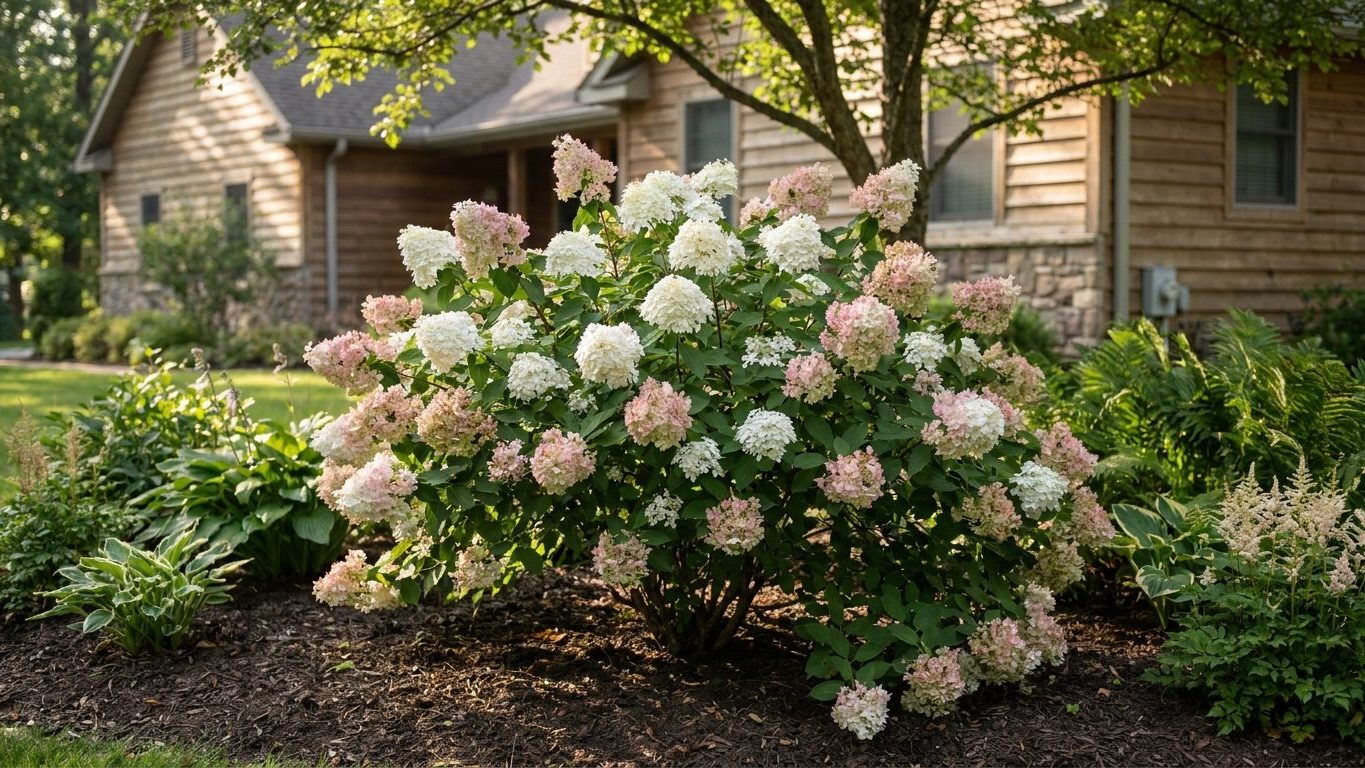
Blushing Bride is a bigleaf hydrangea from the Endless Summer Collection, reaching 3 to 5 feet tall and wide in USDA zones 4 through 9. It reblooms on old and new wood, so a hard prune rarely costs you the whole season. White flowers age into a soft pink blush as they open in the sun, and the shrub wants steady moisture and shade from the harshest afternoon sun.
What This Variety Is
Blushing Bride is a bigleaf hydrangea, Hydrangea macrophylla, developed within the Endless Summer Collection. Missouri Botanical Garden Plant Finder puts it at 3 to 5 feet tall and just as wide, a rounded shrub sized for a foundation bed.
The flowers open white and semi-double. They take on a pink blush as they age in full sun, a shift driven by light and time, not soil pH.
What separates it from older bigleaf types is where it sets buds. It flowers on both old wood and new wood, so a damaged cane from winter still leaves a summer bloom.
Three traits define how it behaves in a yard:
- Reblooms from early summer into fall on fresh growth
- Holds a compact, rounded form without staking
- Sets flower buds that survive a harder frost than classic mophead types
From the almanac
Hydrangeas in your state
The dates on this page depend on where you live. Your state's page carries its frost dates, its USDA zones and the year laid out month by month.
Northeast
Southeast
- Alabama
- Arkansas
- Delaware
- Florida
- Georgia
- Kentucky
- Louisiana
- Maryland
- Mississippi
- North Carolina
- South Carolina
- Tennessee
- Virginia
- West Virginia
Midwest
Southwest
West
Pacific Northwest
Canada
Where It Grows: Zones and Regions
Missouri Botanical Garden Plant Finder rates Blushing Bride for USDA zones 4 through 9, a wider range than most bigleaf hydrangeas manage. Where it lands inside that range changes how much of the old wood survives winter, and that decides how early the first flush opens.
- Upper Midwest and New England (Minnesota, Wisconsin, Maine): zone 4 and 5 winters routinely kill old-wood buds back to the snow line, but the shrub still reblooms on new wood by midsummer.
- Mid-Atlantic and Ohio Valley (Virginia, Ohio, Pennsylvania): zone 6 and 7 conditions let both old and new wood carry buds, giving the longest and heaviest bloom window in the range.
- The South (Georgia, South Carolina, Texas): zone 8 and 9 heat pushes bloom earlier and fades the blush faster, and afternoon shade keeps leaf margins from scorching.
- Pacific Northwest (Oregon, Washington): cool, humid summers in zone 7 and 8 match the conditions the cultivar was bred under, with a slower, longer-lasting blush.
Below zone 4, winter tends to kill the crown along with the wood, and above zone 9 the shrub struggles without a real winter chill. The state selector below this section opens the frost dates and pruning window for where you garden.
The Year With It, Season by Season
Planting
Set new plants in spring or early fall so roots establish before extreme heat or a hard frost arrives, spacing them 3 to 5 feet apart to match the mature spread. Keep the root ball consistently moist for the first several weeks after planting.
Spring
New leaves push out from both the old canes and the base once soil warms, and this is when winter damage becomes visible. Cut back only the tips that stayed bare and dark, since live wood lower on the cane may still carry buds.
Early Summer
The first flush opens on last year’s wood if it survived winter, giving the earliest and often fullest blooms of the year. Deadhead spent clusters just above the next set of leaves without cutting into next year’s buds.
Midsummer Heat
New wood starts flowering through this stretch, which is what keeps color coming after the first flush fades. Water deeply once or twice a week during dry spells, since wilted afternoon leaves usually mean dry roots, not a failing plant.
Fall
Blooms slow and the last flowers deepen into a dustier pink or rust tone as nights cool. Leave the spent flower heads on the shrub through this stretch, since they insulate the buds forming just beneath them.
Winter
Dormant buds on old wood are the part most at risk from a hard freeze, especially where temperatures swing above and back below freezing in late winter. A loose mulch layer over the root zone protects the crown, and pruning waits until new growth shows in spring.
Diseases and Pests It Resists
Clemson Cooperative Extension Home & Garden Information Center lists the common threats to bigleaf hydrangeas, and Blushing Bride carries the same exposure as the rest of the group since no resistance breeding targeted these issues. Humid, still air around the shrub is the main driver behind most of them.
Deer browsing and late frost on old-wood buds are the two problems specific to how this cultivar flowers, since a bud lost to either one still leaves the new-wood bloom intact.
| Threat | This one | Source |
|---|---|---|
| Cercospora leaf spot | Common in humid, still summers | Clemson HGIC |
| Powdery mildew | Shows up in shade with poor airflow | Clemson HGIC |
| Deer browsing | Buds and foliage both eaten | — |
| Late frost bud kill | Old-wood buds lost, new wood still blooms | — |
Aphids and spider mites turn up occasionally but rarely at damaging numbers on an otherwise healthy plant. Other hydrangea types carry their own separate pest pages, since a panicle or smooth hydrangea faces a different mix of threats.
Where to Plant It in a Yard
Blushing Bride works best as a foundation planting or a low hedge along a walkway, where its rounded 3 to 5 foot form fills space without crowding a window. Pair it with ferns or hostas that share its moisture needs, and keep it clear of thirsty tree roots.
- Your state page: the frost dates and the pruning window where you live.
- Which ones hold up here: a side-by-side of hydrangea types rated for your zone.
- Pruning bigleaf hydrangeas: when to cut old wood without losing next year’s buds.
Common Questions
Does Blushing Bride turn blue or pink depending on soil pH?
Not reliably. The pink blush comes from age and sun exposure on a white flower, not from the aluminum uptake that drives color in classic blue or pink mopheads.
How far back can I cut Blushing Bride without losing blooms?
Since it flowers on old and new wood, a hard prune in late winter removes the earliest flush, but the plant still reblooms on new growth by midsummer.
Does Blushing Bride need afternoon shade everywhere?
Only in zone 8 and 9 heat. In cooler zones 4 through 6 it tolerates more direct sun, sometimes full sun, without scorching.
Sources : crosscreeknursery.com | hydrangeasplus.com | patuxentnursery.com