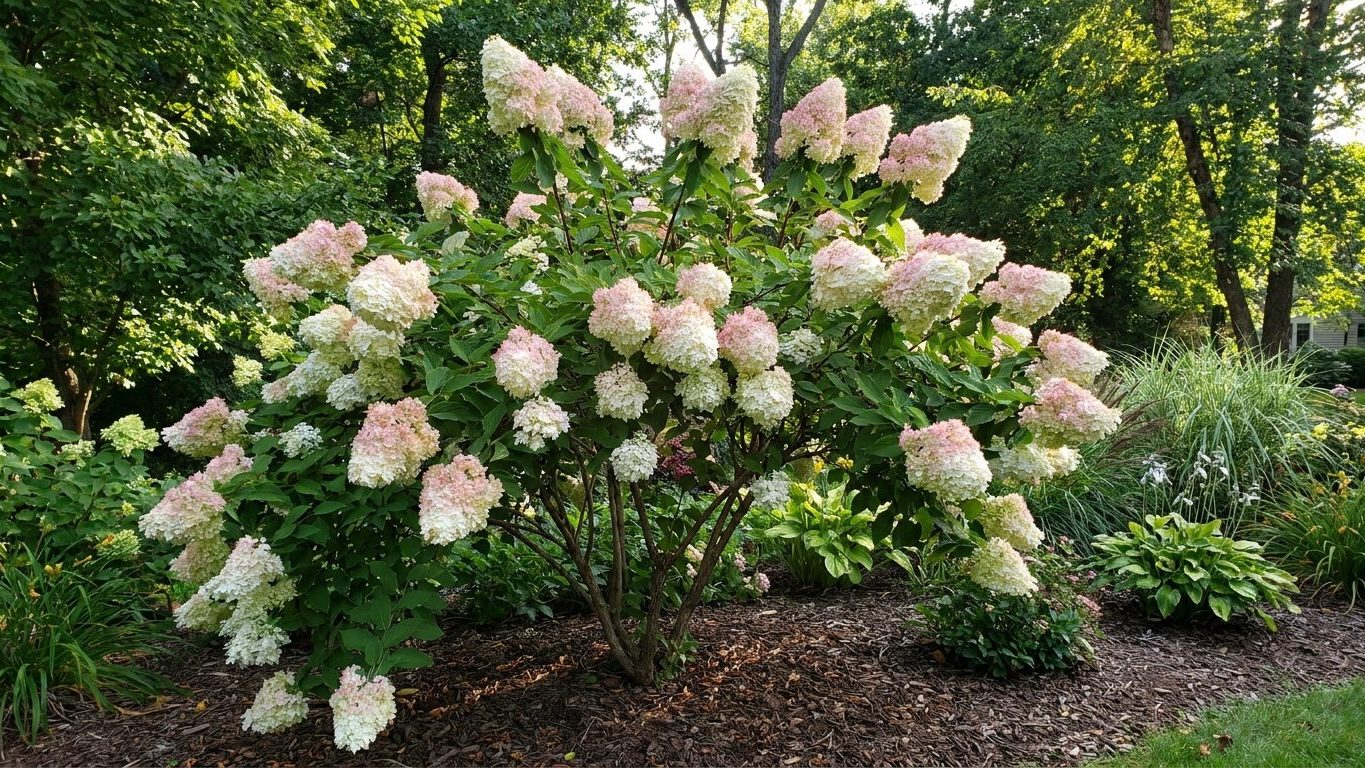
Angel Blush hydrangea is a Hydrangea paniculata shrub with flowers that stay closed in small cupped clusters instead of opening flat, shifting from white to blush pink as summer turns to fall. It tolerates cold better than bigleaf hydrangeas, fits a mid-size yard, and asks for one main gesture: prune in late winter, before new growth starts, since next summer’s blooms form on that fresh wood.
What This Variety Is
Angel Blush is a Hydrangea paniculata selection from Proven Winners. Its blooms keep their sepals fused into small closed cups, unlike most panicle types that open flat.
It grows as a rounded, multi-stem shrub. Sturdy stems hold the panicles upright even after a hard rain.
- Bloom shape: closed, bell-like sepals rather than flat florets
- Bloom color: opens creamy white, ages to blush pink
- Wood: flowers form on new growth each season
Proven Winners puts Angel Blush at USDA zones 3 to 8, wider than most bigleaf hydrangeas manage. Mature shrubs reach 6 to 8 feet tall and spread 4 to 5 feet.
The color shift happens gradually through summer into fall, not overnight. Because it blooms on new wood, a hard prune in late winter still leaves time for flower buds to form before summer.
The panicles run smaller and denser than classic paniculata plumes, closer in scale to a football than a pointed spike. Full sun brings the deepest color change on the flowers.
From the almanac
Hydrangeas in your state
The dates on this page depend on where you live. Your state's page carries its frost dates, its USDA zones and the year laid out month by month.
Northeast
Southeast
- Alabama
- Arkansas
- Delaware
- Florida
- Georgia
- Kentucky
- Louisiana
- Maryland
- Mississippi
- North Carolina
- South Carolina
- Tennessee
- Virginia
- West Virginia
Midwest
Southwest
West
Pacific Northwest
Canada
Where It Grows: Zones and Regions
Proven Winners rates Angel Blush hydrangea for zones 3 to 8, one of the wider ranges among panicle types, though summer length and humidity still separate an easy garden from a hard one. The state selector below this section leads to the frost dates and pruning window for your own address.
- Upper Midwest and Northeast (Minnesota, Wisconsin, Maine): near the cold edge of the range, stems can die back to the ground in a hard winter, and the shrub still rebounds because it flowers on new wood each year.
- Mid-Atlantic and Ohio Valley (Virginia, Ohio, Kentucky): this sits in the comfortable middle of the range, with a long enough season for the blush color to fully develop before frost cuts the show short.
- South and lower Southeast (Georgia, Tennessee, the Carolinas): heat and humidity push conditions toward the upper edge of the range, and afternoon shade helps hold flower color instead of letting it bleach out under strong sun.
- Interior West and high plains (Colorado, Wyoming, Montana): dry air and a late spring frost threaten the shrub more than winter cold itself, so a wind-sheltered spot matters as much as the zone number on the tag.
- Pacific Northwest and coastal areas (Washington, Oregon): mild, damp summers slow the color shift, so the flowers hold their white stage longer than in hotter regions before turning blush.
Use the state selector to check the exact zone and frost window for where you garden before you plant.
The Year With It, Season by Season
Planting
Set new plants in spring or early fall so roots establish before extreme heat or a hard freeze arrives. Because Angel Blush blooms on new wood, a fall planting still flowers well the following summer, since next year’s stems form fresh from the base.
Spring
New growth pushes from the base and from any stems that made it through winter once nights stay reliably above freezing. This is the last safe window for a hard prune, since cutting after strong growth starts costs some of that season’s flower buds.
Summer
Panicles open creamy white by early summer and hold that stage for weeks even in real heat. Afternoon shade slows the blush shift, so full sun gardens see the pink tone move in faster than shaded ones do.
Fall
Flower color deepens from blush toward a dustier rose as nights cool, and the panicles dry in place rather than dropping off the shrub. Leave the dried heads on through fall for a second stretch of texture in the yard.
Winter
Stems can die back partway or all the way to the ground in the coldest part of the zone range, but the shrub rebuilds because next year’s flowers form on new wood regardless. Skip pruning until spring shows exactly where live wood ends.
Diseases and Pests It Resists
Angel Blush carries the general toughness of Hydrangea paniculata, which holds up better against bud loss and cold damage than bigleaf types since it flowers on new wood every year.
Missouri Botanical Garden’s Plant Finder lists the species as having no serious disease or pest problems under normal garden conditions, with occasional trouble showing up mainly in wet or crowded sites.
| Threat | This one | Source |
|---|---|---|
| Bud loss to late frost | Low risk, blooms on new wood so lost buds regrow | Missouri Botanical Garden Plant Finder |
| Powdery mildew | Occasional in humid, shaded sites | Missouri Botanical Garden Plant Finder |
| Leaf spot | Occasional in wet summers | Missouri Botanical Garden Plant Finder |
| Aphids | Occasional on new growth tips | Missouri Botanical Garden Plant Finder |
Scale insects and spider mites can turn up on a stressed plant, but they are not reported as common problems for this cultivar specifically. Good airflow and morning sun on the leaves keep most of the list above from becoming a real issue.
Where to Plant It in a Yard
Angel Blush works best as a specimen or in a small group where its color change through summer draws the eye, since the shrub holds a tidy, rounded shape without staking.
- Your state page: the frost dates and pruning window for where you live.
- Hydrangea pruning guide: when to cut back new-wood bloomers without losing the season’s flowers.
- Hydrangea companion plants: what to pair with a paniculata’s late-summer bloom time.
Give it full sun for the strongest color shift, then check your state page before the first cut.
Common questions
Does Angel Blush hydrangea change color based on soil pH?
No. Unlike bigleaf hydrangeas, panicle types including Angel Blush do not shift color with soil acidity. The white-to-blush change follows the flower’s own aging, not the soil.
How much sun does Angel Blush hydrangea need?
Full sun to part shade both work, but full sun brings out the deepest blush color and keeps the shrub’s habit tighter. In hot Southern gardens, afternoon shade protects the flowers from bleaching out.
When should I prune Angel Blush hydrangea?
Prune in late winter or very early spring, before new growth pushes hard, since flowers form on the current season’s wood. Cutting later in spring costs some of that summer’s blooms.
Sources : landscapeplants.oregonstate.edu