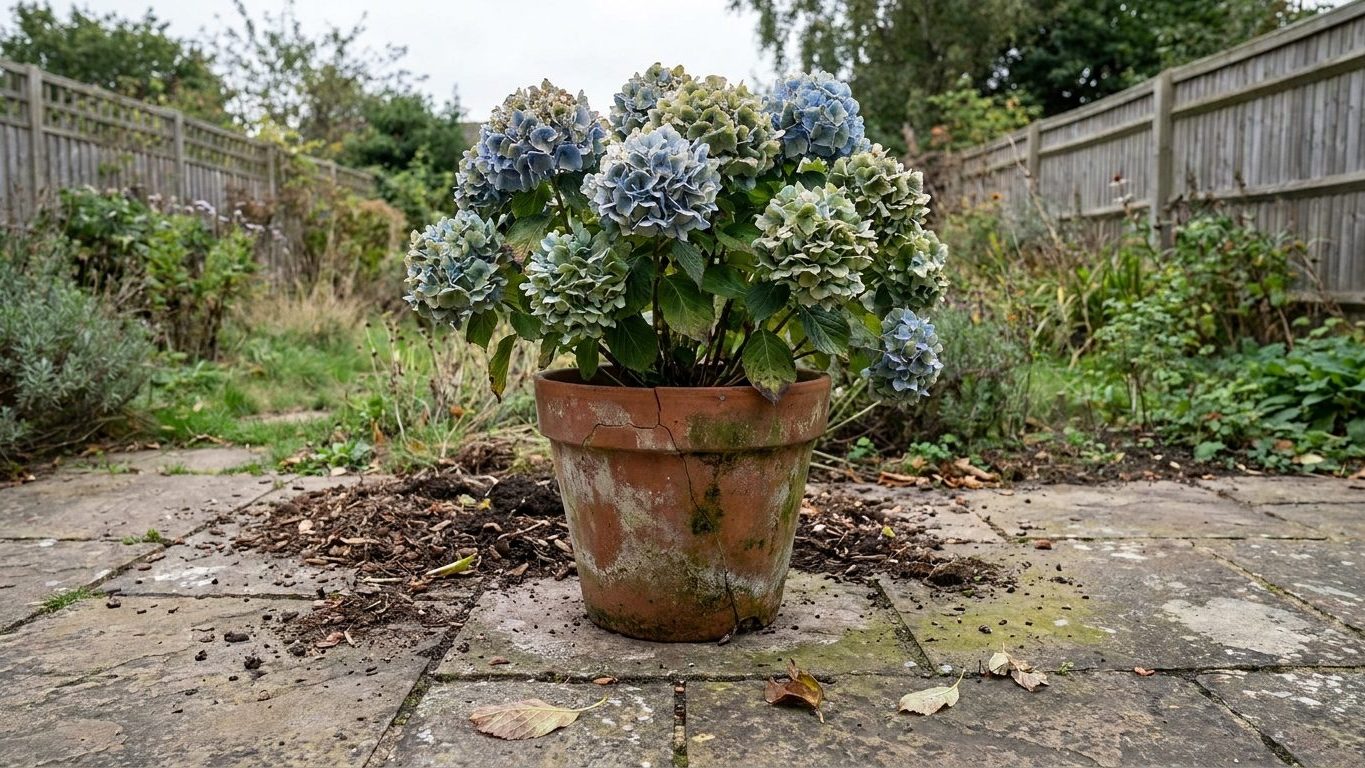
A pot works for most hydrangeas, but the container has to match the type growing in it. Bigleaf needs a wide pot and shade from afternoon sun, while panicle tolerates full sun and a hard late-winter cut.
Soil, water and pot size all follow from that one choice, and the details shift with hardiness zone as much as with type.
Hydrangeas in Pots: The Short Answer
A container works for almost any hydrangea, but the type sets the rule. NC State Extension Gardener Plant Toolbox lists genus hardiness from zone 3a to 9b, yet bigleaf sits at 6a to 11b while panicle runs 3a to 8b.
Bigleaf flowers on last year’s wood, so a pot that freezes hard can lose the whole season. Panicle blooms on the current season’s growth, so a hard late-winter cut still leaves flowers behind.
Root depth matters as much as zone. Both bigleaf and panicle are shallow-rooted, which is why a wide container suits them better than a deep, narrow one.
- Drainage holes, since good drainage is a soil need across the genus.
- A wide pot, sized to the shallow root system rather than the nursery container.
- Mulch on top, which the source recommends for both bigleaf and panicle.
The state selector below leads to your state’s page, with the frost dates and pruning window that decide the rest.
From the almanac
Hydrangeas in your state
The dates on this page depend on where you live. Your state's page carries its frost dates, its USDA zones and the year laid out month by month.
Northeast
Southeast
- Alabama
- Arkansas
- Delaware
- Florida
- Georgia
- Kentucky
- Louisiana
- Maryland
- Mississippi
- North Carolina
- South Carolina
- Tennessee
- Virginia
- West Virginia
Midwest
Southwest
West
Pacific Northwest
Canada
Hydrangeas in Pots, Step by Step

Potting a hydrangea is the same job every time, in this order.
- Match the pot to the type’s mature size: NC State Extension Gardener Plant Toolbox lists bigleaf at 3 to 6 feet tall and wide, so size the container to that spread rather than the small root ball it ships in.
- Check the light before you commit: bigleaf wants dappled sun or partial to deep shade, protected from afternoon sun, while panicle is the one type in the genus built for full sun.
- Fill with a well-drained mix: the source accepts clay, loam or sand as long as drainage is good, so a pot with drainage holes matters more than the exact blend inside it.
- Set the pH for the color you want: on bigleaf and mountain hydrangea only, below about pH 5.5 turns flowers blue, above about pH 6.5 turns them pink, purple sits in between.
- Water before the surface dries out: both bigleaf and panicle are shallow-rooted, so a container dries faster than a garden bed and needs closer watching through summer.
- Mulch the surface and plan to size up: a layer on top holds moisture and shields the shallow roots, and the plant eventually needs a bigger pot as those roots fill the one it’s in.
Bigleaf hydrangea is the only type the source documents as toxic in large amounts, causing nausea, stomach pain and vomiting in people, and the same reaction in cats, dogs and horses, so keep a potted specimen out of reach where animals graze.
Hydrangeas in Pots by Hydrangea Type
The type decides two things a pot can’t fix: when the flower buds form, and how much sun the plant can take. NC State Extension Gardener Plant Toolbox puts bigleaf at 6a to 11b, flowering only on last year’s wood, so a late frost on a potted bigleaf strips the coming season’s blooms.
Panicle sits at the other end, hardy to 3a and flowering on the current season’s growth, which is why the source calls it a substitute for bigleaf where that species isn’t winter hardy. Sun tolerance follows the same split, since panicle is the only type built for full sun.
| Kind | Flowers on | USDA zones | Sun |
|---|---|---|---|
| Bigleaf | Last year’s wood | 6a–11b | Dappled sun to deep shade |
| Panicle | Current season’s growth | 3a–8b | Full sun |
The other kinds are on their own pages: smooth hydrangea blooms on new wood and is the hardiest of the genus, oakleaf keeps its old-wood buds and turns wine-red in fall at about 5 feet, mountain hydrangea’s buds tolerate late frost better than bigleaf’s, and climbing hydrangea flowers on old wood too but is slow to start, eventually reaching 15 feet and more.
Hydrangeas in Pots: Mistakes That Cost a Season
No flowers after a hard prune

Cutting a bigleaf or mountain hydrangea back in spring removes buds set the summer before, since both flower on old wood. NC State Extension Gardener Plant Toolbox sets the cutoff at prune before August 1, so next year’s buds have time to form.
Roots sitting in a wet saucer

Good drainage is a soil need across the genus, and a saucer that never empties keeps shallow roots wet long after watering, which invites the leaf spot and bacterial wilt the source names. Empty the saucer within an hour of a soak.
Blue flowers fading toward pink

High-phosphorus fertilizer locks aluminum in the soil out of the plant’s reach, and blue color on bigleaf and mountain hydrangea depends on that aluminum being available. A routine feeding can push flowers toward pink with no change in pH at all.
Hydrangeas in Pots in Your State
Zone, pruning date and winter protection depend on where the pot actually sits, not on one national rule, so the specifics live one click away.
- Your state page: the frost dates and pruning window for the zone you’re really in.
- Which type holds up there: whether bigleaf survives outdoors or needs to come off the porch for winter.
- Local extension office: soil test results and pest reports specific to the county.
Start with the type already growing in the pot, then check the state page against it.
Common questions
Can a potted hydrangea stay outside all winter?
It depends on the type and the zone. Panicle is hardy to 3a and often stays put, while bigleaf’s range of 6a to 11b means a pot in a colder zone needs the protection described on the state page.
Why did my hydrangea’s flower color change?
Only bigleaf and mountain hydrangea change color, and it tracks soil pH and available aluminum, not coffee grounds or citrus peel, which shift pH too little to matter. A high-phosphorus feeding can also push blue flowers toward pink.
Are potted hydrangeas dangerous to pets?
Only bigleaf hydrangea is documented as toxic, and only if eaten in quantity, causing nausea, stomach pain and vomiting in people and in cats, dogs and horses. Keep a potted bigleaf out of a pet’s reach.