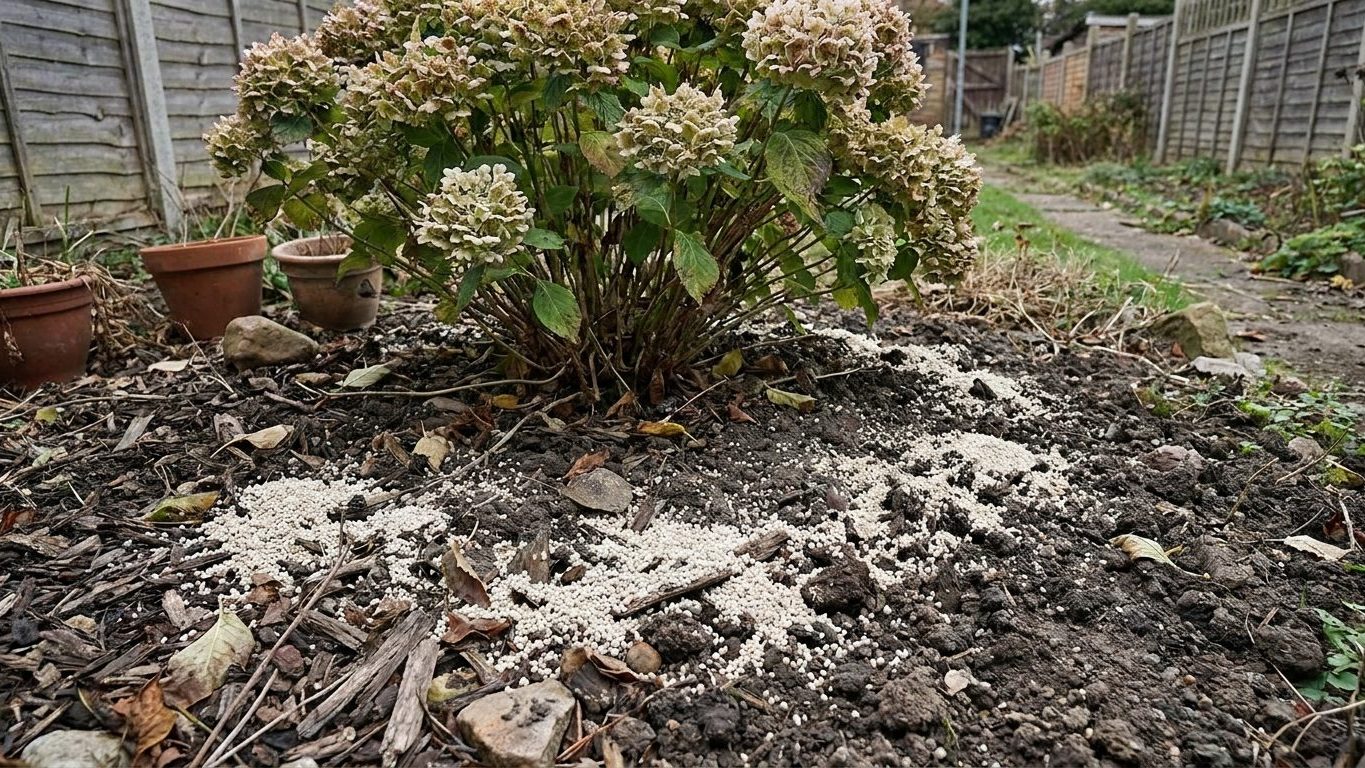
Fertilizing hydrangeas means feeding as new growth starts each spring and easing off well before the plant needs to slow down for the year. The right window shifts by hardiness zone and by which hydrangea you grow, since bigleaf types set next year’s blooms on old wood while panicle types flower on new growth entirely. Type decides more than the calendar does.
Fertilizing Hydrangeas: The Short Answer
NC State Extension Gardener Plant Toolbox puts the genus at USDA zones 3a through 9b, but that depends entirely on the type. Bigleaf hydrangeas run 6a to 11b, while panicle types stretch from 3a to 8b, so the same calendar month reads differently in each zone.
The general rule feeds new growth in spring and stops before the plant sets next year’s flower buds. Bigleaf hydrangeas bloom on last year’s wood and get pruned before August 1, so a late feeding pushes soft growth right when the plant needs to stop.
Panicle hydrangeas flower on the current season’s growth instead, so they tolerate a longer feeding window and a hard cutback in late winter. The type you grow decides more than the calendar does.
The table below, one state per box with its months and its zone, gives the fertilizing window where you live.
From the almanac
When to feed hydrangeas, state by state
The months each state's extension calendar marks for this, kept inside that state's own frost-free season. Open your state for the frost dates, the USDA zone and the rest of the year.
Northeast
- ConnecticutMar, May, JulUSDA 6a-7b
- MaineMar, May, JulUSDA 3b-6a
- MassachusettsMar, May, JulUSDA 5a-7b
- New HampshireMar, May, JulUSDA 3b-6a
- New JerseyMar, May, JulUSDA 6a-7b
- New YorkMar, May, JulUSDA 3b-7b
- PennsylvaniaMar, May, JulUSDA 5a-7b
- Rhode IslandMar, May, JulUSDA 6a-7b
- VermontMar, May, JulUSDA 3b-5b
Southeast
- AlabamaMar, May, JulUSDA 7a-9a
- ArkansasMar, May, JulUSDA 6b-8a
- DelawareMar, May, JulUSDA 7a-8a
- FloridaMar, May, JulUSDA 8b-11b
- GeorgiaMar, May, JulUSDA 6a-9b
- KentuckyMar, May, JulUSDA 6a-7a
- LouisianaMar, May, JulUSDA 8a-10a
- MarylandMar, May, JulUSDA 5b-8a
- MississippiMar, May, JulUSDA 7b-9a
- North CarolinaMar, May, JulUSDA 5b-8b
- South CarolinaMar, May, JulUSDA 7a-9a
- TennesseeMar, May, JulUSDA 5b-8a
- VirginiaMar, May, JulUSDA 5a-8b
- West VirginiaMar, May, JulUSDA 5a-7a
Midwest
- IllinoisMar, May, JulUSDA 5a-7b
- IndianaMar, May, JulUSDA 5b-7a
- IowaMar, May, JulUSDA 4b-6a
- KansasMar, May, JulUSDA 5b-7a
- MichiganMar, May, JulUSDA 4a-6b
- MinnesotaMar, May, JulUSDA 3a-5a
- MissouriMar, May, JulUSDA 5b-7b
- NebraskaMar, May, JulUSDA 4a-5b
- North DakotaMay, JulUSDA 3a-4b
- OhioMay, JulUSDA 5b-6b
- South DakotaMar, May, JulUSDA 3b-5b
- WisconsinMar, May, JulUSDA 3b-6a
Southwest
- ArizonaMar, May, JulUSDA 4b-10b
- New MexicoMar, May, JulUSDA 4b-9a
- OklahomaMar, May, JulUSDA 6a-8a
- TexasMar, May, JulUSDA 6a-10a
West
- AlaskaMay, JulUSDA 1a-8a
- CaliforniaMar, May, JulUSDA 5a-11a
- ColoradoMay, JulUSDA 3b-7b
- HawaiiMar, May, JulUSDA 9a-13a
- IdahoMar, May, JulUSDA 3b-7b
- MontanaMar, May, JulUSDA 3a-6a
- NevadaMar, May, JulUSDA 4a-10a
- UtahMar, May, JulUSDA 4a-9a
- WyomingMay, JulUSDA 3a-6a
Pacific Northwest
Canada
- AlbertaMay, JulZone 4a
- British ColumbiaMar, May, JulZone 9a
- ManitobaMay, JulZone 3b
- New BrunswickMay, JulZone 5a
- Newfoundland and LabradorMay, JulZone 6a
- Northwest TerritoriesMay, JulZone 1b
- Nova ScotiaMay, JulZone 6b
- NunavutMay, JulZone 0a
- OntarioMar, May, JulZone 7a
- Prince Edward IslandMay, JulZone 5b
- QuebecMay, JulZone 5b
- SaskatchewanMay, JulZone 3a
- YukonMay, JulZone 1b
Sources: state frost facts and Clemson HGIC factsheet — Hydrangea. A state with no marked month is not shown.
Fertilizing Hydrangeas, Step by Step

Feeding a hydrangea well means acting in this order, from the first flush of new growth to the last mulch of the season.
- Identify the bloom wood: bigleaf and mountain hydrangeas set flower buds on last year’s wood, while panicle and smooth types bloom on the current season’s growth, and that difference decides how much room there is to push new growth with a feeding.
- Feed as new leaves emerge: this is when a medium to rapid grower like macrophylla or paniculata actually uses the nitrogen, instead of it sitting unused in cold soil.
- Match the fertilizer to the color, on bigleaf and mountain only: NC State Extension Gardener Plant Toolbox puts blue at below about pH 5.5, and pink above about pH 6.5, with purple in between.
- Skip high-phosphorus formulas on a blue hydrangea: phosphorus locks up the aluminum the plant needs for blue color, which pushes flowers toward pink even when the soil pH hasn’t moved at all.
- Mulch right after feeding: both macrophylla and paniculata are shallow-rooted, so a mulch layer holds moisture and nutrients near the roots instead of letting them wash past.
- Stop before the prune date for your type: bigleaf hydrangeas get pruned before August 1 since next year’s buds are already forming, while panicle types tolerate feeding later since they get cut back hard in late winter.
Coffee grounds and citrus peel are a widely held belief for turning flowers blue, but the pH shift they cause is too small to matter much. What actually moves the color is available aluminum in the soil, and a proper amendment reaches it far more reliably.
Fertilizing Hydrangeas by Hydrangea Type
NC State Extension Gardener Plant Toolbox lists bigleaf hydrangea at USDA zones 6a to 11b, blooming on last year’s wood, while panicle hydrangea covers zones 3a to 8b on the current season’s growth.
Color follows the same split. Bigleaf and mountain hydrangeas shift between blue and pink with soil pH, while panicle, smooth, oakleaf and climbing types stay white, cream, pink or green as the season ages, regardless of what’s in the soil.
| Kind | Flowers on | USDA zones | Sun |
|---|---|---|---|
| Bigleaf | Last year’s wood | 6a–11b | Part to deep shade |
| Panicle | Current season’s growth | 3a–8b | Full sun |
Smooth, oakleaf, mountain and climbing hydrangeas are on their own pages, since the source gives each only one of these figures rather than the full set shown here.
Fertilizing Hydrangeas: Mistakes That Cost a Season
No flowers on an otherwise healthy bigleaf

Bigleaf hydrangeas form next year’s flower buds the previous summer, so a spring prune or a late frost removes them before they ever open. The fix is timing any cut before August 1 and checking which type is actually planted, since panicle hydrangeas forgive that same cut.
A blue hydrangea turning pink for no reason
High-phosphorus fertilizer, the kind sold for roses and blooms, locks up the aluminum a bigleaf or mountain hydrangea needs for blue color, pushing flowers toward pink even if the soil pH hasn’t changed at all. Checking the fertilizer label solves what looks like a soil problem.
Acidifying soil under a panicle hydrangea
Panicle, smooth, oakleaf and climbing hydrangeas don’t change color with soil pH, so aluminum sulfate or a pile of coffee grounds does nothing but shift soil chemistry for no reason. Save the color amendments for bigleaf and mountain hydrangeas, the only two that respond to them.
Fertilizing Hydrangeas in Your State
The national rule doesn’t hand out a date, since bigleaf and panicle hydrangeas span several hardiness zones between them, and the frost that ends one state’s growing season hasn’t touched the ground yet in another. Your state page fills in the exact window.
- Your state page: the frost dates and the pruning window where you live.
- Which type grows there: whether your zone supports bigleaf, panicle, or both at once.
- Your local extension office: a soil test and a fertilizer recommendation matched to your actual soil, not the national average.
Common Questions
Can I use the same fertilizer on every hydrangea in my yard?
Only if flower color doesn’t matter to you. Color-neutral fertilizers work fine on panicle, smooth, oakleaf and climbing hydrangeas, but bigleaf and mountain hydrangeas need the color effect factored in, since phosphorus locks up the aluminum that keeps flowers blue.
Do coffee grounds actually turn hydrangeas blue?
Barely. NC State Extension Gardener Plant Toolbox notes that coffee grounds and citrus peel can acidify soil enough to shift color, but the effect is small next to a proper aluminum sulfate application, and what the plant needs most is available aluminum, not just a lower pH number.
Is it safe to fertilize hydrangeas if I have pets in the yard?
The fertilizer itself isn’t the pet risk, the plant is. Only bigleaf hydrangea is documented toxic, and only if large quantities are eaten, causing nausea, stomach pain and vomiting in pets and people alike. Fertilizer labels carry their own separate pet warnings worth reading too.