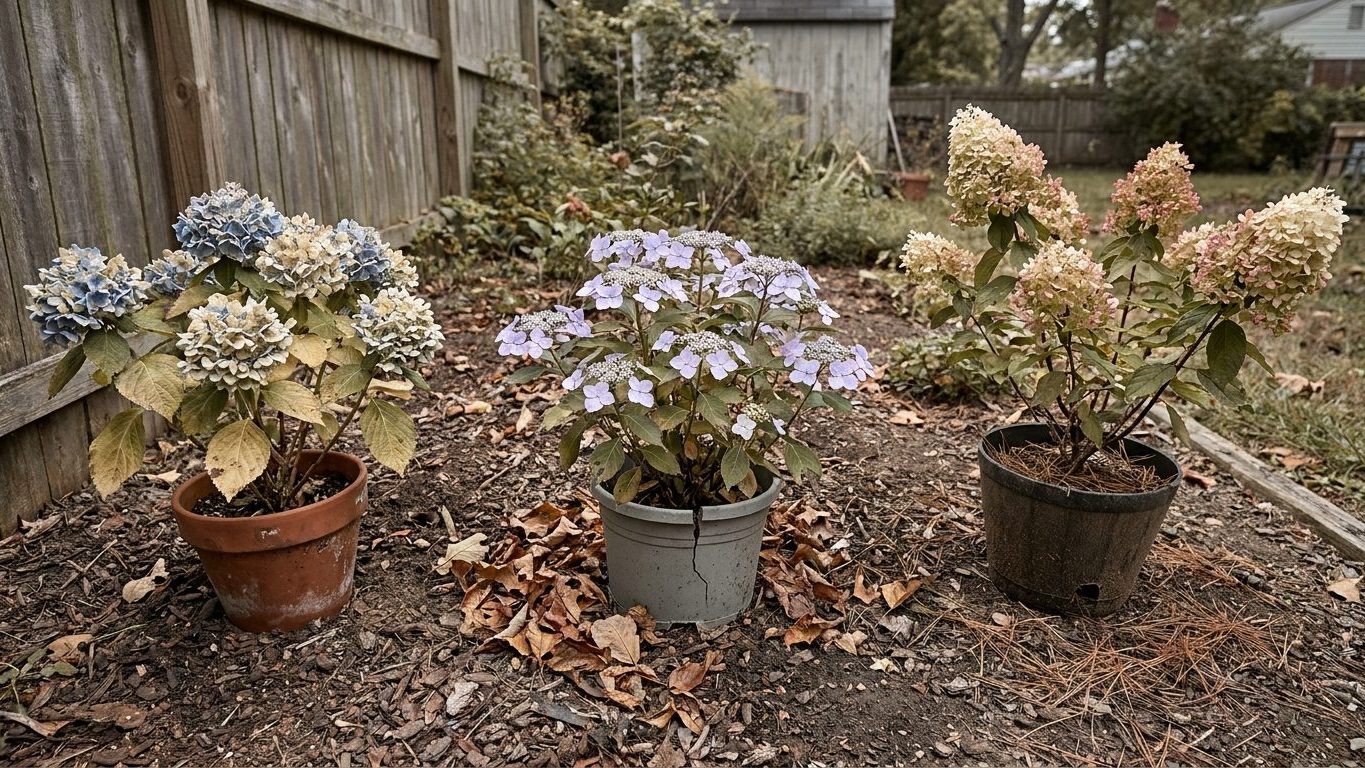
The right hydrangea for your yard depends on which type you pick, not just where you live. The genus spans USDA zones 3a through 9b overall, but bigleaf tops out well short of that range in cold climates while panicle handles far colder winters. Match type to zone and sun first, then let color and pruning follow from that choice.
Choosing a Hydrangea: The Short Answer
NC State Extension Gardener Plant Toolbox puts bigleaf at 6a to 11b, while panicle survives down to 3a. That gap is the whole story: the type decides the zone, not the other way around.
Sun, water, and pruning timing all follow from which type you plant. Pick a type your zone allows, then a spot that matches its sun and shade needs.
Maintenance stays low across the genus once the type fits its zone. Soil can be clay, loam, or sand, with drainage that keeps roots from sitting wet for long.
The state selector below this section leads to your state’s page. That page carries the frost dates and pruning windows this national page can’t cover.
From the almanac
Hydrangeas in your state
The dates on this page depend on where you live. Your state's page carries its frost dates, its USDA zones and the year laid out month by month.
Northeast
Southeast
- Alabama
- Arkansas
- Delaware
- Florida
- Georgia
- Kentucky
- Louisiana
- Maryland
- Mississippi
- North Carolina
- South Carolina
- Tennessee
- Virginia
- West Virginia
Midwest
Southwest
West
Pacific Northwest
Canada
Choosing a Hydrangea, Step by Step

Work through the choice in the order a yard actually presents it, from space down to color.
- Count the sun hours: bigleaf wants dappled or partial to deep shade and scorches in direct afternoon sun, while panicle is the one type in the group that takes full sun well.
- Check your zone against the type: NC State Extension Gardener Plant Toolbox lists bigleaf at 6a to 11b and panicle at 3a to 8b, so a cold zone that rules out bigleaf still leaves panicle, smooth, or oakleaf on the table.
- Measure the mature size before you dig: bigleaf spreads 3 to 6 feet, oakleaf tops out near 5 feet, and panicle can run 8 to 25 feet, so a foundation bed and a fence line call for different plants entirely.
- Decide if you want to steer flower color: only bigleaf and mountain hydrangeas shift with soil pH, running blue below about pH 5.5 and pink above about pH 6.5, with purple in between.
- Match pruning to the wood the flowers grow on: bigleaf, oakleaf, mountain, and climbing types set buds on last year’s wood and need a tighter pruning window, while panicle and smooth bloom on new growth and tolerate a hard late-winter cut.
- Plan for wildlife, pets, and cleanup: native bees nest in dead hollow stems, so cutting back to 12 to 24 inches and leaving the stubs standing helps more than clearing the bed flat, and only bigleaf is documented toxic if eaten in quantity by pets or horses.
None of these steps overrides the others. A plant that fits the zone but not the sun will survive and sulk, and one that fits both but not the space will need moving in a few years anyway.
Choosing a Hydrangea by Hydrangea Type
Old wood and new wood split the genus into two practical groups. Bigleaf, oakleaf, mountain, and climbing hydrangeas set buds the summer before, so a late frost or a spring prune removes that year’s flowers. Panicle and smooth hydrangeas build buds on the current season’s growth, which lets them take a hard cutback in late winter.
NC State Extension Gardener Plant Toolbox calls panicle a good substitute for the mop-head hydrangea in areas where that species isn’t winter hardy, since panicle runs 3a to 8b against bigleaf’s 6a to 11b.
| Kind | Flowers on | USDA zones | Sun |
|---|---|---|---|
| Bigleaf | Last year’s wood | 6a-11b | Dappled, partial to deep shade |
| Panicle | Current season’s growth | 3a-8b | Full sun |
Smooth, oakleaf, mountain, and climbing hydrangeas fill in the rest of the genus, each flowering on old or new wood in its own pattern. The other kinds are on their own pages. Color control by soil pH works only on bigleaf and mountain, since the rest stay white, cream, pink, or green as the season ages regardless of soil.
Choosing a Hydrangea: Mistakes That Cost a Season
No flowers on a healthy shrub

Bigleaf, oakleaf, mountain, and climbing hydrangeas set their buds the summer before, so a spring prune or a late frost strips next year’s blooms even on a plant that looks fine. NC State Extension Gardener Plant Toolbox puts the cutoff for bigleaf before August 1, and your state page carries the exact frost window.
Full sun spot for the wrong type

Bigleaf hydrangea scorches on its sunny side once it’s planted where afternoon sun hits it directly, since it wants dappled or partial shade. Panicle is the one type built for full sun, so swap the spot or swap the plant instead of fighting leaf burn every summer.
Coffee grounds instead of a soil test
Coffee grounds or citrus peel are a widely held trick for turning flowers blue, but the pH shift they cause is too small to move color reliably. What the plant needs is available aluminum, which only comes from actually acidifying the soil, and it only matters on bigleaf and mountain anyway.
Choosing a Hydrangea in Your State
The national zone range doesn’t set a pruning date or a frost window for your yard specifically. Your state’s page and its extension service narrow that down to your county’s climate.
- Your state page: the frost dates and the pruning window where you live.
- Which types hold up here: a zone-by-zone read on bigleaf, panicle, and the rest for your winters.
- Your local extension office: soil test results and pest reports specific to your county.
Common questions
What’s the easiest hydrangea to grow?
Panicle and smooth hydrangeas ask the least. They bloom on new wood, so a hard late-winter cut can’t remove flowers, and panicle handles zones as cold as 3a and full sun without complaint.
Why did my hydrangea’s flowers change color on their own?
If it’s bigleaf or mountain, soil pH moved. Flowers run blue below about pH 5.5 and pink above about pH 6.5, driven by how much aluminum the soil makes available. Other types change with the season, not the soil.
Are hydrangeas safe to have around pets?
Only bigleaf is documented toxic, and only if a large quantity is eaten. Bark, flowers, leaves, and stems all carry the compound, and symptoms include nausea, stomach pain, vomiting, and sweating in pets, horses, and people alike.