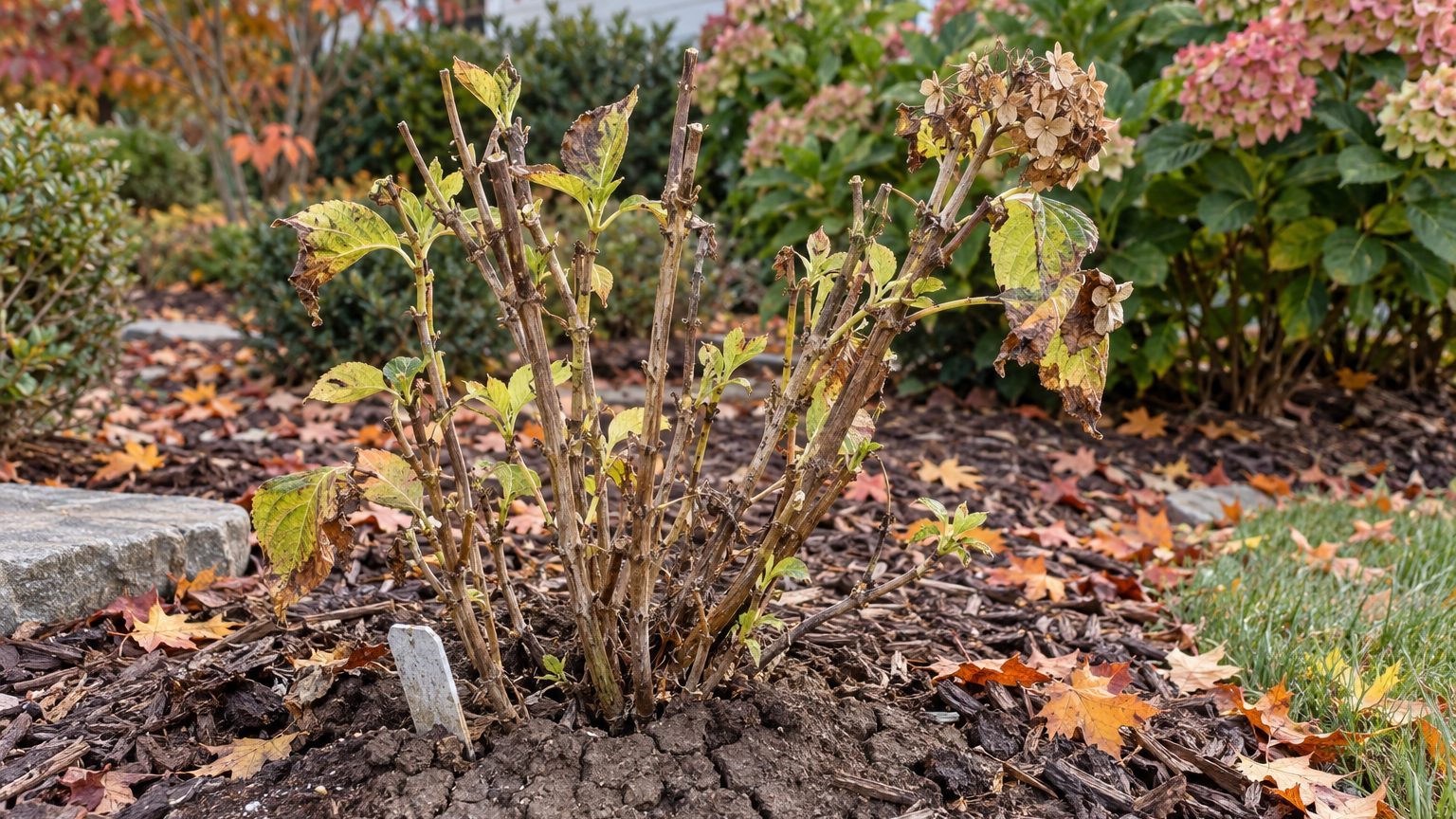
A hydrangea that sits still is usually the wrong type for its spot. It may be a bigleaf that lost its buds to cold or an early cut, or a shallow-rooted shrub short on moisture or light. Genus hardiness runs across USDA zones 3a through 9b.
That range is wide, so the fix changes with the type. Identify the type first, then match the symptom.
Hydrangea Not Growing: What You See

NC State Extension Gardener Plant Toolbox rates growth as medium for the genus and rapid for bigleaf and panicle, so a plant that stalls stands out fast.
- Bare stems long after neighboring shrubs have leafed out.
- Shoots that stall short, carrying small, pale leaves.
- A shrub no taller than the day it was planted, a full season later.
- Leaves that droop and crisp at the edges while the soil around the roots runs dry.
- Healthy green leaves but no flowers on a bigleaf or mountain type.
- Torn tips and missing leaves wherever deer can reach.
The last two matter because bigleaf sets its buds the previous summer on last year’s wood, so a frost or a spring cut can leave a leafy plant with nothing to bloom.
From the almanac
Hydrangeas in your state
The dates on this page depend on where you live. Your state's page carries its frost dates, its USDA zones and the year laid out month by month.
Northeast
Southeast
- Alabama
- Arkansas
- Delaware
- Florida
- Georgia
- Kentucky
- Louisiana
- Maryland
- Mississippi
- North Carolina
- South Carolina
- Tennessee
- Virginia
- West Virginia
Midwest
Southwest
West
Pacific Northwest
Canada
Hydrangea Not Growing or Something Else?
Several problems pass for a stalled plant. NC State Extension Gardener Plant Toolbox says climbing hydrangea reaches 15 feet and more, yet is very slow to start flowering, so a young vine that looks idle may be behaving normally.
One test settles most cases: scratch the bark, then look at where the damage sits. Living tissue, a clinging habit or a pattern on the leaves each point somewhere different.
| Looks like | The sign that tells them apart |
|---|---|
| Dead stems on a bigleaf after winter | Scratched bark is brown and dry along the stem, and no leaf buds swell. |
| A climbing hydrangea that sits still | Aerial rootlets grip the wall or trunk and the leaves look healthy. |
| Deer browsing | Stems end in ragged tips and leaves are missing only at browsing height. |
| Leaf disease | Spotted leaves point to leaf spot, and a white powdery film to powdery mildew. |
Yellow leaves with green veins are a different fault, covered in Hydrangea Yellow Leaves With Green Veins: Causes and How to Fix It. Thin stems stretching toward light have their own page, Leggy Hydrangea: Causes and How to Fix It.
What Causes Hydrangea Not Growing, and Where It Is Worst
The usual cause is a mismatch between type and place. NC State Extension Gardener Plant Toolbox lists bigleaf at 6a-11b and panicle at 3a-8b, with smooth as the hardiest of the genus.
- Great Lakes and the North (Michigan, Minnesota, Wisconsin): panicle and smooth suit the cold, and the source calls panicle “a good substitute for the mop-head hydrangea in areas where that species is not winter hardy.”
- Northeast and Mid-Atlantic (New York, Pennsylvania, Virginia): a late frost after growth starts removes the flower buds on bigleaf, while mountain hydrangea buds take that frost better.
- The South (Georgia, Texas, the Carolinas): afternoon sun is the risk for bigleaf, which wants dappled sun or shade, and its shallow roots dry fast without mulch.
- Plains and Mountain West (Nebraska, Colorado, Utah): smooth is the safest pick, and since the source accepts soil pH from below 6.0 to above 8.0, alkaline ground changes bloom color more than it stops growth.
Your state’s page on this site gives the pruning window and zone check for your reference city, which this national page cannot.
How to Treat Hydrangea Not Growing
Work through these this week and stop at the step that explains what you see.
- Name the type: NC State Extension Gardener Plant Toolbox puts bigleaf at 3-6 feet tall and wide and panicle at 8-25 feet, so mature size, leaf shape and bloom form narrow it down.
- Scratch the bark on several stems: cut dead wood back to living green, and leave live stems alone on old-wood types, since they carry the coming flowers.
- Fix the light: bigleaf wants dappled sun or shade with protection from afternoon sun, while panicle is the only type that takes full sun well.
- Mulch the shallow roots and water when the soil beneath feels dry, because bigleaf and panicle both root near the surface.
- Check leaves and tips for leaf spot, powdery mildew or deer browsing, and ask your state extension office what is registered before spraying anything.
Then give it time. Growth is medium to rapid and maintenance low, so a plant with living wood and suitable light needs little more. High-phosphorus fertilizer locks up aluminum and pushes blue bigleaf flowers toward pink, so skip it if blue matters.
How to Prevent Hydrangea Not Growing Coming Back
NC State Extension Gardener Plant Toolbox lists the genus at USDA zones 3a through 9b, and the type decides where in that range you sit, so prevention starts before the plant goes in the ground.
- Before buying: match the type to your zone, and lean toward panicle or smooth where winters are hard.
- At planting: give bigleaf dappled sun and panicle full sun.
- Late winter: cut panicle back hard, since it flowers on the current season’s growth.
- Right after bloom: prune old-wood types then and not in spring, because spring cuts remove the flowers.
- Late spring: refresh the mulch over the shallow roots.
- Cleanup: cut dead hollow stems to 12-24 inches and leave them standing until they disintegrate, since native bees nest in them.
Exact windows depend on your city, and each state page spells them out.
Where this comes from
Every type, zone, light and soil detail here comes from the NC State Extension Gardener Plant Toolbox entry for Hydrangea. Nothing beyond it is stated as fact here.
Confirm timing and treatments with your state’s extension service, which knows local conditions and what is registered. More sheets sit under Hydrangea Problems.
Common questions
How do I know a bare hydrangea is dead?

Scratch the bark on several stems. Green underneath means the stem is alive, even if it has no leaves yet. Brown and dry all the way along means dead wood, which you can cut back to the first living bud.
Will coffee grounds help my hydrangea?
They do not fix growth. The source says grounds can turn flowers blue, but the pH shift is very small. What bigleaf and mountain types need is available aluminum, which acidity releases. Panicle, smooth, oakleaf and climbing types never change color with pH.
Are cut hydrangea stems a risk to pets?
Only bigleaf is documented as toxic, and only if large quantities are eaten. Symptoms include nausea, stomach pain, vomiting and sweating. The bark, flowers, leaves and stems all carry the compounds, and cats, dogs and horses are affected too.