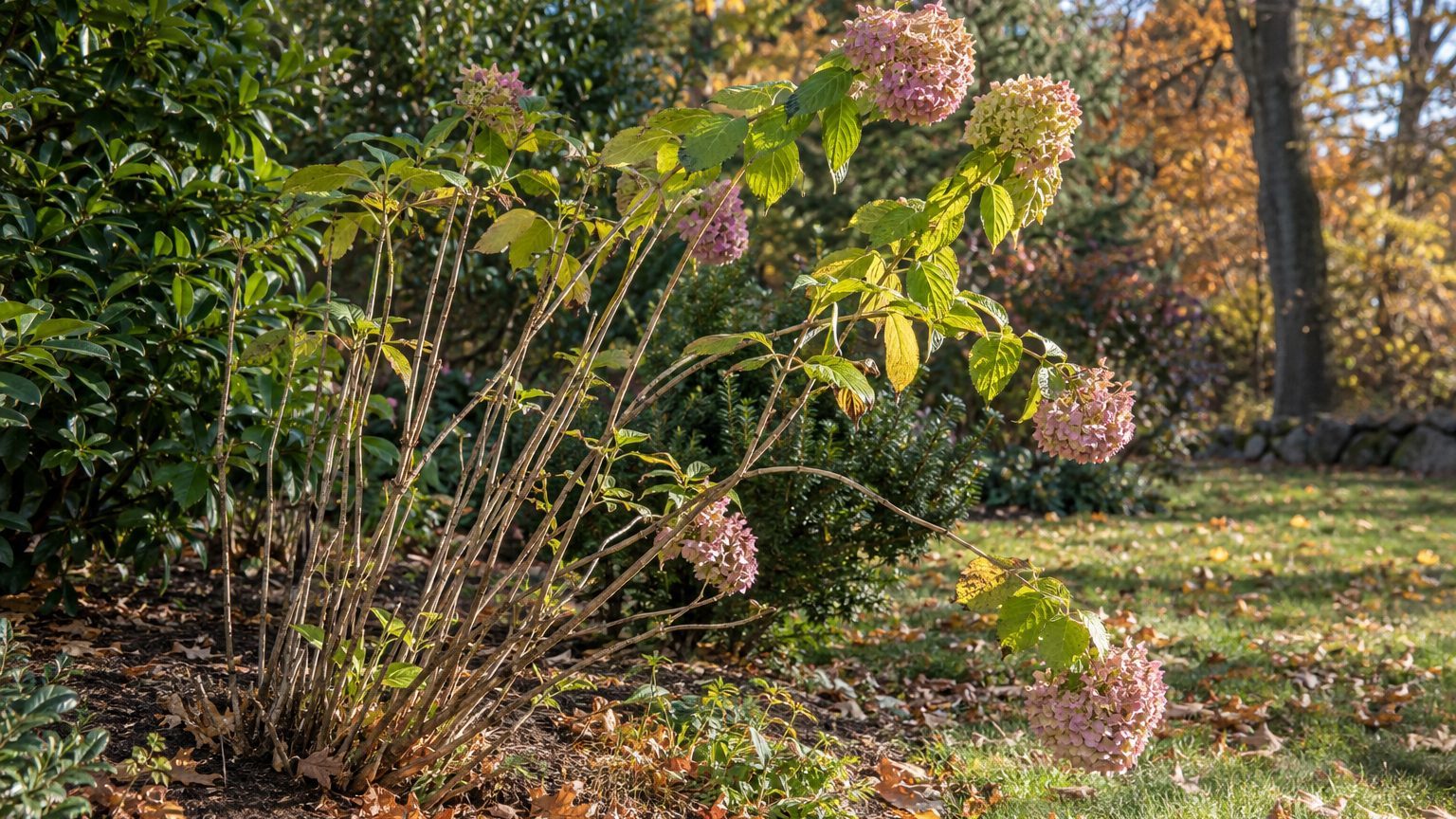
A leggy hydrangea has long, thin stems, few leaves and a sparse crown. The cause is usually too little light, or a cut made at the wrong time for that type.
Dates belong to your state page.
Leggy Hydrangea: What You See
The NC State Extension Gardener Plant Toolbox lists bigleaf hydrangea at 3 to 6 feet tall and wide, so density and spacing tell you more than height alone.
- Long, pencil-thin stems with leaves bunched at the tips
- Bare lower stems, with the green growth pushed up and away from the base
- Stems leaning hard to one side, toward the light
- Few or small flower heads that bow the stem to the ground
- An open crown you can see through from the side
- Most obvious in summer once the heads open, and again in winter when the bare framework shows
The sign that matters most is healthy green leaves spaced too far apart. Browning edges or spotting point to a different problem.
From the almanac
Hydrangeas in your state
The dates on this page depend on where you live. Your state's page carries its frost dates, its USDA zones and the year laid out month by month.
Northeast
Southeast
- Alabama
- Arkansas
- Delaware
- Florida
- Georgia
- Kentucky
- Louisiana
- Maryland
- Mississippi
- North Carolina
- South Carolina
- Tennessee
- Virginia
- West Virginia
Midwest
Southwest
West
Pacific Northwest
Canada
Leggy Hydrangea or Something Else?
Height alone proves little. The NC State Extension Gardener Plant Toolbox gives panicle hydrangea 8 to 25 feet, so a healthy one can look tall and open without any fault.
Bare stems after a hard winter or a spring cut are another lookalike. Check the tips and buds before you decide anything is wrong.
| Looks like | The sign that tells them apart |
|---|---|
| A tall, open panicle | Stiff, thick stems with full leaves along their length, and a size that sits inside 8 to 25 feet |
| A sprawling climbing hydrangea | Aerial rootlets clinging to the surface, growth of 15 feet and more, and very slow flowering |
| Bare-tipped bigleaf | Buds formed the previous summer on last year’s wood are missing, taken by late frost or a spring prune |
Deer browsing also strips tips, and hydrangeas are browsed. Look for ragged, torn ends instead of clean growth. The smooth, oakleaf and mountain kinds are on their own pages, and the rest of the family is on Hydrangea Problems.
What Causes Leggy Hydrangea, and Where It Is Worst
The NC State Extension Gardener Plant Toolbox calls panicle the only hydrangea that takes full sun well. That points to the first cause: stems in shade stretch toward light, and fast growers stretch fastest. Pruning at the wrong season is the second cause, since a spring cut on an old-wood type removes buds.
- Great Lakes and the North (Michigan, Minnesota, Wisconsin): panicle and smooth suit the cold, but bigleaf loses buds to late frost, and the bare stems left behind read as leggy.
- The South (Georgia, Texas, the Carolinas): bigleaf needs protection from afternoon sun, so gardeners tuck it into shade, where rapid growth turns into a long reach.
- Wooded lots in the East and Midwest (Pennsylvania, Ohio, New York): bigleaf accepts partial or deep shade, but the deeper the shade, the longer the stems reach.
Your state page has the pruning window and zone verdict for your type, which this national page leaves out.
How to Treat Leggy Hydrangea
A cut on the wrong type can cost a season of flowers, so this week’s work goes in this order.
- Name the type: bigleaf, mountain, panicle, smooth, oakleaf and climbing behave differently, and old wood versus new wood decides every cut after this.
- Check the light: bigleaf wants dappled sun with protection from afternoon sun, and only panicle takes full sun well, so a mismatch explains the stretch.
- Hold the pruners on old-wood types: panicle can be cut back hard in late winter, but bigleaf flowers on last year’s wood, so a spring prune removes the flowers. With fall here, most plants should simply wait.
- Fix the site if light is the cause: thin overhead branches now, and mark any plant to move while it is dormant.
- Tidy dead stems: the NC State Extension Gardener Plant Toolbox says native bees nest in dead hollow stems, so cut them to 12 to 24 inches and leave them standing until they disintegrate.
I skip products here, since your state extension service knows what is approved locally. Browning leaves are a separate job, covered in Hydrangea Leaves Turning Brown: Causes and How to Fix It. A plant that will not grow at all is on Hydrangea Not Growing: Causes and How to Fix It.
How to Prevent Leggy Hydrangea Coming Back
The NC State Extension Gardener Plant Toolbox rates hydrangea maintenance as low, with growth from medium to rapid, so a few well-timed gestures do the work.
- Dormancy: the one safe window to move a plant, roots undisturbed.
- Planting: match the type to the site, panicle for full sun and bigleaf for dappled light with afternoon shade.
- Late winter: cut panicle back hard, since it flowers on the current season’s growth.
- Right after bloom: prune old-wood types then, never in spring, and stop at the deadline on your state page.
- Spring: lay mulch over the roots, because bigleaf and panicle are both shallow-rooted.
- Summer: keep shallow roots from drying out, and watch for deer.
- Fall: leave old-wood types uncut so the wood can ripen its buds.
Skip the light step and no pruning schedule will hold the shape.
Where this comes from
Plant types, sizes, sun needs and pruning behavior here come from the NC State Extension Gardener Plant Toolbox entry for Hydrangea. The signs and fixes for legginess are general horticultural practice built on those facts.
Pruning windows, zone verdicts and approved products vary by state. Confirm them with your state’s cooperative extension service before you cut.
Common questions
Can I cut a leggy hydrangea back hard?

Only some types. Panicle flowers on the current season’s growth and can be cut back hard in late winter. Bigleaf flowers on last year’s wood, so a hard cut removes the flowers.
Will more fertilizer shorten the stems?
No. The one feeding effect the source documents is color. High-phosphorus fertilizer locks up aluminum and pushes blue bigleaf flowers toward pink. Panicle, smooth, oakleaf and climbing types do not change color with soil pH.
Will a leggy hydrangea still flower?
It depends on the type. Bigleaf buds form the previous summer, so lost tips mean lost flowers. Climbing hydrangea is very slow to start flowering, even when healthy.