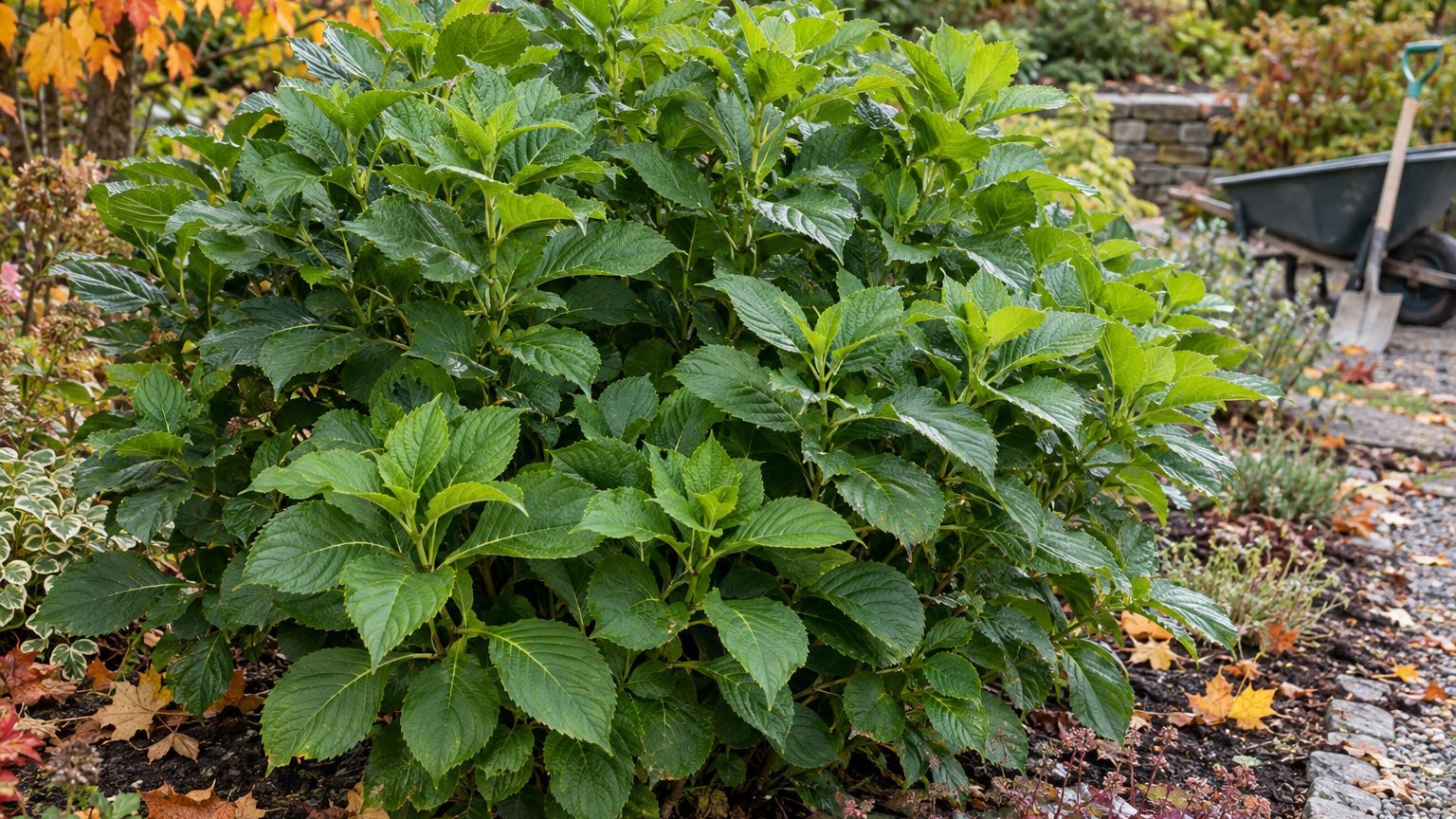
Hydrangea not blooming usually means the flower buds were lost, not that the plant is sick. Bigleaf, mountain, oakleaf and climbing types set buds on last year’s wood, so a late frost or a spring prune can wipe out a whole season.
Panicle and smooth types flower on new growth and rarely fail that way. Knowing which one you own decides the fix.
Hydrangea Not Blooming: What You See

The NC State Extension Gardener Plant Toolbox lists the genus across USDA zones 3a through 9b, and what you see on a bloomless plant depends on the type you planted.
- Healthy green leaves all summer, but not one flower bud where blooms should be.
- Buds that swelled in spring, then turned brown or black after a late frost.
- Freshly cut stem ends on a bigleaf, with new shoots below but no flowers, after a spring prune.
- A tall, floppy shrub in deep shade, all leaf and no bloom.
- A climbing hydrangea with a thick, healthy vine and no flowers, several seasons after planting.
Each sign points to a different cause, so match yours before you pick up the shears.
From the almanac
Hydrangeas in your state
The dates on this page depend on where you live. Your state's page carries its frost dates, its USDA zones and the year laid out month by month.
Northeast
Southeast
- Alabama
- Arkansas
- Delaware
- Florida
- Georgia
- Kentucky
- Louisiana
- Maryland
- Mississippi
- North Carolina
- South Carolina
- Tennessee
- Virginia
- West Virginia
Midwest
Southwest
West
Pacific Northwest
Canada
Hydrangea Not Blooming or Something Else?
The NC State Extension Gardener Plant Toolbox puts the color switch at blue below about pH 5.5, pink above about pH 6.5, and purple in between. That is a color story, not a bloom story, and it applies to bigleaf and mountain only.
Three other situations get mistaken for a failed season. Each has a sign that settles it.
| Looks like | The sign that tells them apart |
|---|---|
| Blooms that came in pink, not blue | Only bigleaf and mountain follow soil pH, and pink means a reading above about 6.5. Panicle, smooth, oakleaf and climbing never shift with the soil. |
| Flowers that aged to green, cream or pink | Panicle, smooth, oakleaf and climbing turn these shades as the season ages, whatever the soil. The bloom is there, just past its peak. |
| Blue flowers sliding toward pink after feeding | High-phosphorus fertilizer locks aluminum up in the soil. The color moves while the flower count holds. |
| Buds killed by a late frost | Bigleaf forms buds the previous summer, so old stems carry dead buds. A panicle nearby, flowering on the current season’s growth, is not affected the same way. |
Deer browsing, leaf spot, bacterial wilt and powdery mildew are covered in Hydrangea Problems.
What Causes Hydrangea Not Blooming, and Where It Is Worst
The NC State Extension Gardener Plant Toolbox lists bigleaf at USDA 6a to 11b and says its buds form the previous summer, so a late frost or a spring prune removes the flowers.
- Great Lakes and the North (Michigan, Minnesota, Wisconsin): panicle, listed at 3a to 8b, and smooth, the hardiest of the genus, flower on new wood, while bigleaf’s old-wood buds are the ones at risk.
- Mid-Atlantic and Ohio Valley (Ohio, Kentucky, Virginia): bigleaf is in range here, so a late frost after spring growth is the risk to watch, and mountain buds take that frost better.
- The South (Georgia, Texas, the Carolinas): bigleaf is listed up to 11b, so the questions are afternoon sun, which the source says to avoid, and pruning at the wrong time.
- Plains and Mountain West (Nebraska, Colorado, Utah): panicle is the only hydrangea that takes full sun well, and the source calls it “a good substitute for the mop-head hydrangea in areas where that species is not winter hardy.”
Your state’s page in this series gives the zone verdict and the pruning window for your reference city. Shade and heavy feeding cause a separate kind of failure, covered in Leggy Hydrangea: Causes and How to Fix It and Hydrangea Big Leaves No Flowers: Causes and How to Fix It.
How to Treat Hydrangea Not Blooming
Start with the type, because the right cut for one hydrangea is the wrong cut for another.
- Identify the type: sort it into bigleaf, mountain, oakleaf and climbing (old wood) or panicle and smooth (new wood) before doing anything else.
- Stop spring pruning on old-wood types: their buds formed the previous summer, so remove only dead wood once new growth shows which stems survived.
- Cut panicle hard in late winter: the NC State Extension Gardener Plant Toolbox says it flowers on the current season’s growth, so a hard cut costs no flowers.
- Match the light to the type: bigleaf wants dappled sun or shade with protection from afternoon sun, while panicle wants full sun.
- Mulch the shallow roots: bigleaf and panicle both root near the surface, and both benefit from mulch and good drainage.
- Give a climbing plant time: climbing hydrangea is very slow to start flowering, so patience beats the shovel.
Buds lost this year stay lost, so the payoff comes next season. Bigleaf is documented as toxic to people, cats, dogs and horses only if large quantities are eaten, so keep clippings out of grazing reach.
How to Prevent Hydrangea Not Blooming Coming Back
The NC State Extension Gardener Plant Toolbox rates maintenance as low and growth as medium to rapid, so the calendar is short and mostly about restraint.
- Late winter: cut panicle back hard, since it blooms on the current season’s growth.
- Early spring: leave bigleaf, mountain, oakleaf and climbing plants uncut apart from dead wood.
- Spring feeding: skip high-phosphorus fertilizer on blue bigleaf and mountain, because it locks up aluminum and pushes flowers toward pink.
- Just after bloom: prune bigleaf soon after the flowers fade, well before the cutoff on your state’s page.
- Summer: refresh mulch over the shallow roots and keep drainage good.
- Fall and winter: on panicle and smooth, cut hollow stems to 12 to 24 inches and leave them standing until they disintegrate, since native bees nest in them.
Planting each type in the light it prefers removes the cause behind most repeat failures.
Where this comes from
The NC State Extension Gardener Plant Toolbox entry for Hydrangea gives hardiness, bloom habit and color by type. Its figures apply to the genus as a whole.
Zones, pruning windows and approved pest controls vary from place to place. Check them with your state’s extension service before you act.
Common questions
Why is my bigleaf hydrangea green and healthy but not flowering?

Bigleaf flowers on last year’s wood, and its buds form the previous summer. A late frost or a spring prune removes them while leaving the leaves untouched, which is why the plant looks fine but stays bare.
Will coffee grounds make my hydrangea bloom blue?
Coffee grounds do not affect blooming, and the pH shift they cause is very small. The source mentions coffee grounds and citrus peel as a popular belief for turning flowers blue.
What moves the color is available aluminum, which acidity releases. Aluminum sulfate acidifies the soil and lime does the opposite. This applies to bigleaf and mountain only.
Which hydrangea is the safest bet in a cold yard?
Smooth is the hardiest of the genus, and panicle is listed at 3a to 8b. Both flower on new wood, so a hard winter or a late frost does not remove their flowers the way it can with bigleaf.