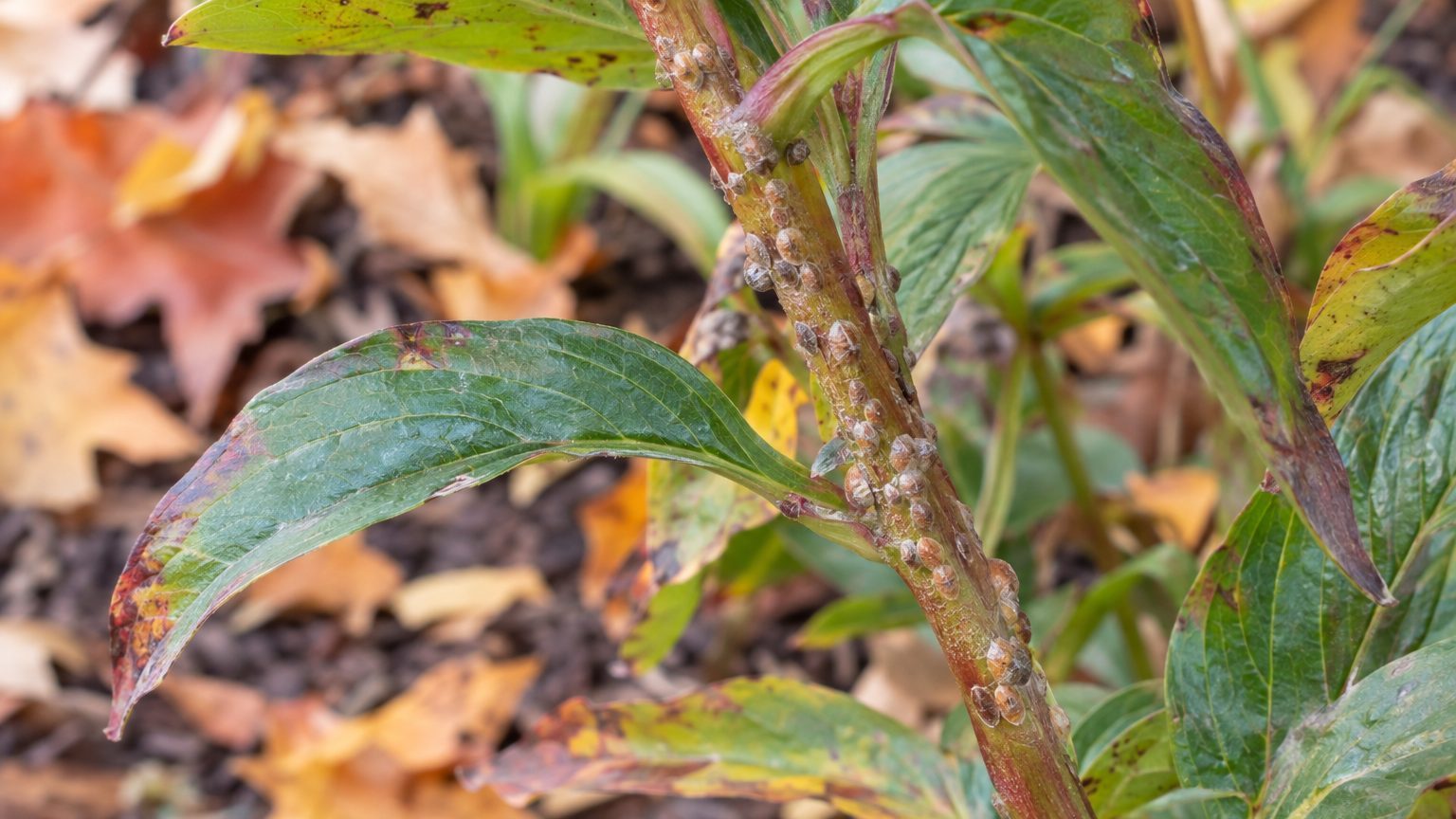
Small, hard bumps on a peony stem, sometimes with ants climbing up and down them, usually mean scale. The insect settles on the bark and stays put, so it is easy to overlook until you run a hand along the stems. Peony scale is a small armored insect that blends into the wood, and it can be found and dealt with once you know what to look for.
Scale: What You See

The signs are small and easy to mistake for part of the stem, so look closely at the bark.
- Small round white discs stay stuck to the stems long after the insect itself has fallen away.
- Live scales are small, purple, round or oval, and about 3/32 inch across, covered by a grayish-brown armor that matches the bark.
- Each one sits as a little raised bump, convex like a tiny dome.
- Some burrow so far into the bark that they are nearly hidden.
- Newly hatched crawlers are tiny, flat, and purple.
- Clear, sugary honeydew may coat the stems, and ants come to feed on it.
Heavy infestations weaken the plant, so a stem crusted with bumps deserves attention.
From the almanac
Peonies in your state
The dates on this page depend on where you live. Your state's page carries its frost dates, its USDA zones and the year laid out month by month.
Northeast
Southeast
- Alabama
- Arkansas
- Delaware
- Florida
- Georgia
- Kentucky
- Louisiana
- Maryland
- Mississippi
- North Carolina
- South Carolina
- Tennessee
- Virginia
- West Virginia
Midwest
Southwest
West
Pacific Northwest
Canada
Scale or Something Else?
Several common problems can look like scale at a glance. A closer look at where the spots sit and how they behave sorts them out quickly.
Run a fingernail over a suspect bump. Scale armor sits on the stem like a small cap, while other look-alikes are part of the plant or move around.
| Looks like | How to tell them apart |
|---|---|
| Lichen: crusty gray-green patches on older woody stems | Flat and spread out rather than domed, and it shows up as irregular patches instead of scattered, evenly sized bumps |
| Aphids: clusters on new shoots and buds, with ants nearby | Soft bodies that crowd together on tender growth and move when touched, while scale stays fixed in place on harder bark |
| Natural bark roughness: small pale bumps on woody stems | Part of the stem and the same color as it, with no purple body or white disc underneath when you scrape gently |
Sticky stems with ants alone do not settle the question. Honeydew comes from aphids and other sap feeders too, so look for the armored bumps themselves before you treat.
What Causes Scale, and Where It Is Worst
Scale arrives as crawlers, the tiny flat purple stage that wanders briefly across a stem. Once a crawler finds a spot it likes, it picks a permanent feeding site and stays there. It feeds by piercing the stem and drawing out sap through sucking mouthparts.
Females lay their eggs under their own armor, so an overlooked patch can restock a stem. Large populations can weaken the plant.
Peony scale is worth checking for when a peony develops raised bumps on its stems. Crowded plants with little air movement and stems that never get a close inspection give it the easiest start.
How to Treat Scale
Start by cutting down the numbers physically, then bring in a treatment your state approves.
- Inspect every stem with good light and a hand lens if you have one, so that you know how far the infestation reaches before you cut or spray.
- Scrub light infestations off the stems with a soft brush or a fingernail, so that the insects and their armor are removed instead of left to hatch more crawlers.
- Remove loose scale and bag the debris, but do not cut a woody stem at the base simply because scale is present.
- Before using a treatment, read the label and local rules carefully, so that anything you apply is legal and labeled for peonies.
- Time any treatment for when crawlers are active, because the tiny flat purple stage is easier to reach than an adult hidden under its armor.
- Check the stems again soon after, so that survivors or fresh crawlers get caught before they settle in.
Armor often stays on the stem after the insect dies, so a white disc alone does not mean the scale is still alive. Look for the purple body under a lifted armor before repeating a treatment.
How to Prevent Scale Coming Back
Prevention for scale means a regular look at the stems through the growing season, since the insects settle in quietly.
- Check new growth and the base of the clump as stems emerge, so that any leftover crawlers are caught before they settle.
- Watch for ants moving up and down the stems, because they often point to honeydew and the insects producing it.
- Look for white discs and raised bumps on the stems, where the armor tends to stay behind.
- When dead herbaceous stems are cut back, bag and discard the cuttings instead of composting them, so that eggs under old armor do not carry over.
- Before growth restarts, scan any woody stems and scrub off whatever you find.
Spacing plants so air moves through the clump makes every one of these checks easier.
Where This Comes From
The Sources box below lists the references behind these descriptions and life-cycle details. Local rules and product labels determine what may be used where you live.
Common Questions
Will Scale Kill a Peony?
Scale feeds on sap, and a heavy infestation weakens the plant over time. A small number on a few stems is a nuisance that you can usually manage by scrubbing and cutting out the worst stems.
Who Can Confirm That It Is Scale?
A knowledgeable local gardener can look at a cut stem and help identify the bumps. Bring a piece with the bumps and any sticky residue still on it.
Can Scale Spread to Other Plants in the Yard?
Crawlers move short distances before settling, so shrubs close to an infested peony are worth a look. Check nearby woody plants for the same raised bumps and white discs before assuming they are clear.